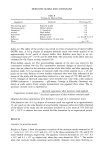
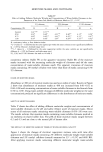
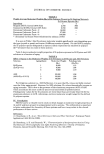
56 JOURNAL OF COSMETIC SCIENCE QUANTITATIVE AND QUALITATIVE MEASUREMENT OF THE ADSORPTION OF CATIONIC HYDROXYETHYL CELLULOSE ONTO KERATIN SURFACES VIA DIRECT POLYMER FLOURESCENT LABELING James V. Gruber', Francoise M. Winnik 2, Andre Lapierre 2, Neela D. Khaloo 2, Niraj Josh •, Aaron Lawrence 2, and Peter N. Konish • •Amerchol Corporation, Edison, NJ 08818-4051 and 2McMaster University, Hamilton, ON L8S 4M1 Canada Introduction The most effective method available to analyze the deposition of cationic hydroxyethyl cellulose [cat- (HEC), Polyquaternium-10] onto keratin surfaces to date has been the use of radio-labeled materials. This method was pioneered by Goddard [1,2]. However, the current lack of availability of these unique radioactive materials has prevented research laboratories from employing them to study the deposition of these cationic materials from surfactant formulations. The labeling of cationic hydroxyethylcellulose using fluoresecent dyes has been reported recently [3]. This development offers a unique opportunity to develop new methodologies for measuring polymer deposition as these fluorescent dyes, covalently attached to the polymer, convert the normally spectroscopically-invisible cat-HECs into species that can be detected by fluorescence techniques. We will discuss our efforts to develop this technology to study the deposition of cat-HECs included in various formulations, their deposition onto hair under standard shampooing conditions, and the quantitative analysis of the amount of polymer deposition. In addition, these unique polymers allow the opportunity to visualize the polymers on individual hair fibers via confocal microscopy. Experimental The methods to attach the fluorescent dye on the cat-HEC and to analyze the labeled polymer have been discussed in detail elsewhere [3]. Virgin blond tresses were washed with a shampoo containing the ingredients listed in Table 1. The polymers employed are listed in Table 2. Each tress was treated with one gram of shampoo at three locations on the tress, washed one minute and rinsed one minute. For multiple wash cycles, each tress was dried with a 1500 watt commercial hair dryer prior to the next treatment cycle. A combination of five virgin blond tresses (except as noted below) (DeMeo Brothers) were shampooed through one or ten wash cycles for each data point. The treated hair was cut at the middle of the tress into one gram sections and the resulting hair specimen was placed into 99 grams of 3% NaOH for 24 hours at room temperature. The resulting pale yellow solutions were filtered to remove any fine non-digested components (virgin blond hair provides the cleanest digested solutions with no detectable residual fluorescence found on the flitrate). The amount of deposited cat-HEC was determined by fluorescence spectroscopy using a standardization curve previously prepared from known concentrations of the fluorescently-labeled cat-HEC used in the shampoo. Deposition amounts are recorded as the mean value and variance in micrograms of polymer per gram of hair. Table 1. Shampoo Ingredients Ingredient % Actives % Solids Ammonium Laureth-(3) Sulfate Ammonium Lauryl Sulfate Cocamidopropyl Betaine DMDM Hydantoin Polyquaternium- 10 Deionized Water 27 28 35 55 100 13.5 4.0 3.0 0.2 0.5 q.s. to 100 Table 2. Polyquaternium-10 Sample Descriptions Polyquaternium-10 Approx. Mw Approx. %N Moles of attached dye/gram of polymer A • 400,000 1.8 4.4 X 10 's B ! 400,000 0.9 1.0 X 10 -4 C: 900,000 1.8 4.7 X 10 -s- 7.9 X 10 -s tDye attachment data provided for one labeled polymer. 2Dye attachment data provided for a combination of five labeled polymers with various values between high and low shown in Table. t Current Address: Ralph Lauren, Terminal Ave., Clark, NJ 07066

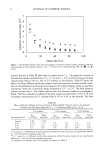
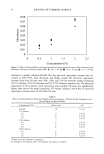
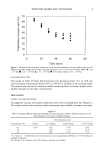
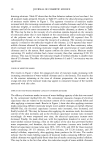
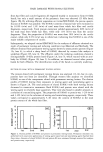
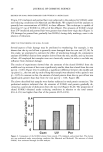
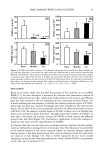
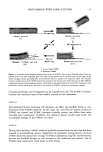
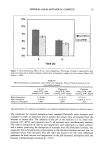
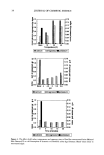
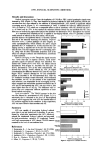
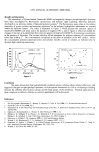
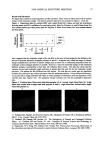
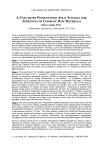
1999 ANNUAL SCIENTIFIC MEETING 57 Results and Discussion We began these studies by examining three cat-HEC polymers which varied in either their level of cationic charge or their molecular weight. The data for polymer deposition are presented in Figure I. From the Figure 1. Deposition data for cationic HEC onto virgin blond hair tresses, one and ten treatments showing mean and 95% confidence for each data point. Data for Polymers A and B taken from five tress measurements per data point, data for Polymer C taken from twenty five tress measurements per data point. ,. 600 -- oo[ L l E E 400 ß E • 300 •" 200 i õ z E• -10 I i '• -200 Cationic HEC 2Std (+) 2Std (-) Mean data it appears that the molecular weight of the cat-HEC is the most critical parameter that influences the amount of polymer deposition (compare polymers A and C). It appears that, within the range of cationic charge examined here, the level of cationic charge plays a minor role in influencing deposition from this surfactant system (compare polymers A and B). However, it must be noted that changes in the surfactant platform, polymer concentration or hair type will influence these results. The data also shows that the variance for the high molecular weight polymers is greater than that seen for the low molecular weight polymers. The reasons for this difference are still unclear. We note that our results gave no significant evidence for build-up for any of these polymers from this surfactant platform. Using confocal microscopy, we are also able to image individual hair fibers to obtain qualitative information about the deposition of the cat-HEC onto hair, Figure 2 [3]. The qualitative images correlate well with the quantitative deposition data. Figure 2. Confocal laser fluorescent photomicrographs of: a) normal virgin blond hair, b) virgin blond hair treated with a single wash with polymer A and c) virgin blond hair treated with a single wash with polymer C. a b c T90-3• / 05:27.9a / 20x / 70 T90-3A / 06:04:98 / 20x 40 T90-3C / 05:27.98 / 10x / 30 l) Goddard, ED Faucher, JA Scott, R J Turney, ME. Adsorption of Polymer JR on Keratinous Surfaces, Part II. J. Soc. Cosmet. Chem., 26, 539 (1975). 2) Goddard, ED Harman, RB Faucher, JA. The Adsorptivity of Charged and Uncharged Cellulose Ethers. In: Goddard, ED and Gruber, JV., eds. Principles of Polymer Science and Technology in Cosmetics and Personal Care. Marcel Dekker, New York, 509-523 (1999). 3) Regismond, STA Heng, YM Goddard, ED Winnik, FM. Fluorescence Microscopy Observation of the Adsorption onto Hair ofa Fluorescently Labeled Cationic Cellulose Ether, Langmuir 55, 3007 (1999).
Purchased for the exclusive use of nofirst nolast (unknown)
From: SCC Media Library & Resource Center (library.scconline.org)