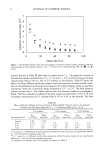
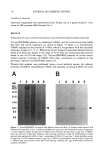
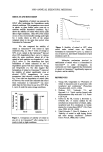
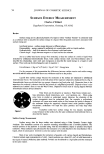
58 JOURNAL OF COSMETIC SCIENCE SURFACE ENERGY MEASUREMENT Charles J. Willard Engelhard Corporation, Ossining, NY 10562 Review Surface energy (c 0 is a physical property of a liquid or solid. "Surface Tension" is commonly used as a substitute term to describe the surface energy of a liquid. Other frequently used terms associated with surface energy are: Interfacial tension - surface energy between to different phases. Dispensability - energy required to uniformly mix a particulate solid in a liquid medium. Hydrophobicity- lack of an attractive force between a solid and water. Contact Angle - Angle between tangents to a liquid surface the substrate Just as a rubber band stores energy when stretched, so does the surface of a solid or liquid when stretched by unbalanced intermolecular forces. Early surface tension work used force/distance units to describe this relationship. Later work uses energy/area to describe the stored energy in a liquid or solid surface. These units can be interchanged as seen in equation 1. Force/distance =( Kg m/s 2 m)* (m/m) = Kg m2/s2m 2 = Energy/area Eq 1 For the purposes of this presentation the differences between surface tension and surface energy are trivial and the reader should feel free to use whichever unit he or she prefers. Liquids have surface energy because the molecules at the surface are subjected to unbalanced intermolecular forces. The molecules in the bulk phase of the liquid are subjected to balanced forces. (fig. l) Intermolecular forces are divided into two groups, dispersive ((•cl) and polar ((•p). Dispersive force is the attraction ofa molecule's electron cloud for the protons of a neighboring molecule. Dispersive force is also referred to as London's force or van der Waal's force. Dispersive forces exist in varying degrees between all molecules and are always attractive. Figure I Polar forces can be attractive or repulsive. Polar forces include acid - base attractions, dipole interactions, acid - acid repulsion, etc.. When using polar force to predict or understand system behavior, the chemistry of the system components must be understood first. For example, a polycationic surfactant will cause most metal oxides to fioc because the positive charges of the surfactant bridge the negatively charged metal oxide particles together. Polyanionic surfactants will repel the same particles and help keep them dispersed. Crystalline solids have surface energy for two reasons: incomplete crystal structure at the surface plus the same unbalanced intermolecular force as described for liquids. Surface Energy Measurement Surface energy data for these studies were obtained using a Cahn Dynamic Contact. Angle Analyzer. This instrument consists of a sensitive recording microbalance and a movable platform. The vertical position of the platform is recorded along with the microbalance output to produce force/depth isotherms. These isotherms typically describe the interaction of a solid attached to the microbalance with a liquid, which is raised and/or lowered to come into contact with the solid. Most of our work investigates the interaction of powders with various liquids and formulations. Classical contact angle measurements of solid - liquid junctions use a sheet (0.5 cm 2) of solid immersed in the liquid of interest (Wilhelmy plate method). Powders can be adhered to a rigid plate and then measured in the same manner.

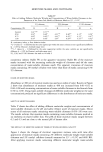
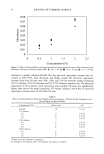
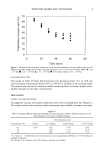
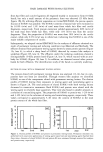
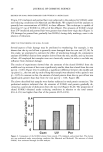
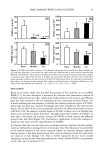
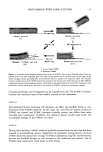
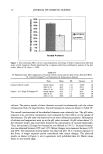
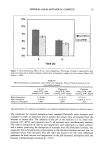
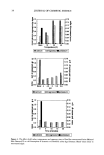
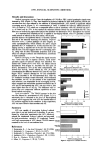
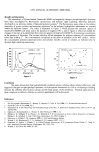
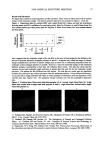
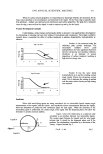
1999 ANNUAL SCIENTIFIC MEETING 59 When the surface tension properties of a liquid-liquid or liquid-gas interface are measured, the du Nouy ring is attached to the microbalance and immersed in the liquid. The du Nouy ring is typically made from platinum - iridium wire and has known dimensions and surface properties. The peak force measured when the ring is removed from the liquid, is used to compute •a and (•p for the liquid. Product Development Examples Understanding surface energy and having the ability to measure it can speed product development by eliminating or reducing trial and error testing of formulations and components. Force/depth isotherms instantly show a researcher the effect of surface treatments to enhance dispersability, hydrophobicity or adhesion 300 200 -100 -200 -300 -400 Exp A in water 0 2 4 6 8 10 Depth (fire) Product A was measured using the Wilhelmy plate powder technique. The force/depth isotherm shows good hydrophobicity but also significant hysteresis between advancing and receding isotherms. Hysteresis is an indicator of uneven deposition of surface treatment resulting in high and low energy sites -50 -100 -150 -200 -250 -300 -350 Exp B in water 0 2 4 6 8 10 Depth (rm•) Product B has the same initial hydrophobicity as A and the receding contact angle closely follows the advancing contact angle. This is indicates the coating is applied over the entire surface leaving no high energy sites exposed. Emulsions Liquid A Figure 2 Liquid B When solid emulsifying agents are being considered for two immiscible liquids contact angle measurements of the agents with the liquids and interfacial tension measurements between the liquids, allow the formulator to predict the best continuous phase for each agent. When the chemistry of the emulsifying agent is understood, the contact angle of the agent with the dispersed phase will allow the formulator to predict emulsion stability. Figure 2 shows the relationship of a spherical solid emulsifier to an interface between two immiscible liquids. The contact angle between the liquids and the solid agent indicate that A should be the dispersed phase and B the 0 medium. The relationship is described by a derivation of the Young- Dupree formula, Eq. 2. Cos 0 = 1- h/r Eq 2
Purchased for the exclusive use of nofirst nolast (unknown)
From: SCC Media Library & Resource Center (library.scconline.org)