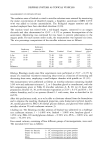
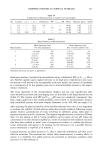
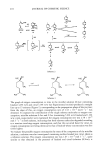
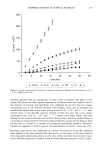
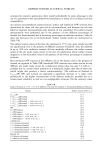
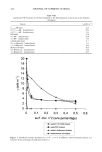
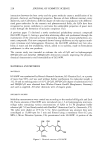
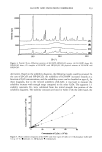
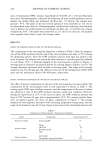
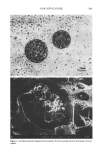
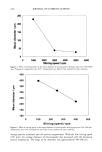
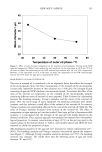
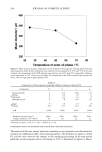
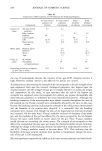
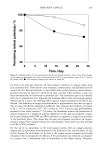
DISPERSE SYSTEMS AS TOPICAL VEHICLES 219 250 200 '5o 100 5O i i i i i i 0 5 10 15 20 25 30 35 time (min) e LC-Lec []-C-Lec --•-L-Lec x Ref o LC --•-Li Figure 1. Oxygen consumption by oxidation of odorous molecules in different miceliar solutions at 45.0 ø + 0.1øC (AIBN 0.25% w/w). therefore appeared that no degradation of either citral or linalool took place in that system. The protective effect against degradation of odorous molecules might be due to the presence of lecithin this hypothesis was confirmed by the fact that the oxygen consumption rate in LC (miceliar solution with linalool, citral, and no lecithin) was considerably higher than in any other system studied (2.21 x 10 -7 mol 1 -• s-Z). Also, linalool alone in the miceliar solution without lecithin (L) gave rise to an oxygen consumption rate of 8.33 x 10 -8 tool 1 -• s -z, almost three-times higher than that obtained in the miceliar solution with lecithin. Soya lecithin, therefore, might behave as a naturally occurring molecule with antioxidant properties, as may also be deduced from the fact that it is used in a number of commercial antioxidant products. Moreover, linalool also appeared to protect against the autooxidation of citral in some way (14). Rheology experiments were performed to evaluate the behavior of miceliar solutions when applied to the skin, and also after dilution by eccrine sweat, or the water derived from insensible perspiration present on the skin surface and after partial water evapo- ration. Miceliar solutions of linalool A and B (with surfactant mixtures 1 and 2, respec-

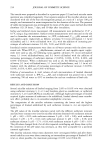
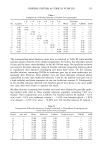
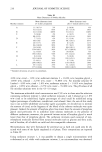
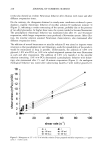
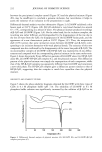
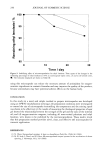
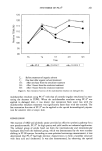
220 JOURNAL OF COSMETIC SCIENCE tively) also showed an evident NewtonJan behavior after dilution with water and after different evaporation times. On the contrary, the rheograms obtained in steady-state conditions evidenced a pseu- doplastic, slightly thixotropic behavior of miceliar solution D (surfactant mixture 3) (Figure 2), indicating a certain structuring of the system, probably due to the presence of two alkyl glucosides. At higher shear rates, the system tended to become Newtonian: The pseudoplastic thixotropic behavior was maintained also after 15- and 30-minute evaporation, while longer evaporation times produced a Newtonian system. After dilu- tion, the miceliar solution assumed Newtonian characteristics, also maintained after different evaporation times. The addition of several humectants to miceliar solution D was aimed to improve water retention so that pseudoplasticity and thixotropy, useful for spreadibility of the product, would be maintained as long as possible. Unfortunately, the addition of 3.0% w/w glycerol, 1.0% w/w PCA, or 3.0% w/w xylitol originated systems that were NewtonJan as such and after evaporation. The addition of 2.0% w/w laureth-2 to the miceliar solution containing 1.0% w/w PCA determined a pseudoplastic behavior with thixot- ropy, also maintained after 15- and 30-minute evaporation (Figure 3). An analogous rheological behavior was noted after substituting laureth-2 with methyl gluceth-10. 18- I I I 60 80 100 0 20 40 shear rate (s A ,,. u -B-I --•- 15' ev u X 15' ev I [] 30'evu 0 30'evl Figure 2. Rheograms at 25 ø + 0. iøC of miceliar solution D just prepared and after evaporation. u = upper curve. 1 = lower curve.
Purchased for the exclusive use of nofirst nolast (unknown)
From: SCC Media Library & Resource Center (library.scconline.org)