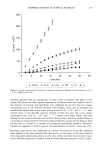
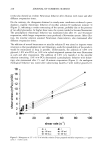
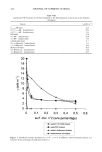
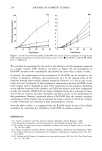
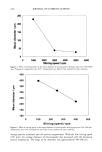
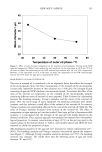
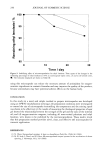
244 JOURNAL OF COSMETIC SCIENCE 250 200 100 0 1000 2000 3000 4000 5000 6000 Stirring spccd I rpm Figure 3. Effect of stirring speed on the mean diameter of microcapsules. Stirring speed was 1000-5000 rpm. Preparation temperature was 70øC. Composition (see Table I) was uniform for each condition. 450 400 350 3OO 25O 200 150 lOO 0 100 200 300 400 500 Stirring speed I rpm Figure 4. Effect of stirring speed on the mean diameter of microcapsules. Stirring speed was 100400 rpm. Temperature was 70øC. Composition (see Table I) was uniform for each condition. average particle diameters and the process temperatures. With the low stirring speed (250 rpm), the average diameter of microcapsules also decreased with the increasing process temperature. The range of the diameters was approximately 300-400 Fm.

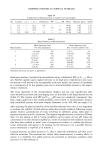
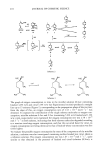
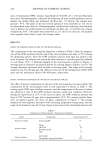
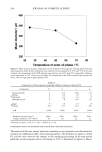
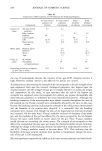
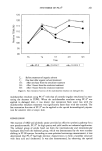
NEW SOFT CAPSULE 245 45 E 40 g 35 E 3o • 25 2o 20 30 40 50 60 70 80 Temperature of outer oil phase I øC Figure 5. Effect of outer oil phase temperature on the diameters of microcapsules. Stirring speed (5000 rpm) and composition (Table I) were uniform for each condition. In the experiment at 50øC and 70øC of the outer oil phase, the temperatures of the O/W emulsion-agar mixture were 50 ø and 70øC, respectively. However, in the experiment at 25øC of the outer oil phase, the temperature of the O/W emulsion-agar mixture was 50øC (since the agar gels at approximately 30øC). MEASUREMENT OF AGAR GEL STRENGTH The ratio of internal oil is considered to be an important factor that affects the strength of the microcapsules. Since the direct measurement of the strength of the microcapsules is practically impossible because of their physical size (400 lam), the strength of gels consisting of agar and O/W emulsion was measured instead. To estimate the effect of the ratio of the internal oil components on the strength of the microcapsules, samples containing different ratios of internal oil were prepared. Table II shows the relationship between the breaking intensity, Young's modulus, and the ratios of the internal oil phase. Over the entire range of ratios employed, the breaking intensities were almost constant, and this indicates a small effect of the volume of the internal oil. In contrast, Young's modulus was considerably affected by the ratio of the internal oil (Table II). The value of Young's modulus decreased with increase of the internal oil. The effect of temperature on agar aqueous gel was also studied. Since agar gel has a thermoreversible property, it is anticipated that the strength of the agar gel will deeply depend on the thermal conditions. Thus, aqueous agar gels were prepared to measure their thermorheo- logical properties. A constant concentration of agar (4.7%) in the gel was used in the aqueous phase of the formula shown in Table I, and butylene glycol and HCO-60 were removed to clarify the properties of agar. The rheological properties of the agar gel were measured at various temperatures (25ø- 90øC). The breaking intensity and Young's modulus were plotted against the tempera- ture (Figure 7). Although Young's modulus started to decrease over 70øC, the breaking intensity was constant. The results show that the softening point of agar gel exists between 70 ø and 85øC.
Purchased for the exclusive use of nofirst nolast (unknown)
From: SCC Media Library & Resource Center (library.scconline.org)