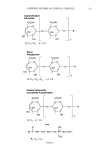
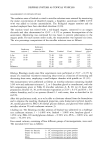
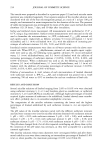
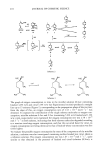
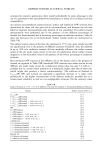
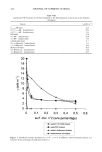
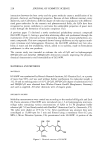
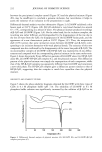
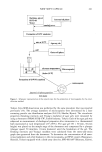
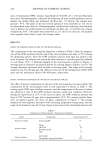
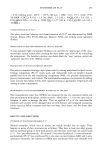
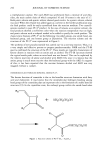
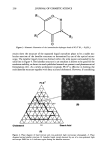
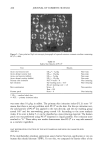
258 JOURNAL OF COSMETIC SCIENCE R R•' • '"Rs 0 Figure 3. Schematic illustration of the intramolecular hydrogen bond of PC-9 s (R• = RoCH2). results show the structure of the separated liquid crystalline phase to be a stable mo- lecular associate of the lameliar structures as determined by use of the optical micro- scope. The lameliar liquid crystal was formed within the wide region surrounded by the solid line in Figure 4. The lameliar structure in an emulsion is known to be good for the emulsion stability, as shown in much published research on cosmetic and pharmaceutical formulations (21). As a newly synthesized ceramide, PC-9 s is effective in forming the multilamellar structure together with fatty acid and cholesterol. However, if considering / A/ V / ", /\/\/V", / \/\/'x o.s Stearic Acid Figure 4. Phase diagram of lipid mixture and cross-polarized light microscopic photograph. A. Phase diagram having lameliar structure. B. Lameliar liquid crystal observed by use of a cross-polarized light microscope. Bold line in A indicates region having the lameliar structure.

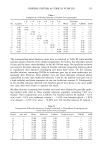
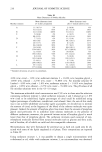
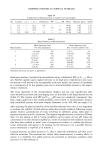
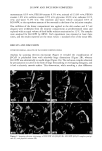
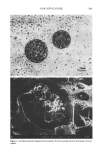
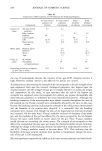
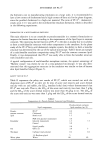
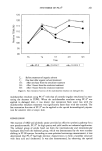
SYNTHESIS OF PC-9 s 259 the formula's cost in manufacturing emulsions on a large scale, it is recommended to have a low content of cholesteraol and a high content of fatty acid in the phase diagram, since the purified cholesterol is a high-cost material. The ratio of PC-9 s: cholesterol: stearic acid, 2:1:7, was used in the multilamellar emulsion formation, which is described in the following experiment. FORMATION OF A MULTILAMELLAR EMULSION The main objective is to use ceramides or pseudoceramides in a cosmetic formulation to improve the barrier function according to the maintenance of the lipid layer in stratum corneum. The improving barrier function of PC-9 s in the skin is mainly due to its ability to form a multilamellar structure with other components in the emulsion. In the phase study of the PC-9S/fatty acid/cholesterol complex system, the ability to form a lameliar structure was determined by the use of the optical microscope. Table I shows an example of a multilamellar emulsion composition using PC-9 s and the stratum corneum lipid. Finally, it was demonstrated that PC-9 s was easily able to form the lameliar structure with emulsifier and oils. A typical configuration of multilamellar mesophase texture, the optical anisotropy of "Maltese crosses" was shown by use of a cross-polarized microscope. It was also dem- onstrated that this aggregation structure in the emulsion was similar to that of human skin lipid lameliar bilayer (Figure 5). SAFETY TEST OF PC-9 s Table II represents the safety test results of PC-9 s, which was carried out with the dispersion state of PC-9 s in olive oil. In tests of acute oral toxicity and acute dermal toxicity with rat and rabbit, the LD5o (median lethal dose) values demonstrated that PC-9 s was very safe. That is, the LD5o of the acute oral toxicity was more than 5 g/kg and the LD5o of the acute dermal toxicity was more than 10 g/kg in rat. The LD5o of the acute oral toxicity was more than 5 g/kg and the LD5o of the acute dermal toxicity Table I Composition of a Pseudo-Stratum Corneum Lipid Emulsion Lipid components Pseudo-stratum corneum lipid emulsion (wt %) Pseudo- PC-9 s 0.6 stratum corneum Cholesterol 0.2 2.3 lipid Stearic acid 1.5 POE (15) glyceryl monostearte 3.0 Emulsifier Glyceryl monostearte 1.5 7.5 Cetanol 3.0 Liquid paraffin 2.0 Oil Olive oil 3.0 5 Thickener Carboxyl vinyl polymer 0.2 0.2 1,3-Butylene glycol 5 Water phase Water 80 85
Purchased for the exclusive use of nofirst nolast (unknown)
From: SCC Media Library & Resource Center (library.scconline.org)