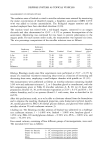
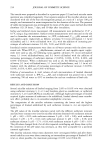
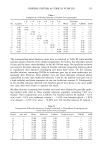
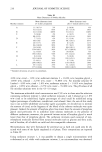
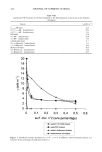
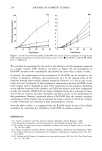
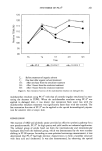
DISPERSE SYSTEMS AS TOPICAL VEHICLES 225 linalool was added to n-dodecanol, a higher 'y value resulted, which increased as a function of the percentage of the odorous molecule this was probably due to a higher affinity of linalool for n-dodecanol than for water. The percentages of surfactant mixture 2 added to the oil-linalool solutions were con- siderably lower than those used in surface tension measurements and to obtain micro- emulsions, as higher concentrations might have produced 'y values too low to be mea- sured by the ring tensiometer employed, since microemulsions are generally character- ized by very low (10 -2, 10 -3 mN m -•) interfacial tensions (15). Increasing percentages of surfactant mixture 2 produced a progressive lowering of the 'y values of all the oil-linalool/water systems (Figure 5). A sharp decrease in 'y values was detected at low percentages of surfactant mixture for the systems C•2_•sAB-linalool/water, IPP-linalool/ water, and n-dodecanol-linalool/water, while at higher concentrations, 'y values stabi- lized at a fixed point. In the case of n-dodecanol-linalool, even in the presence of the 0.01% w/w surfactant mixture, 'y took on values too low to be measured. On the other hand, when increasing percentages of surfactant mixture were added to mineral oil- linalool, a lower and rather linear decrease of 'y values occurred up to 0.3% w/w percentage. The trend observed for C•2_•sAB-linalool, IPP-linalool, and n-dodecanol- linalool might indicate a possible saturation of surfactant molecules at the interface, already at low surfactant concentrations, a condition that could be particularly favorable for microemulsion formation. Lastly, the behavior of microemulsions upon dilution with warm running water was observed to simulate the in-use conditions of a bath oil. The microemulsion with n-dodecanol and C•2_•5AB gave rise to slightly opalescent dispersions and might there- fore be proposed as a dispersible emollient bath oil (15), while the microemulsion with IPP originated a clear solution, as do "soluble bath oils," characterized by a lower emolliency but surely by a higher cosmetic acceptability to the consumer. ACKNOWLEDGMENTS This work was supported by a grant from Ministero dell'Universitl e della Ricerca Scientifica e Tecnologica. REFERENCES (1) J. M. Blakeway, M. L. Frey, S. Lacroix, and M. S. Salerno, Chemical reactions in perfume ageing, Int. J. Cosmet. Sci. 9, 203-214 (1987). (2) G. Malanin and K. Ohela, Allergic reactions to fragrance mix and its components, Contact Dermatitis, 21, 62-63 (1989). (3) J. M. Blakeway, Water-based perfumes, Perfum. Flavor., 18, 33-35 (1993). (4) J. M. Behan and K. D. Perring, Perfume interactions with sodium dodecyl sulphate solutions, Int. J. Cosmet. Sci. 9, 261-268 (1987). (5) M.E. Carlotti, M. Gallarate, S. Morel, and E. Ugazio, Miceliar solutions and microemulsions of odorous molecules, J. Cosmet. Sci., 50, 281-295 (1999). (6) P. Schieberle and W. Grosch, Identification of potent flavor compound formed in an aqueous lemon oil/citric acid emulsion, J. Agric. Food Chem., 36, 797-800 (1988). (7) M. R. Gasco, M. Gallarate, M. Trotta, L. Bauchiero, E. Gremmo, and O. Chiappero, Microemulsions as topical delivery vehicles: Ocular administration of timolol, .J. Pharm. Biomed. Anal., 7, 433-439 (1989).

226 JOURNAL OF COSMETIC SCIENCE (9) (10) (11) (12) (8) M. Trotta, B. Fubini, M. Gallarate, and M. R. Gasco, Calorimetric study on the solubilization of butanol by alkylphosphate and alkylphosphate-lecithin systems, J. Pharm. Pharmacol., 45, 993-995 (1993). M. E. Carlotti, M. R. Gasco, M. Trotta, and S. Morel, Auto-oxidation of linoleic acid in cosmetic formulations,J. Soc Cosmet. Chem., 42, 285-298 (1991). M. E. Carlotti, M. Gallarate, M. R. Gasco, S. Morel, A. Serafino, and E. Ugazio, Synergistic action of vitamin C and amino acids on vitamin E in inhibition of the lipoperoxidation of linoleic acid in disperse systems, Int. J. Pharm., 155, 251-261 (1997). M. Gallarate, R. Cavalli, E. Gagliardi, and M. E Carlotti, On the use of saccharose esters as emulsifiers for W/O/W multiple emulsions containing ascorbic acid, Acta Technologiae et Legis Medicamenti, X, 1-16 (1999). M. E. Carlotti, M. Gallarate, F. Pattarino, R. Cavalli, M. R. Gasco, and I. Cagliani, Preparation of miniemulsions with soya phosphatidylcholine and hydrogenated lecithin, Proceedings of the 19th IFSCC Congress, Sydney, Australia, October •996, pp. 1-25. (13) K. Kimura, H. Nishimura, I. Iwata, and J. Mizutani, Deterioration mechanism of lemon flavor.2. Formation mechanism of off-odor substances arising from citral, J. Agric. Food Chem. 31, 801-804 (1983). (14) S.J. Pearlly. P.J. White, Linalyl acetate and other compounds with related structures as antioxidants in heated soybean oil, J. Agric. Food Chem., 38, 1904-1908 (1990). (15) B. Idson, "Moisturizers, Emollients and Bath Oils," in Principles of Cosmetics for the Dermatologist, P. Frost and S. N. Horwitz, Eds. (C. V. Mosby, St. Louis, 1982), pp. 37-40.
Purchased for the exclusive use of nofirst nolast (unknown)
From: SCC Media Library & Resource Center (library.scconline.org)