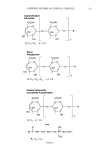
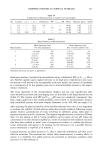
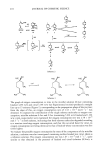
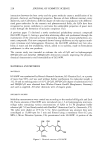
254 JOURNAL OF COSMETIC SCIENCE found to be effective in relieving atopic eczema (5,6), and also in exhibiting therapeutic properties such as wound and ulcer healing through the promotion of cell restoration and growth (7). For these reasons, many extensive efforts had been made by cosmetic and pharmaceutical companies to obtain access to natural ceramides (8-10) or pseudoce- ramides (11-14). In order to synthesize appropriate pseudoceramides, it is preferable that the structure of natural ceramides should be examined first, and that then pseu- doceramides having similar structures should be designed and synthesized. Several pre- vious reports had referred to the importance of multilamellar lipid vesicle structure in cosmetic and pharmaceutical formulation (15). A biphasic multilamellar lipid vesicle comprises a plurality of spaced lipid bilayers that include a liposome-forming compo- nent and optionally a biologically active agent (which means any agent that has a pharmacological, pharmaceutical, or cosmetic effect) entrapped within the lipid bilayers. The lipid vesicle also comprises peripheral aqueous solution compartments formed be- tween the lipid bilayers and a central lipophilic core compartment located at the center of the multilamellar lipid vesicle. The liposome-forming component is usually selected from the group consisting of glycolipids, phospholipids, ceramides, and mixtures thereof, and optionally a fatty substance such as cholesterol is added to enhance the strength of the lipid bilayer (16). Recently, we synthesized a pseudoceramide, N-ethanol-2-(myristyl/palmityl)-3- oxo(stearamide/arachidamide) (PC-9 s) by the reaction of 2-aminoethanol and AKD. It was designed to have properties similar to those of human skin (identical ceramides) and to mimic their behaviors. It showed easy lameliar liquid crystal formation in a mixture with fatty acid and cholesterol, and was demonstrated to be non-toxic, non-irritable and non-sensitizing in skin irritation tests on animals and humans. It was also demonstrated that the multilamellar emulsion using PC-9 s enhanced water barrier function into the skin. EXPERIMENTAL MATERIALS Alkylketene dimer (Taekwang Co., Korea), 2-aminoethanol (Duksan Co., Korea), and ethanol (Dong Yang Co., Korea) were used for the synthesis of a pseudoceramide, PC-9 s. Stearic acid (Junsei Co., Japan), cholesterol (Junsei Co., Japan), POE (15) glyceryl monostearate (Nihon Emulsion Co., Japan), glyceryl monostearate (Nihon Emulsion Co., Japan), cetanol (Kao Co., Japan), liquid paraffin (Seojin Chemical, Korea), olive oil (Junsei Co., Japan), and carboxyl vinyl polymer (B.F. Goodrich, USA) were used as components to form a multilamellar lipid vesicle that was similar to the intercellular lipids of stratum corneum. All water was distilled from an all-glass apparatus. SYNTHESIS OF PC-9 s AKD (15 g, 31.5 mmol) and 2-aminoethanol (2.12 g, 34.7 mmol) were added to 50 ml of ethanol and refiuxed for six hours. After adding about 200 ml of ethanol and cooling this mixture, white solids were precipitated. The solids were purified twice in ethanol to give pure PC-9 s as white crystalline solids (yield 90%). The physical properties of the obtained compound are as follows. TLC (CHCI 3: methanol: acetic acid = 95:5:1), Rf

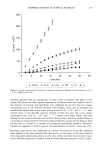
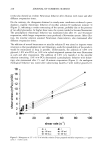
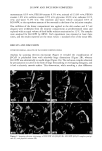
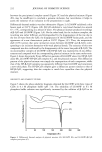
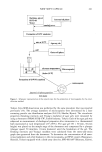
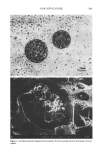
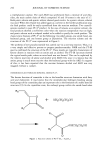
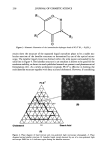
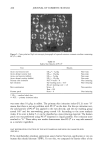
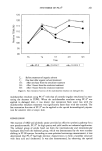
SYNTHESIS OF PC-9 s 255 = 0.36 melting point: 104øC - 107øC IR (cm -•, KBr): 3272, 1717, 1649, 1530 •H-NMR (CDC13): 8 0.8 - 1.9 (m, alkyl), 2.4 (2H, t, R-CH2-CO-), 3.4 (1H, t, CO-CH(R)-CON-), 3.4 (2H, q, -CON-CH2-), 3.55 (2H, d, -CH•-CH•OH), 6.8 (1H, t, -CONH-). CHARACTERIZATION OF PC-9 s The phase transition behavior and characterization of PC-9 s was determined by NMR (Varian, Jemini 200), FT-IR (Mattson, Mattson 7000), and melting point apparatus (Fisher). OBSERVATION OF THE CROSS-MICROSCOPIC OPTICAL TEXTURE A cross-polarized light microscopy (Nikkon) was used for the observation of the cross- microscopic optical texture after catching the meta-stable state of PC-9 s by controlling the temperature. The lameliar structure was shown from the "neat" pattern, and/or the "spherical" patterns with "Maltese crosses." PREPARATION OF THE MULTILAMELLAR EMULSION The process comprises forming a lipid phase melt by mixing multilamellar lipid vesicle- forming components (PC-9 s, stearic acid, and cholesterol) with oil droplets (liquid paraffin and olive oil) and emulsifying components (POE (15) glyceryl monostearate, glyceryl monostearate, and cetanol). The multilamellar emulsion was prepared by adding water into the lipid phase slowly, with vigorous stirring at appropriate temperature and cooling to room temperature. MEASUREMENT OF THE TRANSEPIDERMAL WATER LOSS OF THE SKIN The transepidermal water loss (TEWL) was measured by use of a tewameter before and after pretreatment with organic solvent (acetone: ethyl ether = 1:1) on the inner side of forearms in order to damage the skin. Then we applied 0.5 g of the multilamellar emulsion and controls to the damaged skin on each forearm and compared coutaneous barrier function before treatment and then one hour, three hours, and five hours after treatment. RESULTS AND DISCUSSION SYNTHESIS OF THE PSEUDOCERAMIDE, PC-9 s Natural ceramides, which exist in nature, are widely divided into six types. Their features in terms of their structures are as follows: They have at least two alkyl groups and one hydroxyl group in their head position and also have more than one amide bond (17). The pseudoceramide, N-ethanol-2-myristyl/palmityl-3-oxostearamide/ arachidamide (PC-9 s) was synthesized by a one-step reaction between AKD and 2-ami- noethanol. Generally, the commercial AKDs were synthesized from acyl chlorides with
Purchased for the exclusive use of nofirst nolast (unknown)
From: SCC Media Library & Resource Center (library.scconline.org)