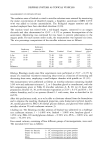
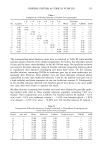
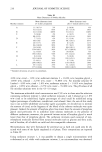
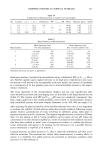
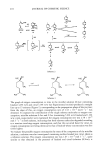
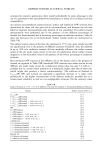
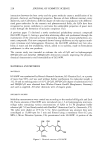
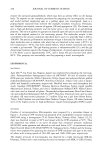
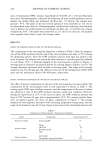
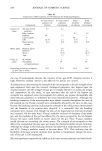
DISPERSE SYSTEMS AS TOPICAL VEHICLES 217 Table IV Compositions of Microemulsions of Linaloo! (w/w percentages) No. Linalool s.m. 1 s.m. 2 n-Dodecanol IPP C•2_•5 AB Water Hexylene glycol EtOH 1 5.0 -- 25.5 5.0 -- -- 60.38 1.85 2.27 2 5.0 -- 20.0 -- 5.0 -- 65.88 1.85 2.27 3 5.0 -- 18.0 -- -- 5.0 67.88 1.85 2.27 4 5.0 24.0 -- 5.0 -- -- 61.88 1.85 2.27 Table V Mean Diameters of Microemulsions Miroemulsion Mean diameters (nm) 24 h after preparation Mean diameters (nm) after 3-month stability tests 1 5.6 (0.8)* 6% 4.2 (1) 5% 72.2 (25) 94% 74.8 (30) 95% 2 14.5 (5) 5% 7.9 (5) 4% 212.0 (36) 95% 230.6 (70) 96% 3 21.4 (8) 5% 16.8 (8) 5% 252.3 (48) 95% 260 (80) 95% 4 3.2 (0.3) 8% 4.6 (1) 7% 55.0 (8) 92% 55.2 (15) 93% *Standard deviations are given in parentheses. Surfactant mixture 2 produced microemulsions using n-dodecanol, IPP, or C12_15 AB as oils. Neither caprylic-capric triglyceride (due to its high steric impediment), nor cyclo- methiocone (well known to be incompatible with most lipids), nor mineral oil (probably as a consequence of its low polarity) gave rise to microemulsified systems in the experi- mental conditions. The mean diameters of the microemulsion droplets did not vary significantly after three-month freeze-thaw and centrifuging tests, as described in the Experimental section (Table V). The systems with IPP and C•2_•5AB were not completely transparent they had a slight opalescence that would probably convert them in miniemulsions, particu- larly emulsified systems with mean droplet diameters in the 100-400 nm range (12). After assessing the physical stability of the miceliar solutions over time, it was important to evaluate the stability of both odorous molecules towards oxidation following oxygen uptake. Indeed, autooxidation of citral, involving its aldehydic group, takes place in aqueous solutions in acidic conditions. The highest degradation rate is noted at pH lower than 3.0, but already at pH 6.5 some instability can be noted. At low pH values the concentration of citral decreases rapidly by a series of cyclization and oxidation reactions that have been studied in detail, even if unequivocal evidence to confirm the deterio- ration mechanism still appear to be lacking. In the literature (13), a possible deterio- ration mechanism is reported as in Scheme 2. Linalool possesses an allylic proton at C 5 that is relatively unhindered and thus acces- sible for oxidation. The resultant free radical (after isomerization) is tertiary allylic in nature it is therefore very stable and has the potential to terminate oxidative chain reactions (14) (See Scheme 3).

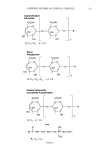
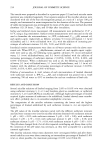
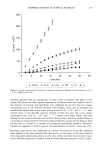
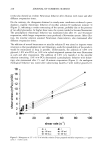
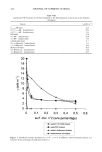
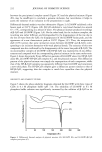
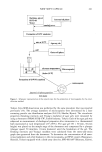
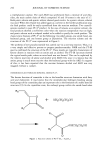
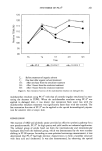
218 JOURNAL OF COSMETIC SCIENCE ,,OHO H + •HH•O Geraniel 65:•5 Neral la lb (•OC21-b OH 4 •. T •ispm 3a OH • •OH 3b 3• Scheme 2 OH OH OH Scheme 3 The graph of oxygen consumption vs time in the miceIlar solution LC-Lec containing linalool 4.0% w/w and citral 1.0% w/w (see Experimental section) produced a straight line up to 15 minutes (Figure 1), corresponding to the propagation phase of the reaction from the slope of this, an oxygen consumption rate of 1.32 x 10 -8 mol l-•s -1 was obtained. To separate the contribution of the single odorous molecules to oxygen con- sumption, miceIlar solutions L-Lec and C-Lec (containing 5.0% w/w linalool and 1.0% w/w citral, respectively) were examined the oxygen consumption rate was 2.78 x 10 -8 mol I- • s- • in both systems, indicating that both odorous molecules degraded according to a reaction involving oxygen consumption, and that this occurred faster for citral, its oxygen consumption rate being identical to that of linalool whose concentration was five times higher. To evaluate the possible oxygen consumption by some of the components of the miceliar solution, a solution was also investigated containing neither linalool nor citral, taken as a reference solution. The oxygen consumption rate was 1.67 x 10 -8 mol 1 -• s -1, quite similar to that obtained in the presence of linalool and citral (solution LC-Lec) it
Purchased for the exclusive use of nofirst nolast (unknown)
From: SCC Media Library & Resource Center (library.scconline.org)