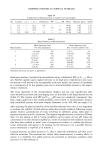
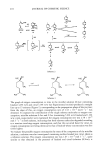
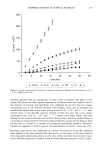
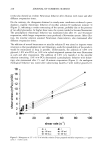
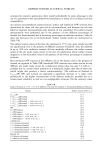
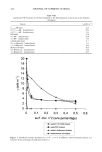
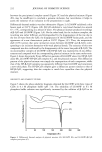
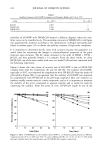
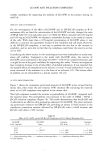
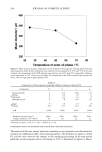
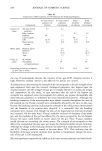
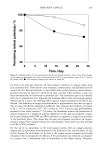
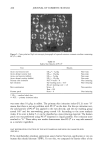
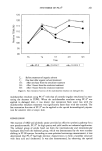
LG106W AND INCLUSION COMPLEXES 235 reliable candidates for improving the stability of LG106W in the product during its shelf life. EFFICACY AND CYTOTOXICITY For the investigation of the effect of LG106W and its HP-[3-CyD complex on B-16 melanoma cells, we fixed the concentration of the LG106W and only changed the ratio of H P-[3-CyD (5 % w/w and molar ratio 1:1) (Table II). When cultured with 0.02 mg/ml and 0.05 mg/ml of LG106W, we obtained a remarkable decrease in the melanin content of the cells. With more than a 0.05-mg/ml concentration of LG106W alone, it was difficult to continue the experiment because of low solubility and cell death. However, in the HP-[3-CyD complexes, it was easy to perform the test due to the increase in solubility, and we were able to find that the complexes could lower the toxicity on that cell as well. Considering the above results, in vitro toxicological tests were undertaken to study more about cell viability. Compared to the result with LG106W alone, the toxicity of LG106W can be attenuated in the range of 0.0047 - 0.012% by complex formation, and it might be one of the good candidates for improving skin safety. Various investigations have revealed a decrease in the irritant effect of included substances. It was reported that the harmful effects of stimulation on the skin by 2-n-octyl-4-octyl-isothizolein-3-one are vastly decreased if the substance is in the form of an inclusion (15). The irritant effect of perfume can be diminished in a similar manner (16-18). IN VITRO SKIN PERMEATION Figure 7 shows the cumulative penetrated amounts of LG106W across excised hairless mouse skin, when water (A) and cosmetic O/W emulsion (B) containing the material alone or its CyD complexes were applied to the mouse skin. The CyD complexes revealed the increase in permeability of LG106W, compared with the material alone. The permeability was increased in the order of DM-[3 HP-[3 [3-CyD inclusion complexes (Figure 7A). This result demonstrates that the [3-CyD and its derivatives are effective skin permeation enhancers for LG106W. The most outstand- ing penetration enhancer was DM-[3-CyD, providing an almost 23-fold increase in the cumulative permeation amount, followed by HP-[3-CyD, with a 6-fold increase, and [3-CyD, with about a 30% increase. Table II Effect of LG 106W and Its HP-[3-CyD Complexes on B-16 Mouse Melanoma Cells LG106W LG106W Complex Complex Conc. (mg/ml) alone (5 % w/w) (1:1) 0.02 +* + + 0.05 ++, 20%** ++(+), 40% ++(+), 40% 0.10 -- ++(+), 20% ++(+), 20% * +, slight whitening effect + +, moderate whitening effect + + +, significant whitening effect. ** Cell viability.

236 JOURNAL OF COSMETIC SCIENCE 100' (A) '80. 0 0 10 20 30 40 50 18 (B) 14 12 10 8 i0 10 •0 3'0 4'0 gO Time(Hours) Time(Hours) Figure 7. In vitro skin permeation profiles of LG106W alone and its inclusion complexes in water (A) and O/W emulsion (B) through on excised hairless mouse skin at 32øC. O, LG106W ¸, [3-CyD •r, HP-[3- CyD V, DM-[3-CyD. We extended the experiment by the study of the influence of CyD complexes contained in a simple cosmetic O/W emulsion. As shown in Figure 7B, the permeability of LG106W increased with complexation and showed the same order as those in water. In general, the enhancement of skin permeation of LG106W can be ascribed to the increase in solubility, diffusion, and concentration of it in the aqueous phase of the emulsion through water-soluble complex formation. However, it is not so easy to elu- cidate the exact mechanism of skin permeation enhancement because LG106W in the CyD complex may be displayed by some other components of the emulsion, depending on the stability constant of the complex, and CyDs also interact with some components of skin. For example, DM-[3-CyD can extract cholesterol from skin, reducing the func- tion of skin as a barrier, and may eventually contribute in part to the enhancement of skin permeation. However, optimized release of LG106W from the cosmetic emulsion containing its CyD complex may be obtained by using a vehicle in which the complex is barely dissociated and maintains a high thermodynamic activity. From the above results, it is suggested that the [3-CyDs might be one of the reliable candidates for improving the availability of LG106W in cosmetic products. REFERENCES (1) J. Szejtli, Cyc/odextrins and Their Inclusion Complexes (Alkad•miai Kiad6, Budapest, 1982). (2) D. Dunchine, Cyclodextrins and Their IndustriM Uses (Les Editions de Sant•, Paris, 1987). (3) W. Saenger, Cyclodextrin inclusion compounds in research and industry, Angew. Chem. Int. Ed. Eng/., 19, 344-362 (1980). (4) J. Szejtli, Cyc/odextrin Technology (Kluwer Academic Publishers, Dordrecht, The Netherlands, 1988). (5) K. Uekama, Pharmaceutical applications of cyclodextrin complexations, Yakugaku Zasshi, 101,857- 873 (1981). (6) K. Uekama and M. Otagiri, Cyclodextrins in drug carrier systems, CRC Crit. Rev. Ther. Drug Carrier Sys., 3, 1-40 (1987).
Purchased for the exclusive use of nofirst nolast (unknown)
From: SCC Media Library & Resource Center (library.scconline.org)