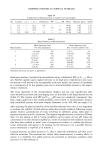
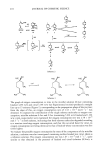
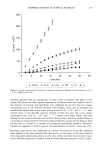
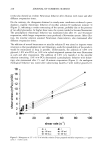
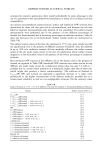
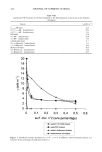
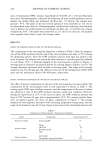
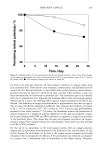
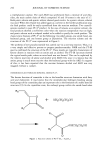
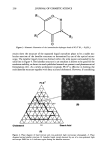
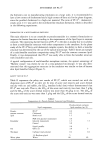
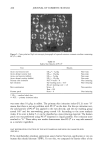
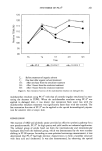
250 JOURNAL OF COSMETIC SCIENCE 1oo 95 9o 85 80 • i 0 10 20 30 Time I day Figure 9. Stabilizing effect of microencapsulation for ethyl linoleate. Time course of the changes in the remaining percentage of ethyl linoleate at 50øC in microcapsule (open circle, O) and in oil (closed circle, 0). The formulae employed are shown in Table III. using this microcapsule can reduce the necessary amount of antioxidant for oxygen- sensitive ingredients in cosmetic formulae and may improve the quality of the product, because antioxidants may have potential adverse effects on the human body. CONCLUSION In this study (a) a novel and simple method to prepare microcapsules was developed using an O/W/O emulsification technique (b) preparation conditions were investigated to control the size of microcapsules (controlling the temperature and the stirring speed was shown to be effective) (c) the results of measuring the rheological properties of agar gel showed the relationship between the strength of the gel and the ratio of the internal oil and (d) oxygen-sensitive reagents, including all trans-retinol palmirate and ethyl linoleate, were shown to be stabilized by the microencapsulation. These results reveal that this preparation method provides novel, clean, and effective soft microcapsules for cosmetic application. REFERENCES (1) N. Olson, Encapsulated enzymes: A boon to cheeseflavor, Daily Rec., 85(8), 86 (1984). (2) M. El. Soda, L. Panel, and N. Olson, Microencapsulated enzyme systems for the acceleration of cheese ripening,J. Microencap., 6(3), 319 (1989).

NEW SOFT CAPSULE 251 (21) (22) (23) (24) (25) (26) (27) (28) (29) (30) (31) (3) M. Samejima, G. Hirata, and Y. Koida, Studies on microcapsules. I. Role and effect of coacervation- inducing agents in the microencapsulation of ascorbic acid by phase separation method, Chem. Pharm. Bull., 30(8), 2894-2899 (1982). (4) P. B. Deasy, "Microencapsulation and Related Drug Processes," in Drugs and the Pharmaceutical Science, Volume 20 (Marcel Dekker, New York). (5) J.J. Vallner, I. L. Honigberg, J. A., Kotzan, and J. T. Stewart, A proposed general protocol for testing bioequivalence of controlled-release drug products, Int. J. Pharm. 16, 47-55 (1983). (6) W. E. Longo, H. Iwata, T. A. Lindheimer, and E. P. Goldberg, Preparation of hydrophilic albumin microspheres using polymeric dispersing agents,.]. Pharm. Sci., 71(12), 1323-1328 (1982). (7) R. Chandrasekhar, Water based UV curable ink-jet printing fluid containing encapsulate liquid crystal, J. Radiat. Curing, 15(4), 6-11 (1988). (8) M. Magill, Microencapsulation for the personal care industry, Cosmet. Toilerr., 105(6), 59-62 (1990). (9) R.J. Versic, Microcapsulation and scented fragrance inserts, DCI, 144(6), 30, 32, 34, 75 (1989). (10) J.P. Marion and A. Audrin, L'encapsulation d'aromes en images, RIA 411, 41-42, 44-46 (1988). (11) P. W. Morgan and S. L. Kwolek, Interfacial polycondensation. 2. Fundamentals of polymer formula- tion at liquid interface..]. Polymer. Sci., 15, 299-327 (1959). (12) J. W. McGinity, A. Martin, G.W. Cuff, and A.B. Combs, Influences of matrixes on nylon- encapsulated pharmaceuticals,.]. Polymer. Sci., 4, 1075-1096 (1963). (13) B. Dupuy, H. Gin, C. Baquey, and D. Ducassou, In situ polymerization of a microencapsulating medium around living cells. J. Biotaed. Mat. Res., 22, 1061-1070 (1988). (14) J. Okada, A. Kusai, and S. Ueda, Factors affecting microencapsulativity in simple gelatin coacervation method, J. Microencap., 2(3), 163-173 (1985). (15) A. R. Bachtsi and C. Kiparissides, Synthesis and release studies of oil-containing poly (vinyl alcohol) microcapsules prepared by coacervation, J. Control Release, 38(1), 49-58 (1996). (16) K. P. R. Chowdary and A. Annapurna, A comparative evaluation of the permeability of ethyl cellulose microcapsules prepared by coacervation methods, IndianJ. Pharm. Sci., 51(2), 53-56 (1989). (17) G.R. Chhilvers and V.J. Morris, Coacervation of gelatin-gellan gum mixtures and their use in microencapsulation, Carbohydr. Polym., 7(2), 111-120 (1987). (18) A. Ribeiro, P. Arnaud, S. Frazao, F. Venancio, and J. C. Chaumeil, Development of vegetable extracts by microencapsulation, J. Microencap., 14(6), 735-742 (1997). (19) H. Takenaka, Y. Kawashima, and S. Y. Lin, Polymorphism of spray-dried microencapsulated sulfa- methoxazole with cellulose acetate phthalate and colloidal silica, montmorillonite, or talc,.]. Pharm. Sci., 70(11), 1256-1260 (1981). (20) Y. Fukumori, Y. Yamaoka, H. Ichikawa, T. Fukuda, Y. Takeuti, and Y. Osaka, Coating of pharma- ceutical powders by fluidized bed process. II. Microcapsules produced by layering of fine powder on coarse particles and subsequent aqueous enteric coating, Chem. Pharm. Bull., 36(4), 1491-1501 (1984). A. R. Baachtsi and C. Kiparissides, Synthesis and release studies of oil-containing poly (vinyl alcohol) microcapsules prepared by coaservation. J. Control Release, 38, 49-58 (1996). P.L. Madan, D. K. Madan, and J. C. Price, Clohibrate microcapsules: Preparation and release rate studies,.]. Pharm. Sci., 52, 1476-1479 (1976). P. L. Madan, Clohibrate microcapsules. II. Effect of wall thickness on release characteristics,.]. Pharm. Sci., 70, 430-433 (1981). J. Rozenblat, S. Magdassi, and N. Garti, Effect of electrolytes, stirring and surfactants in the coacer- vation and microencapsulation processes in presence of gelatin, J. Microencap., 6, 515-526 (1989). N. N. Salib, M. E. E1-Menshaw, and A. A. Ismail, Preparation and evaluation of the release charac- teristics of methylcellulose micropellets, Pharm. Ind., 38, 577-580 (1986). J. W. Beyger and J. G. Nairn, Some factors affecting the microencapsulation of pharmaceuticals with cellulose acetate phthalate, J. Pharm. Sci., 75, 573-578 (1986). S.A. Mortada, Preparation of microcapsules using the N-butyl half-ester of PVM/MA coacervate system, Pharmazie, 36, 420-423 (1981). C. Araki, Structure of the agarose constituent of agar-agar, Bull. Chem. Soc Japan, 29, 543 (1956). S. Hirase, Studies on the chemical constitution of agar-agar. XlX. Pyruvic acid as a constituent of agar-agar (Part 1). Indication and estimation of pyruvic acid in the hydrolystate of agar, Bull. Chem. Soc. Japan, 30, 68, 70, 75 (1957). S. Arnott, A. Fulmer, W. E. Scott, I. C. M. Dea, R. Moorhouse, and D. A. Rees, The agarose double helix and its function in agarose gel structure,.]. MoL BioL 90, 269 (1974). K. Nishinari, M. Watase, K. Kohyama, N. Nishinari, D. Oakenfull, S. Koide, K. Ogino, P.A.
Purchased for the exclusive use of nofirst nolast (unknown)
From: SCC Media Library & Resource Center (library.scconline.org)