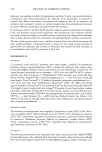
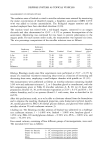
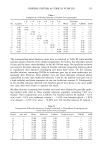
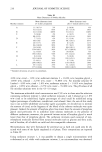
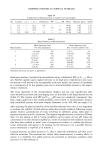
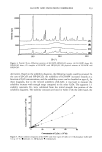
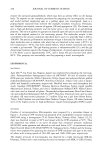
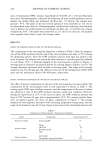
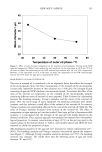
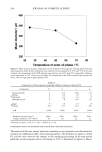
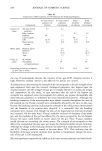
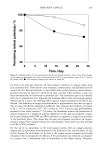
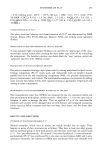
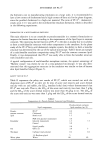
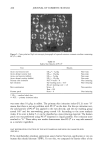
246 JOURNAL OF COSMETIC SCIENCE 450 E =. 400 E 350 ß 300 250 • ' ' • • 20 30 40 50 60 70 8O Temperature of outer oil phase I øC Figure 6. Effect of outer oil phase temperature on the diameter of microcapsules. Stirring speed (250 rpm) and composition (Table I) were uniform for each condition. In the experiment at 50øC and 70øC of the outer oil phase, the temperatures of the O/W emulsion-agar mixture were 50øC and 70øC, respectively. However, in the experiment at 25øC of the outer oil phase, the temperature of the O/W emulsion-agar mixture was 50øC, since the agar gels at approximately 30øC. Table II Composition of Microcapsules Containing Different Volumes of Internal Oil Compounds a* b c d fLiquid paraffin A•Water [HCO-60 (Butylene glycol BfAgar Water A:B 0 11.0 20.0 33.3 0 0.6 1.0 1.7 0 0.6 1.0 1.7 0 7.8 14.0 23.3 4.7 3.8 3.0 1.9 95.3 76.2 61.0 38.1 0:100 20:80 36:64 60:40 Breaking intensity (kg/m 2) 2090 2050 Young's modulus (x 10 -4 N/m 2) 46 29 2O5O 2O4O 22 12 * Internal oil ratios: a, 0% b, 11.0% c, 20.0% d, 33.3%. STABILIZING EFFECT OF MICROENCAPSULATION FOR UNSTABLE REAGENTS The amount of all trans-retinol palmitate remaining in microcapsules was determined to evaluate the stabilization effect of microencapsulation. The formulae are shown in Table Ill, and the time course of the changes in the remaining percentage of all trans-retinol palmitate in microcapsule and in oil solution at 50øC is illustrated in Figure 8. Micro-

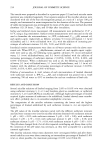
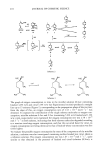
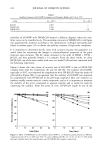
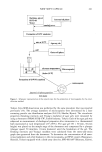
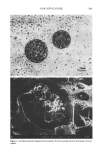
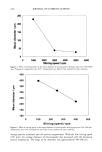
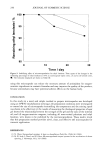
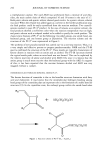
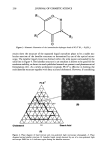
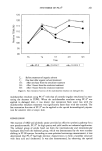
NEW SOFT CAPSULE 247 x 10 4 35000 2500 30000 25000 o o o 2000 60 80 1500 20000 ' 1000 20 40 100 Temperature / øC Figure 7. Effect of temperature on the breaking intensity and Young's modulus of agar aqueous gels. The open (O) and closed (O) circles represent the breaking intensity and Young's modulus, respectively. encapsulation improved the stability of all trans-retinol palmitate compared to that of the oil solution. The remaining percentages of all trans-retinol palmitate at 50øC for four weeks in oil solution and in the microcapsule were 72% and 87%, respectively. The effect of the microcapsulation on ethyl linoleate was also studied. The remaining per- centages of ethyl linoleate in oil solution and in microcapsules were 91% and 95%, respectively (Figure 9). DISCUSSION The microcapsule in this study has a polynuclear structure. The average diameter of internal oil droplets (nucleus) depends on the conditions for preparing the primary O/W emulsion (35). The average diameter of internal oil droplets was small enough (0.5-2 pm) for preparing an O/W/O emulsion without a significant loss of internal oil. The size of the microcapsule itself is governed by conditions during the addition of the agar-O/W emulsion mixture to the outer oil phase. The average diameter of microcap- sules was controlled by changing the stirring speed and the process temperature. The average diameter decreased as the stirring speed increased because of the increase of mechanical shear. The process temperature also contributed to the control of average diameter because the interfacial tension is reduced with the rise in temperature. The magnitude of the contribution to the average diameter of the microcapsule by changing the stirring speed was greater than that caused by changing the temperature. This result shows that controlling mechanical power is the most effective way to control
Purchased for the exclusive use of nofirst nolast (unknown)
From: SCC Media Library & Resource Center (library.scconline.org)