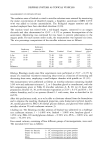
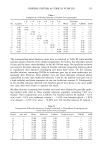
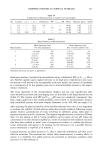
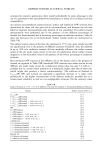
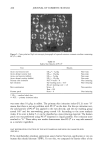
DISPERSE SYSTEMS AS TOPICAL VEHICLES 215 Table I Compositions of Micellar Solutions of Linalool (w/w percentages) s.m. s.m. s.m. s.m. s.m. s.m. Hexylene No. Linalool 1 2 3 4 5 6 Water glycol CDCNa etOH 1 2.80 8.40 .... 84.68 1.85 -- 2.27 2 5.00 14.00 .... 76.88 1.85 -- 2.27 3 2.60 -- 9.00 -- -- -- 84.28 1.85 -- 2.27 4 9.70 -- 25.50 -- -- -- 60.68 1.85 -- 2.27 5 4.10 -- -- 12.40 -- -- -- 79.38 1.85 -- 2.27 6 10.00 -- -- 26.00 -- -- -- 59.88 1.85 -- 2.27 7 3.90 -- -- -- 10.80 -- -- 82.54 -- 0.49 2.27 8 8.40 -- -- -- 20.70 -- -- 68.14 -- 0.49 2.27 9 3.20 -- -- -- 10.90 -- 83.14 -- 0.49 2.27 10 10.30 -- -- -- 26.90 -- 60.04 -- 0.49 2.27 11 3.70 .... 10.40 83.14 -- 0.49 2.27 12 10.60 .... 26.80 59.84 -- 0.49 2.27 The corresponding mean diameter values were as indicated in Table III. Each miceliar solution sample consisted of two droplet populations: the former, less abundant, around 10 nm, and the latter, more abundant, in the 40-100 nm range. No significant variation was noted in the mean diameter values of miceliar solutions containing hexylene glycol as cosurfactant after repeated centrifuging and freeze-thaw cycles. On the contrary, miceliar solutions containing CDCNa as surfactant gave rise to some opalescence im- mediately after filtration. After stability tests the mean diameters remained almost unmodified in most cases (surfactant mixtures 5 and 6) the stability tests gave rise to a high turbidity and phase separation in one case (surfactant mixture 4). Consequently, as the miceliar solutions obtained with hexylene glycol were shown to be more stable over time, they were chosen to continue the study. Micellar solutions containing both linalool and citral were obtained by partially replac- ing linalool with citral in those miceliar solutions originally containing 5.0% w/w linalool. Their compositions were as follows: For miceliar solution M: linalool -- 4.5% w/w citral -- 0.5% w/w surfactant mixture 1 = 14.0% w/w hexylene glycol = 1.85% w/w ethanol = 2.27% w/w water -- 76.88% w/w. For miceliar solution N: linalool = Table II Compositions of MiceIlar Solutions of Linalool Submitted to Three-Month Centrifuging and Freeze-Thaw Cycles (w/w percentages) System Surf. mix. Water Surfactant Linalool Hexylene glycol CDCNa etOH A 1 76.88 14.00 5.00 1.85 -- 2.27 B 2 74.88 16.00 5.00 1.85 -- 2.27 C 2 60.38 25.50 10.00 1.85 -- 2.27 D 3 76.48 14.40 5.00 1.85 -- 2.27 E 3 59.88 26.00 10.00 1.85 -- 2.27 F 4 77.04 15.20 5.00 -- 0.49 2.27 G 5 74.84 17.40 5.00 -- 0.49 2.27 H 5 60.24 27.00 10.00 -- 0.49 2.27 I 6 74.24 18.00 5.00 -- 0.49 2.27 L 6 60.44 26.80 10.00 -- 0.49 2.27

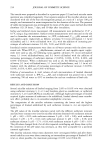
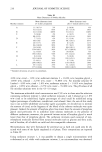
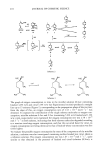
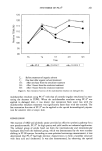
216 JOURNAL OF COSMETIC SCIENCE Table III Mean Diameters of Swollen Micelies Mean diameters (nm) Miceliar solution 24 h after preparation Mean diameters (nm) after 3-month stability tests A 11.2 (0.7)* 5% 2.4 (0.8) 4% 41.0 (13.5) 95% 63.7 (31.9) 96% B 41.0 (15.0) 100% 51.8 (5.1) 100% C 5.6 (0.8) 2% 3.2 (0.5) 4% 88.4 (23) 98% 83.4 (31.4) 96% D 7.7 (3.3) 6% 11.2 (3.0) 13% 96.0 (39) 94% 98.3 (39.1) 87% E 20.5 (7.7) 10% 8.5 (2.9) 11% 84.6 (26.0) 90% 55.7 (8.2) 99% F 16.0 (6.8) 10% 80.0 (20.1) 28% 150.0 (60.1) 90% 657.6 (200.6) 72% G 12.5 (4.0) 6% 19.8 (6.0) 4% 183.0 (30.3) 94% 155.4 (42.2) 96% H 8.4 (3.0) 7% 5.6 (O.8) 4% 145.0 (46.0) 93% 129.9 (45.1) 96% I 15.4 (6.1) 10% 9.7 (1.0) 10% 204.0 (90.3) 90% 119.0 (40.6) 90% L 49.1 (14.3) 25% 54.1 (24.3) 27% 377.0 (10.8) 75% 399.0 (140.5) 93% * Standard deviations are given in parentheses. 4.0% w/w citral = 1.0% w/w surfactant mixture 2 = 16.0% w/w hexylene glycol = 1.85% w/w ethanol -- 2.27% w/w water -- 74.88% w/w. For miceliar solution O: linalool = 4.0% w/w citral = 1.0% w/w surfactant mixture 3 = 14.4% w/w hexylene glycol = 1.85% w/w ethanol = 2.27% w/w water = 76.48% w/w. The pH values of all the miceliar solutions were in the 4.5-5.0 range. The maximum achievable citral concentration was 0.5% w/w in those micellar solutions containing surfactant mixture 1, while surfactant mixtures 2 and 3 allowed up to 1.0% w/w citral to be solubilized higher percentages of citral could be solubilized using higher percentages of surfactant, cosurfactant, and ethanol. Since the aim of this study was to use as little solubilizer and surface agent as possible, we decided not to increase the amount of citral, as the fragrance of the blend of the odorous molecules was quite pleasant. Indeed, the amount of hexylene glycol was lower than the amount of propylene glycol used previously (5) to solubilize some odorous molecules in the presence of different surfactants moreover, the potential irritant action of hexylene glycol is much lower than that of propylene glycol. The surfactant mixtures used consisted of non- ethoxylated molecules derived from natural molecules such as glucose and fatty acids, and of lecithin, all of which are mild and skin-compatible substances. Microemulsions that were formulated for potential use as bath oils could only be ob- tained with some of the lipids employed as oil phase. Their compositions are reported in Table IV. Using surfactant mixture 1, it was possible to obtain a single microemulsion with n-dodecanol as oil, while with surfactant mixture 3, no microemulsion was obtained.
Purchased for the exclusive use of nofirst nolast (unknown)
From: SCC Media Library & Resource Center (library.scconline.org)