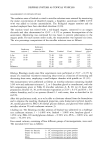
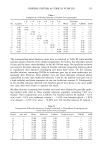
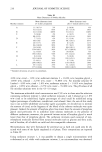
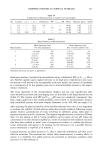
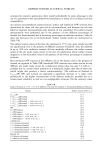
DISPERSE SYSTEMS AS TOPICAL VEHICLES 223 solutions for cosmetic application, there would undoubtedly be some advantage to the use of a preservative-free and alcohol-free formulation in terms of its mildness and skin compatibility. As concerns microemulsion characterization, surface and interfacial O/W tensions were determined for those oils that gave rise to microemulsions, and between the oils that failed to originate microemulsions only mineral oil was considered. The surface tension measurements were performed also in the presence of two different percentages of linalool (see Experimental) and of increasing percentages of surfactant mixture 2 only for these oils that gave rise to microemulsions. Surface tension results are summarized in Table VII. The surface tension values of the four oils examined at 37øC were quite similar and did not significantly vary in the presence of different amounts of linalool. Also, the addition of up to 10% w/w surfactant mixture did not markedly influence the surface tension values of the oils under study, except in the case of n-dodecanol, whose surface tension dropped to a non-detectable value in the presence of the lowest percentage of surfactant mixtures. The interfacial O/W tensions of the different oils in the absence and in the presence of linalool are reported in Table VIII. Interfacial O/W tensions were rather similar for the different oils under study except for n-dodecanol, whose value was only 5.2 mN m -• probably due to a certain water solubility of n-dodecanol, higher than that of other oils, which might also produce a better emulsionability. The addition of linalool to C•2MsAB, IPP, and mineral oil originated a significant decrease in •/ value, more pronounced at the higher concentration of the odorous molecule, partially due to a certain water solubility as well as to an amphyphilic structure. On the contrary, when Table VII Surface Tensions at 37.0 ø + 0.1øC of Different Oils and Oil-Linalool or Oil-Linalool-Surfactant Mixtures System Surface tension (mN m •) C•2_15 AB 9:1 C•2_•5AB:linalool 1:1 C12_1. 5AB :linalool 1:1 C•2_•5AB:linalool + 1.0% w/w s.m. 2 1:1 C•2_•5AB:linalool + 5.0% w/w s.m. 2 1:1 C•2_•5AB:linalool + 10.0% w/w s.m. 2 IPP 9:1 IPP:linalool 1:1 IPP:linalool 1:1 IPP:linalool + 1.0% w/w s.m. 2 1:1 IPP:linalool + 5.0% w/w s.m. 2 1:1 IPP:linalool + 10.0% w/w s.m. 2 n-Dodecanol 9:1 n-dodecanol:linalool 1:1 n-dodecanol:linalool 1:1 n-dodecanol:linalool + 1.0% w/w s.m. 2 1:1 n-dodecanol:linalool + 5.0% w/w s.m. 2 1:1 n-dodecanol:linalool + 10.0% w/w s.m. 2 Mineral oil 9:1 Mineral oil:linalool 1:1 Mineral oil:linalool 33.5 32.7 3O.5 3O.5 3O.4 30.1 29.5 29.6 29.2 29.2 29.0 28.7 29.6 29.6 29.6 n.d. n.d. n.d. 28.3 28.8 27.5

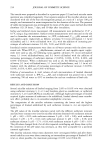
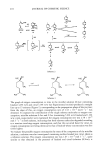
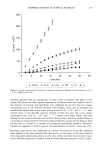
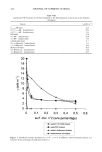
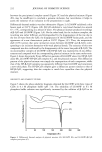
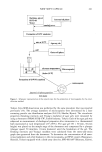
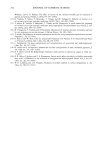
224 JOURNAL OF COSMETIC SCIENCE Table VIII Interfacial O/W Tensions ("f) of Oils Employed in the Microemulsion as Such and in the Presence of Linalool System "f (mN m -•) C12_15AB/water 24.5 9:1 C•2_•5AB: linalool/water 20.1 1:1 C12_15AB: linalool/water 13.3 lPP/water 25.8 9:1 IPP: linalool/water 20.0 1:1 IPP: linalool/water 13.3 n-Dodecanol/water 5.2 9:1 n-dodecanol: linalool/water 7.6 1:1 n-dodecanol: linalool/water 10.4 Mineral oil/water 20.5 9:1 Mineral oil: linalool/water 14.0 1:1 Mineral oil: linalool/water 10.5 20 • 18- 16- 14-: • 12 E _ 8 6 4 2 0 - X---• • A , 4• • ,• 0 0,1 0,2 0,3 0,4 0,5 0,6 surf. mix. nø2 (w/w percentage) --•--watedC12-15AB-linalool -•-- ware r/I PP-I inalool + watedn-dodecanol-linalool "watedmineral oil-linalool Figure 5. Interfacial tensions determined at 37.0 ø + 0.1øC of different water/oil-linalool systems as a function of the percentage of surfactant mixture 2.
Purchased for the exclusive use of nofirst nolast (unknown)
From: SCC Media Library & Resource Center (library.scconline.org)