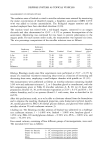
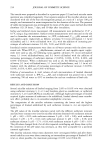
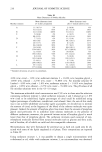
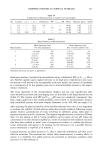
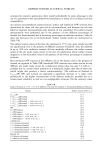
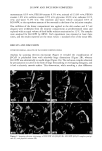
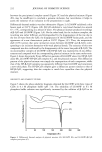
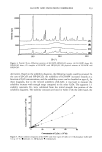
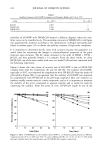
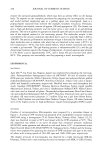
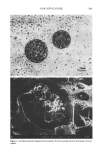
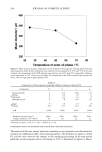
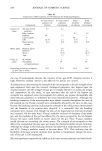
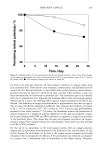
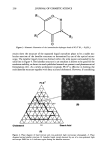
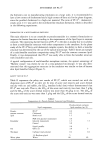
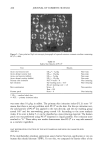
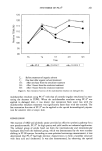
260 JOURNAL OF COSMETIC SCIENCE Figure 5. Cross-polarized light microscopic photograph of a pseudo-stratum corneum emulsion containing PC-9 s (x400). Table II Safety Test Results of PC-9 s Test Results Acute oral toxicity (rat) Acute dermal toxicity (rat) Acute oral toxicity (rabbit) Acute dermal toxicity (rabbit) Primary skin irritation Eye irritation Skin sensitization Human patch LD5o* 5 g/kg LD5o 10 g/kg LD5o 5 g/kg LD5o 10 g/kg P.I.I.** score = 0 Eye-washing score = 0.67 No eye-washing score = 4.0 Score = 0 Rate = 0% Score = 0 Non-toxic Non-toxic Non-toxic Non-toxic Non-irritating Non-irritating Non-sensitize Non-irritating * LD5o = median lethal dose. ** P.I.I. = primary irritation index. was more than 10 g/kg in rabbit. The primary skin irritation index (P.I.I.) score "0" means that there is not any problem with PC-9 s on the skin. For the eye irritation test, the solid particle of PC-9 s was applied to the eyes directly, and the eye washing group scored 0.67 and the non-washing group scored 4.0. According to the score analysis index, if its score is below 5, it can be classified as a non-irritating material. The human patch test was performed using PC-9 s dispersed in liquid paraffin. The irritation score resulted in "0." These safety test results demonstrate that PC-9 s is a very safe material as a cosmetic ingredient. FAST RESTORATION FUNCTION OF THE MULTILAMELLAR EMULSION ON DAMAGED SKIN (FIGURE 6) If the multilamellar emulsion application assists barrier function, application in vivo on human skin should decrease TEWL. To test this, we compared the barrier effect of the

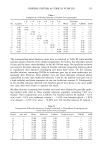
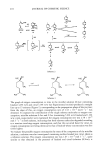
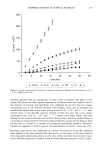
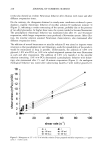
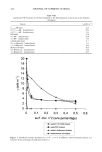
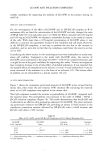
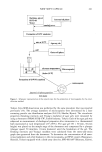
SYNTHESIS OF PC-9 s 261 125 1 20 •' 115 • 11o .- lO5 -- rr 100 95 90 Tb Ta 1 H 3H 5H Time --+--MLE •Control 1 +Control 2 Tb: Before treatment of organic solvent T•: One hour after organic solvent treatment 1H: After one hour from the emulsion treatment 3H ß After 3 hours from the emulsion treatment 5H: After 5 hours from the emulsion treatment Figure 6. Fast restoration function of the multilamellar emulsion on damaged skin. multilamellar emulsion using PC-9 s with that of controls (regular emulsions) by mea- suring the decrease in TEWL. When the multilamellar emulsion using PC-9 s was applied to damaged skin, it was shown that restoration from water loss with the multilamellar emulsion treatment was significantly faster than with the controls. The fast restoration function of PC-9 s can be applied to the special dermatological prepara- tion for sensitive skin or atopic skin. CONCLUSION The reaction of AKD and alcoholic amine provided an effective synthetic pathway for a new pseudoceramide, PC-9 s. Its high purity and yield enable an industrial application. The carbonyl group of amide bond can form the intermolecular and intramolecular hydrogen bond with the hydroxyl group, which was demonstrated by the wave number shifting in FT-IR spectra. According to cross-polarized microscopy measurement, it was determined that PC-9 s had high intrinsic characteristics to form a lameliar structure with fatty acid and cholesterol. It was also demonstrated, by observing the optical
Purchased for the exclusive use of nofirst nolast (unknown)
From: SCC Media Library & Resource Center (library.scconline.org)