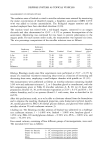
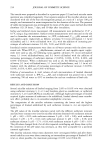
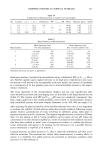
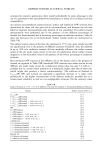
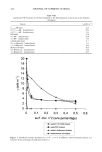
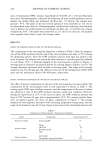
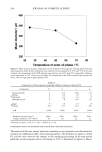
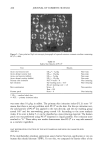
214 JOURNAL OF COSMETIC SCIENCE The inocula were prepared as described in a previous paper (12) and each microbe strain operation was completed separately. Four separate samples of the miceliar solution were inoculated with one of the four microorganism groups, at a ratio of 1 ml per 100 g of sample, and maintained at room temperature for the duration of the test. The presence of viable microorganisms was investigated by means of the plate count method described elsewhere (12) 24 hours, 7 days, and 30 days after inoculation. Surface and interfacial tension measurements. All measurements were performed at 37.0 ø + 0.1øC using a ring tensiometer. Surface tension measurements were executed on the oils used to formulate the microemulsions, i.e., IPP, n-dodecanol, C•2_•5AB , mineral oil, and caprylic-capric triglyceride, as follows: oil alone 9:1 (w:w) oil:linalool 1:1 (w:w) oil:linalool and 1:1 (w:w) oil:linalool (w:w 1:1), with the addition of increasing per- centages of surfactant mixture 2 (1.0%, 5.0%, and 10.0% w/w). Interfacial tension measurements were done on oil/water systems with the above men- tioned oils. When IPP, C•2_•5 alkylbenzoate, mineral oil, and caprylic-capric triglyc- eride were used as oils, the following ratios applied: oil/water 9:1 (w:w) oil:linalool/ water 1:1 (w:w) oil:linalool/water and 9:1 (w:w) oil:linalool with the addition of increasing percentages of surfactant mixture 2 (0.05%, 0.10%, 0.15%, 0.30%, and 0.50% w/w)/water. When n-dodecanol was used as oil, the following ratios applied: oil/water 9:1 (w:w) oil:linalool/water 1:1 (w:w) oil:linalool/water, and 1:1 (w:w) oil- linalool, with the addition of increasing percentages of surfactant mixture 2 (0.05%, 0.10%, 0.15%, 0.30%, and 0.50% w/w)/water. Dilution of microemulsions. A 4-ml volume of each microemulsion of linalool obtained with surfactant mixture 2, IPP, C•_•5AB, and n-dodecanol was poured into a vessel containing 700 ml water at 45øC to simulate the real-use conditions of bath oils. RESULTS AND DISCUSSION Several miceliar solutions of linalool ranging from 2.8% to 10.6% w/w were obtained using surfactant mixtures 1, 2, or 3 and hexylene glycol as cosurfactant, or surfactant mixtures 4, 5, or 6 and CDCNa as cosurfactant. Although higher percentages of linalool required higher amounts of surfactant to be solubilized, linalool showed some cosurfac- rant effect, probably due to its somewhat amphiphilic structure. The composition of the miceliar solutions containing the lowest and the highest percentages of linalool solubilized by each surfactant mixture (s. m.) are reported in Table I. The pH values of the miceliar solutions varied with the different surfactant mixtures used and were constant over time for miceliar solutions obtained with surfactant mixture 1: pH = 4.83 + 0.02 with surfactant mixture 2: pH = 4.62 + 0.03 with surfactant mixture 3: pH -- 4.79 _+ 0.02 with surfactant mixture 4: pH = 6.06 _+ 0.18 with surfactant mixture 5: pH = 5.74 + 0.18 with surfactant mixture 6: pH -- 5.85 _+ 0.10. The pH values changed little if at all after repeated centrifuging and freeze-thaw cycles. No correction of the pH values was necessary, as they were acceptable for a potential cosmetic application. The miceliar solutions whose mean diameters were investigated before and after three- month stability tests were those containing an intermediate percentage of linalool (5.0% w/w) or, when possible, the maximum percentage (10.0% w/w) (Table II).

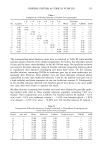
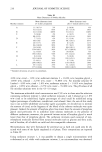
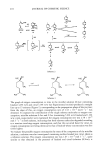
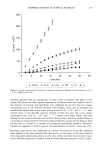
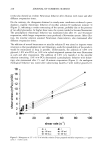
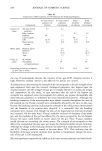
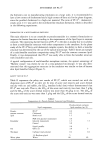
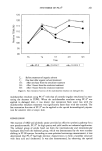
DISPERSE SYSTEMS AS TOPICAL VEHICLES 215 Table I Compositions of Micellar Solutions of Linalool (w/w percentages) s.m. s.m. s.m. s.m. s.m. s.m. Hexylene No. Linalool 1 2 3 4 5 6 Water glycol CDCNa etOH 1 2.80 8.40 .... 84.68 1.85 -- 2.27 2 5.00 14.00 .... 76.88 1.85 -- 2.27 3 2.60 -- 9.00 -- -- -- 84.28 1.85 -- 2.27 4 9.70 -- 25.50 -- -- -- 60.68 1.85 -- 2.27 5 4.10 -- -- 12.40 -- -- -- 79.38 1.85 -- 2.27 6 10.00 -- -- 26.00 -- -- -- 59.88 1.85 -- 2.27 7 3.90 -- -- -- 10.80 -- -- 82.54 -- 0.49 2.27 8 8.40 -- -- -- 20.70 -- -- 68.14 -- 0.49 2.27 9 3.20 -- -- -- 10.90 -- 83.14 -- 0.49 2.27 10 10.30 -- -- -- 26.90 -- 60.04 -- 0.49 2.27 11 3.70 .... 10.40 83.14 -- 0.49 2.27 12 10.60 .... 26.80 59.84 -- 0.49 2.27 The corresponding mean diameter values were as indicated in Table III. Each miceliar solution sample consisted of two droplet populations: the former, less abundant, around 10 nm, and the latter, more abundant, in the 40-100 nm range. No significant variation was noted in the mean diameter values of miceliar solutions containing hexylene glycol as cosurfactant after repeated centrifuging and freeze-thaw cycles. On the contrary, miceliar solutions containing CDCNa as surfactant gave rise to some opalescence im- mediately after filtration. After stability tests the mean diameters remained almost unmodified in most cases (surfactant mixtures 5 and 6) the stability tests gave rise to a high turbidity and phase separation in one case (surfactant mixture 4). Consequently, as the miceliar solutions obtained with hexylene glycol were shown to be more stable over time, they were chosen to continue the study. Micellar solutions containing both linalool and citral were obtained by partially replac- ing linalool with citral in those miceliar solutions originally containing 5.0% w/w linalool. Their compositions were as follows: For miceliar solution M: linalool -- 4.5% w/w citral -- 0.5% w/w surfactant mixture 1 = 14.0% w/w hexylene glycol = 1.85% w/w ethanol = 2.27% w/w water -- 76.88% w/w. For miceliar solution N: linalool = Table II Compositions of MiceIlar Solutions of Linalool Submitted to Three-Month Centrifuging and Freeze-Thaw Cycles (w/w percentages) System Surf. mix. Water Surfactant Linalool Hexylene glycol CDCNa etOH A 1 76.88 14.00 5.00 1.85 -- 2.27 B 2 74.88 16.00 5.00 1.85 -- 2.27 C 2 60.38 25.50 10.00 1.85 -- 2.27 D 3 76.48 14.40 5.00 1.85 -- 2.27 E 3 59.88 26.00 10.00 1.85 -- 2.27 F 4 77.04 15.20 5.00 -- 0.49 2.27 G 5 74.84 17.40 5.00 -- 0.49 2.27 H 5 60.24 27.00 10.00 -- 0.49 2.27 I 6 74.24 18.00 5.00 -- 0.49 2.27 L 6 60.44 26.80 10.00 -- 0.49 2.27
Purchased for the exclusive use of nofirst nolast (unknown)
From: SCC Media Library & Resource Center (library.scconline.org)