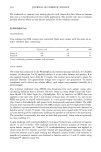
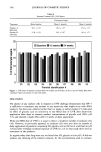
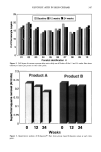
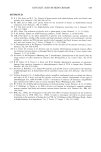
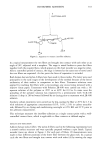
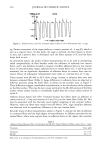
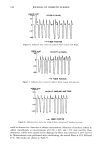
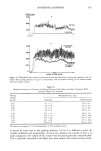
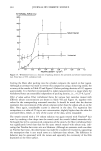
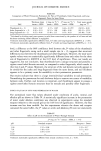
354 JOURNAL OF COSMETIC SCIENCE FORCE {p.N) O - -IO -20 UNTR. •' FIBER POSITION Figure 3. Adhesion force curves for untreated nylon-6 fibers at 65% RH (normal force -2 mg). up. Further movement of the stage produces a contact pressure of-2 mg (B), which is seen as a negative force. At that point, the stage is reversed, the force begins to return to zero, and a positive force is developed until the fibers separate at (C) and the force drops back to zero. As mentioned earlier, the results of these measurements are to be used in interpreting radial compressibility of fiber bundles under the influence of relatively low contact forces, and it was therefore decided to measure interfiber adhesion forces at low normal forces. In the preliminary stages, adhesion forces at normal forces of 2, 4, and 8 mg were measured, but no significant dependence of adhesion forces on contact force was ob- served. Hence all subsequent measurements were made at a normal force of-2 mg. Fibers treated with JR-400 at 20øC show a large increase in adhesion force over that between untreated fibers (Table I). Large differences in adhesion force are observed at different positions along the lower fiber, as shown on the recorder trace in Figure 4. These differences suggest considerable nonuniformity in the distribution of the polymer on the fiber surface. This may be due to poor wetting by the JR-400 solution of the fiber surface, whose surface tension is considerably higher than the critical surface tension of nylon-6. Adhesion between human hair j•bers. Untreated human hair fibers show no adhesion at contact forces of-2 mg and tensions of 4 and 10 g on the lower fiber (Table II). This may be associated with the relatively much higher roughness of the cuticular surface. However, when the fibers were treated with JR-400 at 20øC, high interfiber adhesion was observed with no significant difference at the two tension levels. Recorder traces of these measurements, shown in Figure 5, indicate the lack of adhesion in untreated fibers and the high degree of nonuniformity in different positions for the treated fibers, where some regions show no adhesion forces at all. Again, this variation Table I Adhesion Forces Between Pairs of Untreated and JR-400-Treated Nylon-6 Fibers (contact force -2 mg) Treatment Force (•N) Untreated 4.3 + 0.9 JR-400 9.8 + 3.2 Each entry is an average of 20 measurements at the 95% confidence level.

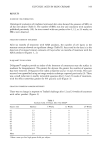
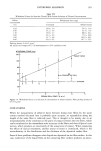
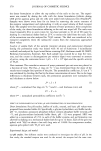
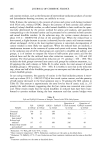
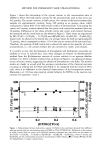
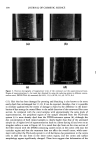
INTERFIBER ADHESION 355 FORCE 30 = 20- IO 0 -IO -20 NYLON -6- J R 400 = FIBER POSITION Figure 4. Adhesion force curves for JR-400-treated nylon-6 fibers at different positions along the fiber. Table II Adhesion Forces Between Pairs of Untreated and JR-400-Treated Human Hair Fibers (contact force -2 mg) Tension (g) 4 10 Student t Treatment Untreated 0 0 JR-400 17.2 + 6.4 12.5 + 4.2 n.s. Each entry is an average of 20 measurements at the 95% confidence level. n.s., not significant in adhesion forces with position must be attributed to the nonuniform distribution of the polymer on the surface of the hair, repeatedly observed in wettability measurements (2). To confirm these observations, measurements were repeated on four pairs of hair fibers pretreated with a dilute surfactant solution (Tr-X-100) to promote a more uniform spreading of polymer JR-400. Adhesion forces for these fibers are given in Table III. The data in Table III show large variations in the forces of adhesion from pair to pair. This may be due to different levels of pick-up of the polymer or to differences in the areas of contact as a result of the ellipticity of the fiber cross section. Surprisingly, a 0.3-ks rinse in water eliminates adhesion in all four pairs. A second polymer treatment after the rinse again gives rise to an increase in adhesion. A third treatment with JR-400 at 60øC for 0.9 ks, followed by a single dip in water, gave no adhesion forces for all four pairs. Earlier work on the substantivity of JR-400 using wettability measurements (2) has clearly shown that some of the polymer is retained after rinsing with water, even if the treatment was carried out at 20øC, and that substantivity of the polymer reaches a maximum if the treatment is carried out at 60øC. A comparison of the data in the first and second part of Table III shows that the pretreatment with a surfactant did not have any effect on the resulting adhesion forces.
Purchased for the exclusive use of nofirst nolast (unknown)
From: SCC Media Library & Resource Center (library.scconline.org)