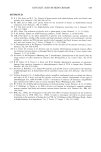
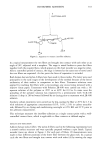
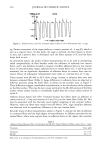
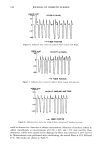
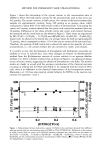
METHOD FOR PERMANENT HAIR STRAIGHTENING 397 lOO 8o 6o 4o 20- 0 o 35 a 5 10 15 20 25 30 20(degree) Figure 10. Ire • versus 2 0 curves for the untreated and the supercontracted hairs at different extents of contraction in %: , Ife• at •p 0ø Ire • at •p = 90ø (a) untreated (b) 8.4 (c) 9.9 (d) 12.5. 2 ntlt2 r o = (13) r m = n'l' (14) From equations 13 and 14, equation 15 can be derived: LRc/L m = ((ro2))•/2/rm = (n')•/21'/n'l ' = 1/(n')•/2 (15) where L m is the maximum length of the extended or-chain, namely, the [3-chain length. The pitch lengths per amino acid residue in the or-helix and the [3-pleated sheet struc- tures are 1.5 and 3.4 fk, respectively (25). Thus, we obtain equation 16: Lo•/L m = 1/(3.4/1.5) = 0.44 (16) From equations 15 and 16, equation 17 can be obtained: LRc/L = = 1/0.44(n')•/2 (17) When supercontraction is 10% and affine deformation is assumed, LRc/L = -- 0.9, and the number of segments, n', in a random chain of the network cross-linked with disulfide bonds can, therefore, be calculated to be about 6.3. The value of n' for the S-[3-cyanoethylated human hair synthesized by blocking the free thiol groups with acrylonitrile after reduction of the disulfide bonds amounted to about 86% of the total cystine content of the hair (662.5 pmol/g of hair) and has been reported to be about 6.3 for the network chains comprised of the low-sulfur (LS) proteins or the or-helix-forming proteins with a molecular weight of about 50,000 (26,27). The mo- lecular weight of the chain between the disulfide cross-links, Mc, was also determined to be 7,920. Hence, the molecular weight per segment: Mc/n' = 1,250. This value is

398 JOURNAL OF COSMETIC SCIENCE characteristic of the LS protein of hair keratin, which corresponds to about 11 amino acid residues. The number of disulfide cross-linking sites per helix-forming protein can, therefore, be estimated to be 6.3 (= 50,000/7,920). Similar characterization for the LS protein in native human hair showed that the values of n' and M c are 3.24 and 4,050. Therefore, the number of the disulfide cross-linking sites per helix-forming protein is about 12.3 (= 50,000/4,050), which corresponds to about two times (= 12.3/6.3) the number of disulfide bonds in the LS protein of the S-[3-cyanoethylated hair. The value of n' calculated for the present 10% supercontracted hair is very similar to that of the S-[3-cyanoethylated hair, which in turn is about one half the number of interchain disulfide bonds in the intact LS protein that has been reduced before being subjected to the heat treatment. Therefore, in the case of our curing treatment, when about one half the number of interchain disulfide bonds in the or-helix is disrupted in the reaction step and all of the or-helix chains are randomized in the subsequent heat treatment step, supercontraction reaches about 10%. These calculation results agree with the previous conclusion that the degree of supercontraction up to about 10% is caused by the randomization of the or-helix. REFERENCES (11) (12) (13) (14) (15) (1) R. Feinland, F. E. Platko, L. White, R. DeMarco, J. J. Varco, and L. J. Wolfram, "Hair Preparations," in Kirk-Othmer: Encyclopedia of Chemical Technology, 3rd ed., Vol. 12 (John Wiley & Sons, New York, 1980), pp. 80-117. (2) S. Ogawa, K. Fujii, K. Kaneyama, K. Arai, and K. Joko, A practical method for permanent hair straightening and the permanency related to supercontraction induced by microstructure change, Proceedings of the 4th Scientific Confirence of the Asian Societies of Cosmetic Scientists, Bali, 348-361 (1999). (3) S. Ogawa, K. Fujii, K. Kaneyama, K. Arai, and K. Joko, Theory and its practical application for permanent hair straightening, J. Soc. Cosmet. Chem. Japan, 34, 63-71 (2000). (4) M. Wong, G. Wis-Surel, and J. Epps, Mechanism of hair straightening, J. Soc. Cosmet. Chem., 45, 347-352 (1994). (5) A. R. Haly and J. W. Snaith, Differential thermal analysis of wool•The phase transition endotherm under various conditions, Textile Res. J., 37, 898-907 (1967). (6) J. s. Crighton and E. R. Hole, A study of wools in aqueous media by high pressure differential thermal analysis, Proceedings of the 7th International Wool Textile Research Conference, Tokyo, 1, 283-292 (1985). (7) F.-J. Wortmann and H. Deutz, Characterizing keratins using high-pressure differential scanning calorimetry, J. Appl. Polym. Sci., 48, 137-150 (1993). (8) J. Cao, K. Joko, and J.R. Cook, DSC studies of the melting behavior of ix-form crystallites in wool keratin, Textile Res. J., 67, 117-123 (1997). (9) R.S. Asquith and W. H. Leon, "Chemical Reactions of Keratin Fibers," in Chemistry of Natural Protein Fibers, R.S. Asquith, Ed. (Plenum, New York, 1977) pp. 193-265. (10) K. Arai, N. Sasaki, S. Naito, and T. Takahashi, Cross-linking structure of keratin. I. Determination of the number of cross-links in hair and wool keratins from mechanical properties of swollen fiber, J. Appl. Polym. Sci., 38, 1159-1172 (1989). K. Ziegler, "Crosslinking and self-crosslinking in keratin fibers" in Chemistry of Natural Protein Fibers, R.S. Asquith, Ed. (Plenum, New York, 1977), pp. 267-300. M. A. Manuszak, E. T. Borish, and R. R. Wickerr, The kinetics of disulfide bond reduction in hair by ammonium thioglycolate and dithiodiglycolic acid, J. Soc. Cosmet. Chem., 47, 49-58 (1996). J. Koga, K. Joko, and N. Kuroki, Dye uptake by supercontracted wool fiber, Sen'i GakkaishL 42, T685-69! (1986). C.R. Robbins, "Dyeing Human Hair" in Chemical and Physical Behavior of Human Hair, 2nd ed. (Springer-Verlag, New York, 1988), pp. 171-198. D. Weigmann, L. Rebenfeld, and C. Dansizer, Kinetics and temperature dependence of the chemical stress relaxation of wool fibers, Text. Res. J., 36, 535-542 (1966).
Purchased for the exclusive use of nofirst nolast (unknown)
From: SCC Media Library & Resource Center (library.scconline.org)