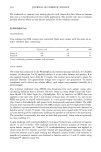
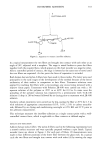
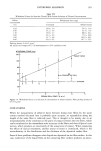
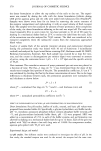
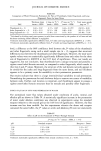
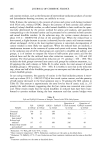
360 JOURNAL OF COSMETIC SCIENCE Table IV Adhesion Forces Between Pairs of Nylon-6 and Human Hair Fiber Treated With Various Liquids Liquid surface tension Treatment (pN/m) Force (pN) Nylon-6 Human hair Observed Calculated Untreated 2.8 + 0.7 0.1 + 0.1 Nujol 35 7.0 + 0.3 6.3 6.6 + 0.3 Untreated 2.8 + 0.6 -- Glycerol 64 6.4 + 0.6 11.5 -- Untreated 1.6 + 0.8 0 Vaseline hair tonic 31 5.6 + 0.2 5.6 13.9 + 0.7 8.1 _+0.2 Based on contact perimeter of 180 pm. All entries are averages of 20 measurements at 95% confidence level. Table V Adhesion Forces Between Pairs of Human Hair Fibers Treated With Synthetic Sebum Adhesion force (pN) SSB concentration (%) Pair 1 Pair 2 0 0 0 0.5 7.2 + 0.9 10.0 + 1.7 0 1.1 + 0.6 0.4 + 0.4 1.0 2.2 + 0.7 4.7 + 1.2 0 0 0 1.5 5.2 + 0.8 7.0 + 0.9 All entries are averages of 20 measurements at 95% confidence level. measure the force of adhesion acting on a fiber resulting from its longitudinal contact with other parallel fibers in an assembly. Although this method is not as controlled as the single-point contact method, the results seem to correlate better with the assembly behavior. It should be noted that the concept for this method is not new. Denby and Andrews (4) measured forces of withdrawal of single fibers from wool fabrics to interpret felting behavior. EXPERIMENTAL The apparatus used for the measurement of "dynamic" interfiber adhesion is shown in Figure 11a. The hair assembly is packed into an aluminum cylinder (40-mm long, 15-mm diameter), with a single hair partly pulled out and attached to a hook with Duco © cement as shown in Figure 1 lb. Direct attachment of the fiber to the hook of a Cahn recording electrobalance gives rise to a noisy zero line when the system is at rest. It appears that small vibrations are directly transmitted to the balance beam by the single hair, but interposing a fine Kevlar © monofilament between hair and hook elimi-

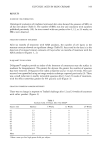
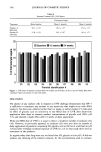
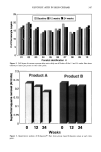
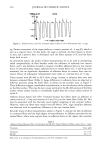
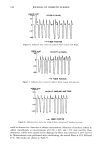
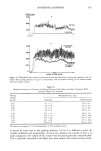
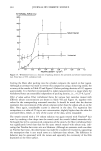
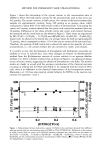
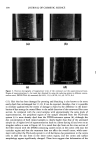
INTERFIBER ADHESION 3 61 RECORDING ELECTROBALANCE ,---SINGLE HAIR O mmx 15 mm I Tnchworm STAGE Hook -----m.. Fine Kevlor © •,• Filoment Figure 11. Apparatus for interfiber adhesion measurement by the pull-out method. nated this problem. The force of withdrawal was recorded while the "Inchworm" stage (Burleigh Instruments, Inc.) was moving downwards. In each measurement, about 5 mm of the fiber were pulled out of the bundle. The nature of the curve depends on the treatment of the assembly and will be discussed in detail below. The recorder trace was integrated electronically to obtain an average force acting on the fiber. RESULTS AND DISCUSSION Adhesio, force carves. The force of withdrawal of a fiber from a fiber bundle is a function of the number of points of contact and the normal force acting at these points. Since the number of points of contact is dependent on the length of the fiber in contact with the assembly, the force would be expected to decrease as the length of the fiber withdrawn increases. However, in these studies the length of fiber withdrawn (5 mm) is too short to have a perceptible effect on the withdrawal force. Occasionally such a decrease is indeed observed, but not often enough to take it into consideration. The dependence of the withdrawal force on the normal force acting at the points of contact should result in an increase in the withdrawal force as the number of fibers in the cylinder, i.e., the packing density, increases, provided the number of contact points remains constant. Although an increase in force is clearly seen in the force curves shown in Figure 12, it cannot be attributed to an increase in normal force. This aspect is further discussed below. It should be noted that these forces of interfiber friction cannot be used to obtain frictional coefficients, since the normal force and the number of contact points are not known. The nature of the force curve is altered considerably by changing the fiber geometry, by "perming" for example, or by surface treatments. Untreated clean fibers show low forces of withdrawal with a faint stick-slip pattern (Figure 12), which is accentuated by increasing fiber packing density. Setting the hair in a wavy pattern (wavelength 2-4 cm) by reduction (perming) results in a pronounced stick-slip pattern and an overall increase
Purchased for the exclusive use of nofirst nolast (unknown)
From: SCC Media Library & Resource Center (library.scconline.org)