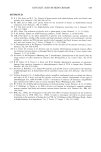
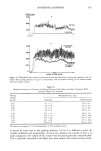
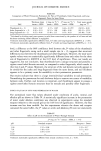
METHOD FOR PERMANENT HAIR STRAIGHTENING 383 RESULTS AND DISCUSSION REACTIONS OCCURRING IN CURING TREATMENT The effects of the curing treatment on the chemical composition of hairs were investi- gated. Table I shows the amino acid contents of the untreated and the typical cured hair samples obtained by applying various reducing systems. The cystine contents of the three different kinds of untreated samples used were considerably different among the samples. Samples A and B were used for elucidating the difference in chemical changes occurring in the curing treatment using TGA only, without DTDG, and sample C was used for a biocomponent system including DTDG. It can be known that for the cured samples the amino acid content, other than cystine and cysteic acid, was substantially unchanged. It is important to note that the half-cystine plus cysteic acid and lysine contents were approximately the same in the before and after treatments, Here, the cystine content was represented conveniently as half-cystine, which is defined by the molar fraction of cysteine residues. This suggests that the reactions occurring in the curing treatment are apparently simple, and many complex reactions related to cystine Table I Amino Acid Compositions of Untreated and Cured Hairs • Hair samples A B C Treatment Untreated Treated 2 Untreated Treated 2 Untreated Treated 3 Treated 3 Reduction, DTDG:TGA -- 0:7 -- 0:7 -- 2:5 3:8 He• treatment temp. (øC) -- 180 -- 220 -- 180 180 Asp 321 285 399 395 326 318 314 Thr 304 306 445 505 343 361 335 Ser 628 627 712 786 513 562 479 Glu 618 616 821 921 666 707 666 Gly 310 320 370 412 283 286 283 Ala 242 249 302 341 231 235 234 1/2CyS 540 489 929 916 662 602 570 CySO3H 19 82 24 74 38 114 109 VM 161 182 321 373 278 245 283 Met 87 109 49 55 50 40 43 lie 60 80 152 178 138 126 148 Leu 289 307 393 438 310 327 323 Tyr 156 168 143 142 113 117 112 Phe 90 99 105 119 87 92 94 Lys 99 99 160 174 118 109 115 His 93 104 67 85 50 51 51 Arg 251 246 381 431 301 304 306 Pro 241 252 321 385 283 299 276 1/2CyS+ CySO3H 559 571 953 990 700 716 679 Values given in 1• mol per gram. Reduction: TGA-only system, pH 9.20 45øC, 15 min. Oxidation: 7% NaBrO• 35øC, 15 min. Reduction: DTDG/TGA bicomponent system, pH 9.30 45øC, 15 min. Oxidation: 7% NaBrO3 35øC, 5 min.

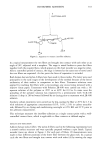
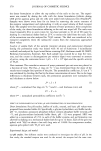
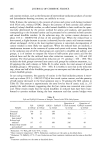
384 JOURNAL OF COSMETIC SCIENCE and cysteine residues, such as the formation of intermediate oxidation products of cystine and lysinoalanine-forming reactions, are unlikely to occur. Table II shows the variation in the contents of cystine and cysteic acid during treatment with TGA only, without DTDG. Despite the presence of both cysteine and carboxy- methyl-3-alanyl disulfide residue, so-called mixed disulfide in hair could not be quan- titatively determined by the present method for amino acid analysis, and quantities corresponding to the decreased cystine can be presumed to be converted to both cysteine and mixed disulfide residues. In the reduction step, the cystine content decreases to about 33% [= 100(89/270)] of that of the untreated hair. When the reduced hair is heat-treated, a slight decrease in cystine is observed, but the cysteic acid content remains almost unchanged. As far as the heat treatment process is concerned, decomposition of cystine residues is most likely not significant. When the reduced hairs are oxidized, a simultaneous increase in the contents of cystine and cysteic acid occurs. Assuming that in the oxidation step all of the thiol groups are converted to disulfide and sulfonic acid groups, it is of interest to compare the values of half-cystine plus cysteic acid for the reduced hairs and for the oxidized hairs after reduction treatment, i.e., 189 and 360 pmole/g. The thiol groups produced by reduction are 171 pmol/g (= 360 - 189). This includes the thiol groups converted into cysteic acid groups by oxidation treatment, i.e., 48 pmole/g (the sixth column in Table II). In other words, the total amount of mixed disulfide groups is 199 pmol/g (= 559 - 360). It is worthy to note that in the reduction step, about one half of the disulfide groups goes to mercaptan and the other half goes to mixed disulfide groups. In our curing treatment, the quantity of cystine in the final oxidation process is recov- ered up to about 91% [-- 100(245/270)] of the initial cystine content, and the quantity of half-cystine decreased in the final oxidation step is 50 pmol/g (the fifth column in Table II). This amount is approximately the same level as that of cysteic acid, i.e., 63 pmol/g (the sixth column), suggesting that the lost cystine was converted into cysteic acid. These results imply that the mixed disulfides in reduced hairs have been trans- formed to cysteine residues during the heat treatment and that cystine bridges were Table II CyS and CySO3H Contents of Samples Treated with TGA-Only System CyS CySO3H Samples (p mol/g) (p mol/g) Quantities of Quantities of 1/2CyS + CySO3H 1/2CyS decreased CySO•H increased (p mol/g) (p tool/g) (p mol/g) Untreated 270 19 559 -- -- Reduced • 89 12 189 362 -7 Reduced and heat-treated 2 78 18 174 384 - 1 Reduced and oxidized • 147 67 360 246 48 Reduced heat-treated and oxidized 4 245 82 571 50 63 • Reduction: 7% TGA, pH 9.20 45øC, 15 min. 2 Heat treatment temperature: 180øC. Reduction conditions are the same as described above. 3 Oxidation: 7% NaBrO3 35øC, 15 min. Reduction and heat treatment conditions are the same as described above. 4 Treatment conditions are the same as described above.
Purchased for the exclusive use of nofirst nolast (unknown)
From: SCC Media Library & Resource Center (library.scconline.org)