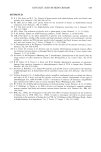
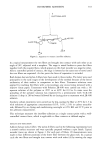
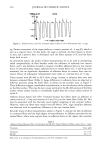
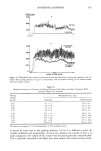
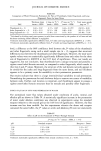
3 5 8 JOURNAL OF COSMETIC SCIENCE FORCE [•N) c IO -IO NYLON-6- NUJOL • FIBER POSITION Figure 6. Adhesion force curves for nylon-6 fibers treated with Nujol. FORCE (•.._N) I0 0 -I0 -20 - NYLON-6-GLYCEROL '-'•FIBER PosmoN Figure 7. Adhesion •rcecurves •rnylon-6 fiberstreated with glycerol. FORCE(..•u.N) I0 - ø t -!0 I NYLON-6- VASELINE HAIR TONIC -• FIBER POSITION Figure 8. Adhesion force curves for nylon-6 fibers treated with Vaseline hair tonic. could be observed as a function of sebum concentration. Solutions of synthetic sebum in carbon tetrachloride at concentrations of 0.5%, 1.0%, and 1.5% were used for these treatments, which were carried out by dipping the fibers into solutions at 20øC for 0.9 ks. Measurements were performed after conditioning the treated fibers at 65% RH and 21 øC. The results are shown in Table V.

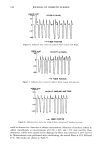
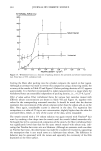
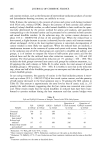
INTERFIBER ADHESION 3 5 9 FORCE {p. ,N) IO- UNTR. 0 -I0 -20 N UJOL Figure 9. Adhesion force curves for human hair fibers treated with Nujol. FORCE {u.N) 20:- iO UNTR. 0 -I0 -20 VASELINE HAIR TONIC --• FIBER POSITION Figure 10. Adhesion force curves for human hair fibers treated with Vaseline hair tonic. Variations in the adhesion forces are smaller than those observed in the case of Polymer JR-400-treated fibers. Since synthetic sebum is an oily material, the mechanism of adhesion seems to be guided by the surface tension of the liquid. There does not seem to be a consistent effect of concentration. This may be due to insignificant variations in add-on, although it should be noted that in treatments of hair swatches significant differences in add-on were obtained by changing the concentration of the treating liquid. However, in the treatment of fiber assemblies, solution is held between fibers by cap- illary forces, an effect that is not possible on single fibers. PART II: DYNAMIC PULL-OUT FORCE MEASUREMENT Although the method of measuring adhesion forces during static point contact between two fibers, which is described above, works satisfactorily when the surface films are continuous and the forces acting between the fibers at the point of contact are capillary forces, it was shown to be inadequate in our efforts to establish correlations between adhesion and compressibility parameters (3). Because of the parallel alignment of the fibers in a hair swatch, the forces of interfiber adhesion could be quite high, since a large number of contact points are involved. We have therefore developed a method to
Purchased for the exclusive use of nofirst nolast (unknown)
From: SCC Media Library & Resource Center (library.scconline.org)