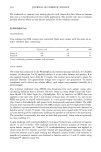
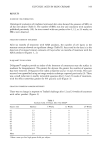
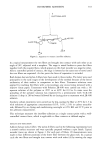
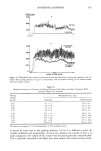
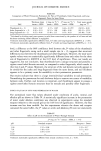
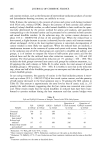
352 JOURNAL OF COSMETIC SCIENCE Figure 1. Interfiber adhesion apparatus of Kul and Smith (1). perimeter and the surface tension of the oil. However, the measured forces were three to five times higher than those calculated. The drawback of the method is that the normal force with which the fibers are brought together is not controlled, and hence the reproducibility of contact is poor. An attempt has therefore been made to develop a method for measuring forces of interfiber adhesion by a modification of the above technique. The ultimate aim is to be able to measure forces of interfiber adhesion that are relevant to the radial compression of hair assemblies as experienced during hair body evaluations. We have also investigated a dynamic pull-out method that gives a realistic force of interfiber cohesion in a fiber assembly. These are described separately in Parts I and II of this communication. PART I: SINGLE-POINT CONTACT ADHESION FORCE MEASUREMENT EXPERIMENTAL The apparatus developed for the interfiber adhesion force measurement is shown sche- matically in Figure 2. One of the fibers is mounted on a bow that in turn is mounted on the weighing arm of a Cahn recording electrobalance and tared to zero. The other fiber is hung horizontally over two glass rods that are supported by a dish. Two equal weights are mounted on each end of the fiber to keep it taut in the work reported here, 2- and 5-g weights were used. The dish with the fiber mounted on the glass rods is placed on a reversible stage (Burleigh Instruments Inc.) that moves up or down at a controlled rate (-3.0 lam/s).

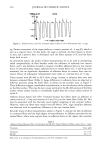
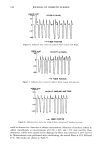
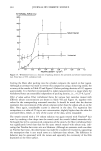
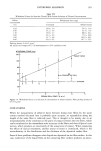
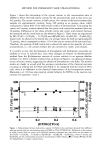
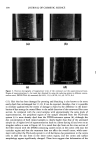
INTERFIBER ADHESION 3 5 3 ELECTROBALANCE GLASS ROD Figure 2. Apparatus to measure interfiber adhesion. In a typical measurement the two fibers are brought into contact with each other at an angle of 90 ø, adjusted with a template. The stage is raised further to press the fibers together with the required force, which appears on the chart recorder as a negative value. After a controlled period of contact, the stage is lowered at the same rate of travel until the two fibers are separated. At this point the force of separation is recorded. Both human hair and nylon-6 fibers have been used in these studies. The latter were used principally in the early stages of the development of the method because of the better uniformity of their surface in comparison to hair fibers. Treatment solutions were applied by touching the fibers with a microsyringe, any excess being removed with a sorptive tissue paper. Treatments with Polymer JR-400 were carried out with a 1% aqueous solution of the polymer at 20øC or at 60øC for 0.9 ks. In some cases the spreading of the polymer solution was improved by a pretreatment with Tr-X-100 solution (1 drop in 200 ml water) followed by air drying prior to treatment with JR-400 solution. Synthetic sebum treatments were carried out by dip-coating the fiber at 20øC for 1.5 ks with solutions of appropriate concentrations (0.5%, 1.0%, 1.5%) in carbon tetrachlo- ride, followed by air drying and conditioning overnight at 65% RH and 21øC prior to the adhesion measurement. This technique measures the interfiber adhesion at a single contact point with a well- controlled contact force, which is applicable to fiber contacts at defined angles. RESULTS AND DISCUSSION Adhesion between nylon-6fibers. The nylon-6 fibers used in the following experiments have a smooth surface structure and were specially prepared without a spin finish. Typical recorder traces are shown in Figure 3. For each pair of fibers, 20 measurements were made in four different positions of the lower fiber between the glass rods. In a typical cycle the two fibers are brought into contact with each other (A) by moving the stage
Purchased for the exclusive use of nofirst nolast (unknown)
From: SCC Media Library & Resource Center (library.scconline.org)