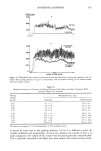
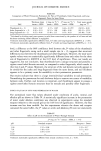
METHOD FOR PERMANENT HAIR STRAIGHTENING 387 Figure 1 shows the relationship of the cystine content to the concentration ratio of DTDG to TGA. The half-cystine content for the untreated hair used in this series was 662 pmol/g. The cystine contents, as half-cystine, for a variety of the heat-treatment hair samples are approximately constant, being 589 pmol/g as an average value, which corresponds to about 89% of the half-cystine content of untreated hair. Concerning the cysteic acid content, analysis showed that the cysteic acid content for untreated hair was 38 pmol/g. Differences in the values of both cystine and cysteic acid contents between the untreated and the cured hairs are also shown in Figure 1. These values are represented by A[1/2CyS] (=[1/2CyS] o - [1/2CyS]) and A[CySO3H] (=[CySO3H] - [CySO3H]o) , respectively. As shown by the dotted line, the average values for both are approximately 75 pmol/g, which corresponds to about 11% of the cystine content of the untreated hair. Therefore, the quantity of half-cystine lost is almost the same as the quantity of cysteic acid produced, i.e., the cystine residues lost are converted to cysteic acid residues. It is worthy to note that the formation of lysinoalanine and lanthionine cross-links are unlikely to occur in reduced hair, since these linkages are formed via dehydroalanine residues from the [3-elimination reaction of cystine residues in an aqueous alkaline medium (11). There is further evidence that, as shown in Figure 1, no substantial change occurs in lysine content, suggesting the absence of lysinoalanine cross-links. The present results are clearly in accord with the previous consideration of the chemical reactions occurring in reduced hair for TGA only (Table I). As compared with the result of TGA only, there is no difference in the chemical characteristics of the bicomponent system. Manuszak et al. (12) have also reported similar behavior for DTDG in the reaction rate constant for equations 3 and 4. 800 400 600 400 2oo o o 300 ! ! ! 0.2 0.4 0.6 lOO o [DTDG]/[TGA] Figure 1, Relationships between half-cystine content [1/2CyS] of the cured hairs obtained from different reducing systems and the concentration ratios of DTDG to TGA (DTDG:TGA). Differences in the content of either cystine (CyS) or cysteic acid (CySO3H) between untreated and cured hairs are also shown as A[1/2CyS] = ([1/2CyS] o - [I/2CyS]) or A[CySO3H] = ([CySO3H] - [CySO•H]o), where [1/2CyS] o and [CySO3H] o are the corresponding contents of untreated hair: (¸) [1/2CyS]o, (O) [1/2CyS], (ß) A[1/2CyS], ([•) A[CySO3H ]. (O) lysine content [Lys].

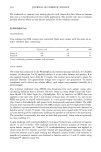
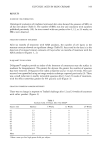
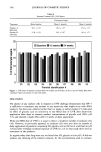
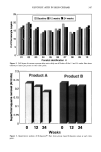
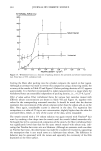
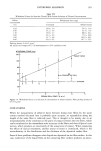
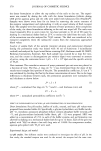
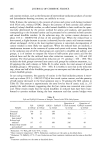
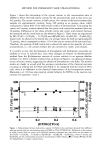
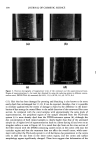
388 JOURNAL OF COSMETIC SCIENCE RELATIONSHIP OF SUPERCONTRACTION TO THE DEGREE OF HAIR STRAIGHTENING Table IV shows the relationship of hair supercontraction to the degree of hair straight- ening at different concentration ratios of DTDG to TGA. The results show that per- manent hair straightening is achieved by supercontraction above 5 % but that the surface smoothness is lost by a higher contraction of about 15%. In a practical application, a range of about 5 % to 8% supercontraction of hair has been recommended from the point of view of the mechanical property relationships (3). Figure 2a shows the relationship between the percentage of supercontraction, L c and the concentration ratio of DTDG to TGA. An approximately straight line is obtained for both reducing systems at pH 9.20 and 9.30, although the plots show scatter. The Lc decreases gradually with the increase of the concentration ratio. For TGA only, the values of L• are markedly dependent on the concentration of TGA and pH. Figure 2b shows the relationship of L• to the time of reduction using the bicomponent system in the concentration ratio of 1:5 and at pH 9.30. The curve initially increases gradually until about 25 rain reduction time, and then steeply increases. These results show that the extent of supercontraction is clearly dependent on the extent of reduction, which may be dependent not only on the chemical equilibria as expressed by. equations 3 and 4, but also on the rate of diffusion of the component molecules into the reducing sites of the structure controlling the supercontraction. It is of interest that the physical phenomenon of supercontraction is greatly affected by the reducing systems used, in spite of their small differences (Figure 1). DYEING TESTS FOR DAMAGE OF CURED HAIR Figure 3 shows the scanning electron micrographs in the longitudinal direction of the untreated and cured hairs. Less damage to the cuticles is observed on the fiber obtained Table IV Relationship of Hair Supercontraction to Degree of Hair Straightening Concentration ratio pH 9.20 pH 9.30 Calculated Lc • Degree of hair Lc • DTDG:TGA value (%) straightening 2 (%) Degree of hair straightening 2 0:5 0 18.0 Surface smoothness was lost 21.1 0:4 0 7.8 Complete/permanent 14.73 0:3 0 0.5 None 8.53 1:3 0.33 -- -- 7.9 1:4 0.25 -- -- 8.8 1:5 0.2 9.9 Complete/permanent 8.43 2:5 0.4 6.6 Complete/permanent 5.5 3:5 0.6 4.6 Partial/temporary 5.4 1:6 0.167 8.5 Complete/permanent 8.7 2:7 0.286 7.5 Complete/permanent -- 3:8 0.375 7.0 Complete/permanent 8.9 2:9 0.22 -- 9.9 4:9 0.44 4.0 Partial/temporary 8.4 Surface smoothness was lost Surface smoothness was lost Complete/permanent Complete/permanent Complete/permanent Complete/permanent Complete/permanent Complete/permanent Complete/permanent -- Complete/permanent Complete/permanent Complete/permanent Straight hair samples were used. Kinky hair samples were used. Samples were used for dyeing.
Purchased for the exclusive use of nofirst nolast (unknown)
From: SCC Media Library & Resource Center (library.scconline.org)