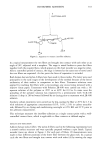
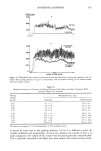
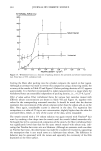
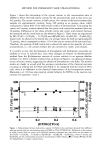
METHOD FOR PERMANENT HAIR STRAIGHTENING 393 samples, a broad exothermic peak ranging from about 100 ø to 160øC can be observed on each PDSC curve, although the exotherm is absent from the untreated sample. The correlation between the magnitudes of the exothermic and endothermic peak areas is uncertain. However, it seems that in the series of the bicomponent system, except for sample d, the smaller the endothermic area of the melting peak, the larger the exother- mic area. The evolution of heat in the exotherm increases with decreasing o•-helix content and is likely concerned with the randomization of the keratin chains or the thermal stability of the cross-linked structure of the cured hair. It has been shown (2,3) that the exothermic peak disappears for the PDSC samples of cured hairs pretreated by soaking in an aqueous solution of 10 -2 M of N-ethylmaleimide as a strong blocking agent for the free thiol groups in keratin fibers (15,16). When hairs are reduced to break down the disulfide bonds and subsequently oxidized to reform the disulfide bonds in new positions on the randomized chains, internal strains may occur within the network structure under the conditions of relatively high-speed drying. For a moderate condition such as raising the temperature of the hair sample enclosed in the PDSC pan, the keratin chain commences the molecular motion near Tg, and the strain energy stored in the network chains is dissipated by the mechanical scission of disulfide bonds to generate thiyl radicals (17). The radicals may transform to thiol groups through hydrogen abstraction from the environment. It is reasonable to consider that the thiol groups are oxidized into disulfide bonds or sulfonic acid groups in the presence of air and absorbed water in the PDSC sample pan, resulting in an exothermic response. A detailed report on this mechanism will be presented in the future. 2O 15 [] 0 5 10 15 AH m (J/g) Figure 6. Relationship between the degree of supercontraction, Lc, and the enthalpy of melting, AH•n: (¸) untreated hair, ([•) cured hairs obtained by using various reducing systems.

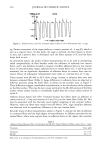
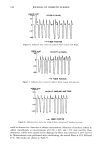
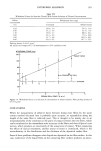
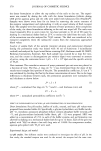
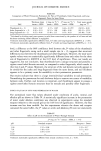
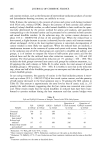
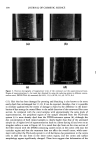
394 JOURNAL OF COSMETIC SCIENCE Figure 6 shows the relationship of supercontraction, L c to the enthalpy of melting, AH•n. An approximately linear relationship is obtained. The intercept of the straight line extrapolated to the Lc axis is about 10%. For higher values than this, the smoothness of the hair surface and even the circular shape of the fiber tend to be lost, as shown in Figures 3 and 4. This indicates that the supercontraction within about 10% is respon- sible for the breakdown of the tx-crystallites. On the contrary, the higher contractions follow unwanted alterations resulting from the changes in the matrix components in the cortex as well as in non-keratin components in the cell membrane complex. DEGREE OF CRYSTALLINITY OF CURED HAIR Figure 7 shows the x-ray diffraction photographs of the untreated hair (a) and the cured hairs supercontracted up to 8.4% (b) and 12.5% (c). For the untreated hair, the reflection characteristic of tx-keratin fibers appears in the equatorial spot at 0.98 nm and in the meridianal arc at 0.51 nm. It can be observed, however, that for the supercontracted fiber no discrete reflection exists on a diffused scattering ring near 1 nm, suggesting that the tx-crystallites were either changed in part into amorphous materials or crystallites ar- ranged in an unoriented state or both. To demonstrate the crystal forms and the degree of crystallinity in further detail, x-ray diffraction analyses were carried out accoMing to the method reported by one of the present authors (18,19). Figure 8 shows the scattering intensities from the untreated hair at azimuthal angles at q = 0 ø, 75 ø, and 90 ø in the range of the Bragg angles, 2 0 from 5 ø to 30 ø. It has been shown that for keratin fibers, the diffracted intensity from the amorphous materials is based on the azimuthal angle at q = 75 ø. The degree of crystallinity can be estimated by using equation 12: 100(Ato t - Aamor)/Ato t (12) where hto t is the total area under the curve of the diffracted intensity at 2 0 = 5 ø to 30 ø, and Aamor is the corresponding area under the base line. The degree of crystallinity was estimated to be 29.0%. From a similar treatment of the intensity curves for the cured hair shown as an example in Figure 9, the corresponding values obtained were 16.0%, 12.2%, and 5.8% for the supercontracted fibers at 8.4%, 9.9%, and 12.5%, respectively. This suggests that the amount of crystalline material decreases considerably with in- (a) (b) (c) Figure 7. High-angle x-ray diffraction photographs of the untreated and the supercontracted hairs at different extents of supercontraction, L o in %: (a) untreated, (b) 8.4, (c) 12.5.
Purchased for the exclusive use of nofirst nolast (unknown)
From: SCC Media Library & Resource Center (library.scconline.org)