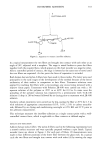
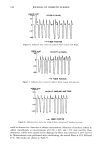
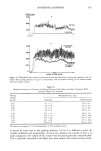
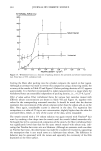
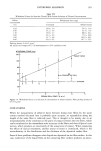
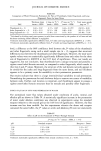
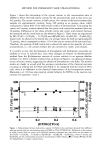
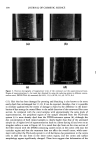
METHOD FOR PERMANENT HAIR STRAIGHTENING 395 250 200 150 100 5O 1 3 2 1 I I I i I i I 0 5 10 15 20 25 30 35 20(degree) Figure 8. X-ray diffraction intensities versus 2 0 curves for the untreated hair. Curves 1, 2, and 3 denote the azimuthal angels at q• = 0 ø (equator), 75 ø, and 90 ø (meridian), respectively. creasing supercontraction. A minor difference either between the diffracted intensities or the diffraction angles due to structural changes occurring in keratin containing a large amount of amorphous material cannot be easily detected in the curves of these simple diffraction traces. In fact, as seen in Figure 9, there is an uncertainty for the existence of the reflection from the [•-crystal at 2 0 = 19.1 ø. A reliable quantitative treatment has been performed by introducing an approximation of the relative intensity defined as an index of the x-ray intensity diffracted from the crystallites in the fibers (19). The relative intensity, Ire•, was calculated as the ratio of the intensity diffracted from the cured hairs to that from the untreated fiber. Here, Ire• = 100(Icr/Ic•O), where Ic• is the intensity above the amorphous baseline at a given spacing, and Icr ø is the intensity in the 0.98-nm equatorial or-reflection (2 0 = 9.6 ø) for the untreated hairs. The results are shown in Figure 10. The intensity of the meridianal diffraction at 0.51 nm (2 0 -- 17.4 ø) corresponds to about a quarter of the intensity at 0.98 nm. It is noted that for the cured hairs supercontracted up to 8.4%, 9.9%, and 12.5% as typical samples already shown, (i) the equatorial peak positions are shifted by 2 0 = 9 ø from 2 0 = 9.6 ø observed for the untreated fiber (ii) the intensities near 2 0 = 9 ø drop up to about 47.0%, 33.2%, and 13.4% for the respective samples (iii) the 0.51-nm or-reflections disappear, sug- gesting less ordered situations of the ot-helices and (iv) the [•-reflections at 0.465 nm (2 0 = 19.1 o) appear in about 12%, -0%, and 7%, respectively. In the x-ray photographs in Figures 7b and 7c, more or less unoriented [•-reflections can be differentiated from the

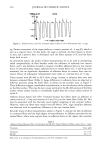
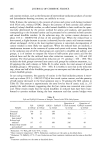
396 JOURNAL OF COSMETIC SCIENCE 200 150 1oo 50 2,3 I I I I I I I 0 5 10 15 20 25 30 35 20(degree) Figure 9. X-ray diffraction intensities versus 2 0 curves for the supercontracted hair at 8.4%. Curves 1, 2, and 3 denote the azimuthal angles at q• = 0% 75 ø, and 90 ø (approximately the same as the curve at q• = 75ø), respectively. amorphous diffused ring (as an arc pattern in the case of the latter). Returning to the diffraction curves in Figure 10, the [3-reflection is unlikely to always occur in the supercontracted fibers. No distinct reflection near 2 0 = 19 ø can be recognized on the I•e 1 versus 2 0 curve of the 9.9% contracted fiber. The equatorial reflection in the vicinity of 2 0 = 9 ø includes the components of reflections from both the o•- and [3-crystallites (20). This means that the intensity at 0.98 nm is not proportional to the content of the o•-crystallites in fibers. It can be expected, therefore, that the relative o•-content is less than the maximum intensity value near 2 0 -- 9 ø for the supercontracted fibers shown in Figure 10. Whether the [3-crystallites originate from the deformed o•-helices or from the matrix segments remains unresolved (19,21,22). This makes it difficult to interpret the results of the present x-ray analyses. In any way, permanently straightened hairs with about 5% to 8% supercontraction might provide a variety of forms of protein chains cross-linked with each other by disulfide bonds. Although it is difficult to determine precisely the amount of each material in crystalline and random coil forms, it can be presumed that most of the o•-helices are transformed into random coil chains by super- contraction up to about 10%, as suggested by the L c versus A H m plot. The permanency related to hair straightening seems to be a result of the irreversible transformation of o•-crystal into the amorphous phase. It is of interest to demonstrate the relationship of the length of the o•-crystallites cross-linked with disulfide bonds, L w to the length of random chains in the network after randomization of the o•-helical chains, Li• c. The mean square length, (ro2), and the maximum length, rm, for the random chains are represented in terms of the segment length, 1', and the number of segment, n' as in equations 13 and 14 (23,24):
Purchased for the exclusive use of nofirst nolast (unknown)
From: SCC Media Library & Resource Center (library.scconline.org)