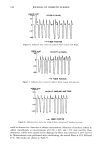
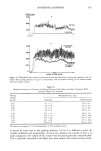
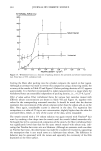
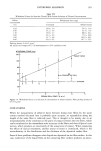
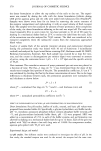
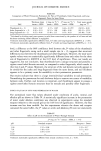
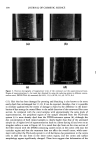
METHOD FOR PERMANENT HAIR STRAIGHTENING 391 (a) (c) (d) Figure 4. Optical micrographs of cross-sectional views of the untreated and the supercontracted hairs dyed with acid black. The samples are the same as described in Figure 3. cell membrane complex in both cuticlar and cortical cells occurs. It should be empha- sized that the present test method of dyeing is a useful technique to characterize hair damage induced by chemical and physical treatments, especially for the peripheral regions of fiber. It is further important to note that as compared with the TGA-only system, the reducing system including DTDG gives much less damage to the fiber. RELATIONSHIP OF SUPERCONTRACTION TO THE AMOUNT OF tx-CRYSTALLITES Figure 5 shows the PDSC curves of the cured hair s,amples. The PDSC response of the untreated hair is designated as curve a, whereby a sharp peak can be observed at about 183øC, which is ascribed to the melting or denaturation of the c•-crystallites (6,7). For the sample obtained from the TGA-only system, there is no significant endotherm, as

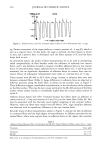
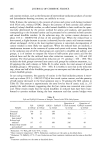
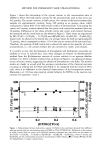
392 JOURNAL OF COSMETIC SCIENCE (a) (b) (c) (d) (e) (f) (g) (h) (i) 142 176 183 100 150 200 Temperature(øc) Figure 5. PDSC responses for the untreated hairs and the cured hairs prepared by using various reducing systems at pH 9.20 and, in different concentration ratios, DTDG:TGA (parentheses show the calculated value corresponding to the concentration ratio), followed by the values of the extent of supercontraction, L o in %: (a) untreated hair (b) 0:5 (0), 18.0 (c) 1:6 (0.167), 8.5 (d) 1:5 (0.2), 9.9 (e) 2:7 (0.286), 7.5 (O 3:8 (0.375), 7.0 (g) 2:5 (0.4), 6.6 (h) 4:9 (0.444), 4.0 (i) 3:5 (0.6), 4.6. shown by curve b. This indicates that almost all of the o•-crystallites have been disrupted by the treatment. Curves c-i are the responses for the samples obtained from the bicomponent system. As the concentration ratios increase, the peak heights gradually increase, while the peak temperatures decrease up to about 176øC. For all of the cured
Purchased for the exclusive use of nofirst nolast (unknown)
From: SCC Media Library & Resource Center (library.scconline.org)