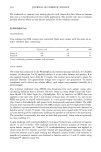
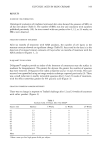
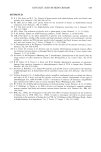
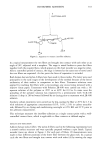
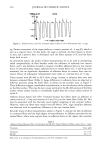
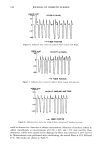
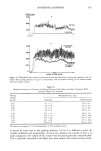
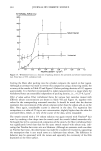
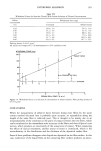
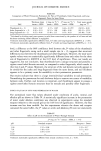
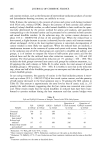
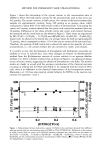
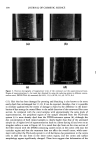
362 JOURNAL OF COSMETIC SCIENCE FORCE(mg) 70- 60- 50- 40- 30- 2C UNTREATED HAIR O. 12B g/cm 3 . • t• - 0.03 g/crn $ O • ,,.,5 mm L LENGTH OF FIBER MOVED Figure 12. Withdrawal force curves for untreated human hair fibers at various packing densities. in the force of withdrawal (Figure 13a). This is due to an increase in the "springiness" of the assembly and a consequent increase in the normal forces at the points of contact, when such an assembly is packed into the cylinder. The stick-slip phenomenon is particularly pronounced in swatches that had been permed and treated with sebum, as seen in Figure 13b, reflecting the combined effects of the increased normal forces at the points of contact due to waving and the increased interfiber adhesion due to capillary forces caused by sebum deposition at these points of contact between fibers. Efj•ct of fiber packing density. As pointed out above, the force of withdrawal of a single fiber from an assembly depends on the lateral force acting on the assembly. This lateral force is proportional to the normal force acting at the points of contact between the fibers. An indirect way of increasing this lateral force would be to increase the packing density in the cylinder. In order to study the effect of packing density on the withdrawal force, a series of hair swatches (about ! 50-mm long) containing various amounts of hair were prepared. The cylinders were packed with hair from these swatches taken near their tip ends. The swatches were cut, and the remaining parts of each swatch were saved to repeat these measurements after treatment with synthetic sebum (1% solution in CC14). Fifteen to twenty measurements were made on each swatch to obtain a reliable average force value. The fibers withdrawn were randomly chosen throughout the area of the cylinder. The average withdrawal forces are shown in Table VI as a function of packing density before and after treatment with sebum. The data in Table VI are also shown graphically in Figure 14. It can be seen that the withdrawal forces increase up to a packing density of-0.3 g/cm 3 and then remain essentially constant over the range studied. Treatment with sebum causes a considerable increase in withdrawal force, which follows a packing density dependence similar to that of the untreated material.

INTERFIBER ADHESION 363 FORCE 2O0 400 O J Untreated 4OO 3OO b - 2 % Sebum, perreed ' I 2% Seburn, no perrn •- ,'-, 5 mm • Length of fiber moved Figure 13. Withdrawal force curves for untreated human hair fibers after waving and treatment with 2% sebum. Fiber packing density 0.25 g/cm 3. (a) untreated, with and without waving (b) 2% sebum-treated, with and without waving. Table VI Withdrawal Forces as a Function of Packing Density of Hair Before and After Treatment With Synthetic Sebum (1% solution) Packing density (g/cm 3) Withdrawal force (mg) Untreated Sebum-treated 0.03 4.1 + 1.3 33.0 + 6.1 0.05 2.8 + 0.9 35.4 + 9.0 0.08 5.2 + 1.9 35.1 + 4.8 0.13 9.8 + 6.5 36.9 + 6.5 0.18 24.5 + 3.9 38.0 + 5.9 0.29 41.9 + 12.4 92.4 + 18.8 0.36 39.3 + 6.6 135.6 + 16.3 0.44 33.7 + 4.8 91.7 + 18.2 0.64 45.0 + 6.5 120.7 + 23.5 All entries are averages of 15-20 measurements at 95% confidence level. It should be noted that at low packing densities (0.15) it is difficult to pack the cylinder uniformly and reproducibly. At these low densities the amount of hair is so small compared to the volume of the cylinder that the packing becomes irreproducible. This is especially noticeable if the fibers have been treated with sebum and are sticky.
Purchased for the exclusive use of nofirst nolast (unknown)
From: SCC Media Library & Resource Center (library.scconline.org)