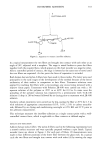
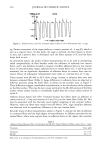
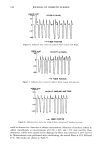
366 JOURNAL OF COSMETIC SCIENCE tive force upon contact and the resulting capillary forces contribute to the force of separation. While the reproducibility of the measurements is good, the uncertainty regarding the area of contact remains. In our efforts to establish correlations between adhesive interactions and compressibility parameters, it appeared that the single-point contact method did not provide an ad- equate parameter and we decided to test a multipoint contact method with fibers aligned parallel to each other. The dynamic pull-out method, using an appropriate packing density, provides an empirical adhesion parameter, i.e., the "withdrawal force," which can help in the prediction of compressibility behavior, as will be shown in a subsequent paper (3). ACKNOWLEDGMENTS The authors would like to thank Mrs. C. J. Dansizer and Mrs. Hannelore Mark for their diligent contributions to the experimental work discussed here. The work reported was carried out as part of the Core-Technolog Project, The a4odification of Human Hair Properties by Surface Treatments, at TRI/Princeton. The authors would like to thank the corporate participants in this project for their support. REFERENCES (1) A. Kul and P. A. Smith, Appl. Polymer Symp., 18(Part II), 1467 (1971). (2) Y. K. Kamath, C.J. Dansizer, and H.-D. Weigmann, J. AppL Polymer Sci., 29, 1011 (1981). (3) Y. K. Kamath and H.-D. Weigmann, in preparation. (4) E. F. Denby and M. W. Andrews, Textile Res. J., 35, 913 (1965).

j. Cosmet. Sci., 51,367-377 (November/December 2000) Characterization of the physical factors affecting nail permeation using water as a probe GOURI GUPCHUP MALHOTRA and JOEL L. ZATZ, Unilever Research U.S., 45 River Road, Edgewater, NJ 07020 (G.G.M.), and College of Pharmacy, Rutgers University, 160 Frelinghuysen Road, Piscataway, NJ 08854 (J.L.Z.). Accepted for publication September 14, 2000. Poster entitled "Methodology for Studying Nail Permation In Vitro" presented at the Annual Scientific Seminar of the Society of Cosmetic Chemists, Chicago, May 1999. Synopsis Our research objectives were to (a) develop a reproducible technique to measure nail permeation in vitro, (b) study variations in nail permeability as a function of location (toenails vs fingernails), and (c) study the effect of pH and temperature. We monitored the permeation of tritiated water from aqueous gels using specialized Franz-type diffusion cells. For pH studies, the gels were buffered at pH 2, 7, and 12. For temperature studies, three settings (37øC, 47øC, and 57øC) were investigated. Our results showed that there was a large interindividual variability in nail permeation. Normalization of the data for toenail thickness reduced the standard deviation for flux from 42% to 21% of the mean value. Repeated measurements resulted in less than 5% variability, indicating that the technique was reproducible. Thumbnails, despite their reduced thickness, resulted in water fluxes equal to those of toenails, suggesting the presence of a tighter keratin network. Although not conclusive, our results suggest that thumbnails also differ in structure from other fingernails. While pH did not affect permeation through nails, increased temperature significantly enhanced water permeation. The effects of pH and heat treatment were reversible. INTRODUCTION The permeability properties of the human nail were summarized in a recent review (1). It is now generally accepted that the human nail is primarily composed of a highly cross-linked keratin matrix that gives the nail its effective barrier properties. The nail keratin itself is composed of or-helical filaments and non-helical matrix keratins that are rich in the sulfur-containing amino acid half-cystine. This results in numerous disulfide linkages throughout the matrix that give rise to its extensively cross-linked structure and resistance to penetration (2,3). The nail has been documented to be more permeable to small, hydrophilic molecules such as water, methanol, and ethanol, than to larger, lipophilic molecules (4,5). Some attempts have been made to characterize the effect of pH by using ionizable drugs however, it is not clear whether pH alters the nature of the nail plate itself or whether better permeation under certain pH conditions results from 367
Purchased for the exclusive use of nofirst nolast (unknown)
From: SCC Media Library & Resource Center (library.scconline.org)