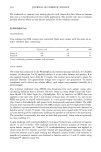
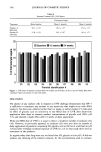
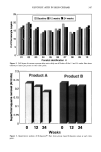
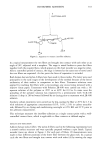
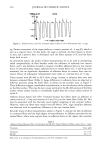
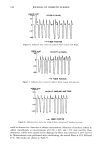
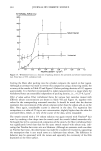
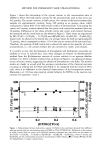
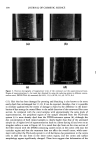
METHOD FOR PERMANENT HAIR STRAIGHTENING 389 [TGA](%) 4 2:5 ,3 , ,5 (a) *** 15[ (b) 20 "•ø d • 10• •. .. • s•, , , , . / / 2o 2s p / ' 0 0.1 0.2 0.3 0.4 0.5 0.6 [DTDGI/[TGA] Figure 2. (a) Relationships between the degree of supercontraction, Lc, and the concentration ratios of DTDG to TGA for bicomponent system (lower axis) at pH 9.20 (•) and pH 9.30 ([]), and the concen- tration of TGA for the TGA-only system (upper axis) at pH 9.20 (0) and pH 9.30 (O). (b) Relationship between Lc and the time of reduction, t in min: DTDG:TGA = 1:5 and pH 9.30. from the bicomponent system (b), while the smoothness of the surface is consider- ably lost for the fiber from the TGA-only system (c). For the case of highly contracted fiber (d), a crevice-like striation running along the fiber axis direction can be seen together with a significant disordering in the alignment of the cuticles. Figure 4 shows the optical micrographs of the transverse cross section for the untreated hairs and the cured hairs dyed with acid black. Each photograph designated as (a), (b), (c) and (d) corresponds to that of the sample in Figure 3. One of the present authors reported that the rate of diffusion of dyes into keratin fiber is increased by virtue of physical phenomenon such as supercontraction induced by the fine structure change

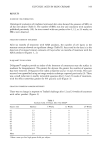
390 JOURNAL OF COSMETIC SCIENCE x•oo x•oo (a) (b) (c) (d) Figure 3. Electron micrographs of longitudinal views of the untreated and the supercontracted hairs. Degree of supercontraction, Lc, for cured hair obtained by ming the reducing system in different concen- tration ratios, DTDG:TGA: (a) untreated (b) 8.4%, 1:5 (c) 8.5%, 0:3 (d) 14.7%, 0:4. (13). Hair that has been damaged by perming and bleaching is also known to be more easily dyed than undamaged hair (1,14). It can be expected, therefore, that it is possible to estimate qualitatively the extent of damage to hairs by the difference in the distri- bution of dye among the treated fibers in the radial direction of the transverse fiber cross section. As compared with the cured samples with approximately the same levels of supercontraction, the peripheral region of the sample obtained from the TGA-only system (c) is more densely dyed than the DTDG-existence system (b), although the dye concentration of both treated samples is clearly higher than that of the untreated sample (a). A higher level of supercontraction leads to a dense dyeing (d) and even to an irregular surface as seen in Figure 4d. It is noted that dye front on the cross section of the fiber treated with the DTDG-containing system exists in the cortex cells near the cuticular region and that the treatment does not affect the overall cortex, while treat- ment with either the TGA-only system (c or d) facilitates dye penetration in the cortex cells to shift the dye front to the inner cortex region, and the cortex and surface morphology appear significantly changed. These facts suggest that deformation of the
Purchased for the exclusive use of nofirst nolast (unknown)
From: SCC Media Library & Resource Center (library.scconline.org)