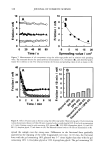
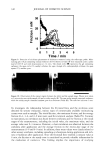
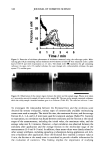
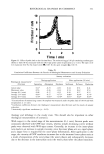
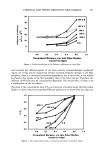
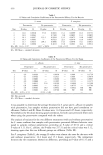
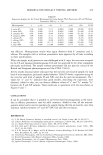
332 JOURNAL OF COSMETIC SCIENCE In contrast, the viscosity of W/O emulsions decreases due to the decrease in the inner- phase ratio. Therefore, these changes in viscosity probably lead to the characteristic friction curves of O/W and W/O creams in the early stage of measurement. In some cases, frictional curves at this stage can be directly attributed to stickiness before drying, as we have shown in measurements with model formulations containing various thick- eners. However, many factors, including rotation speed of the roller and the spreading status of sample, should be considered upon the measurement of more complex formu- lations, since they could differ greatly among samples at the initial stage. Optical observation during the measurements should provide useful information for interpreting the frictional data. Our results clearly demonstrate that our newly developed rheological measuring device can be used to predict the changes in sensation following the application of cosmetics, such as the spreading change of massage gels and the stickiness induced by thickening of polymers in moisturizing gels. The new rheological measuring device developed in this study has structural similarities to conventional reciprocation-type rheometers used in other reports (5,6), in that both have reciprocating sample stages and strain gauge sensors. It has, however, a unique combination of features: the sensitive sensor, the insensitivity to zero-point shifting, the probe-lifting function for better sample spread- ing on the stage, and the novel roller-type probe. Stickiness after application, which often determines consumer preference for cosmetic products, was well reflected in the frictional force with the roller-type probe, rather than with the block-type probe. Re- garding evaluation of stickiness, Iida et al. (7) reported measurements of emulsions with a tensipresser, using a multipoint biting method. Their device continuously detects the force in the repeated compression and decompression of samples on the stage to a decreasing thickness (0.2 mm at the start and 0. ! mm at the end of measurement) with a flat plunger. This type of measurement depends on the contact of two flat surfaces. As opposed to this, our system with the roller-type probe depends on the contact between the roller and flat surface, which is more controllable. Moreover, the frictional force in each reciprocation process is calculated from a large pool of detected force data sampled during a relatively long time (about ! s), instead of at an instant in the decompression process. These factors presumably contribute to the high reproducibility of the method. The present method can be performed with a small amount of sample in a short time, and so should be suitable for routine work. In this study, polyimide was selected from among various plastic materials and used as an artificial skin, but future work will be directed at developing a stage material that more closely resembles human skin. Although we have shown the usefulness of our novel device, it is important to emphasize that the balanced use of various evaluation methods is necessary in the actual develop- ment of cosmetic products. For example, our method would be especially suitable for the screening of prototype formulations or ingredients. Once candidates are selected, de- scriptive sensory evaluation would play an important role, since it brings reliable in- formation about various sensory attributes. Consumer evaluation also provides valuable information on consumer perception, which is not readily accessible with other evalu- ation methods. CONCLUSIONS In this study, a novel rheological measuring device was developed to measure the rheological changes in cosmetics after application. The characteristics of the device were

RHEOLOGICAL CHANGES IN COSMETICS 333 investigated with two different probes (block-type and roller-type). With the block-type probe, the spreading change of massage gels was clearly related to the detected frictional force, which correlated with the sample viscosity. On the other hand, the stickiness properties of cosmetics were well reflected in the force detected with the roller-type probe. The frictional force at the steady state correlated with the post-application stickiness, as well as spreading or absorption during application, and richness or hydra- tion after application. We conclude that this measuring device can provide useful information for the development of cosmetic formulations. REFERENCES (1) L. B. Aust, L. P. Oddo, J. E. Wild, O. H. Mills, andJ. S. Deupree, The descriptive analysis of skin care products by a trained panel of judges,.]. Soc. Cosmet. Chem., 38, 443-449 (1987). (2) A. H. F•3rster and T. M. Herrington, Rheology of two commercially available cosmetic oil in water emulsions, Int. `]. Costa. Sci., 20, 317-318 (1998). (3) S. Wang, M.S. Kislalioglu, and M. Breuer, The effect of theological properties of experimental moisturizing creams/lotions on their efficacy and perceptual attributes, Int. `]. Costa. Sci., 21, 167-188 (1999). (4) R. Bruinruer and S. Goriersky, Rheological studies to objectify sensations occurring when cosmetic emulsions are applied to the skin, Colloid. Surf A, 152, 82-94 (1999). (5) K. Masaki and N. Totani, The evaluation of oily components by using the frictional feel analyzer, `].Soc. Cosmet. Chem. `]pn., 32, 59-64 (1998). (6) K. Suganuma and M. Niwa, Relation between physical property of massage creams and skin surface smoothness,.]. Soc. Cosmet. Chem.`]pn., 23, 212-219 (1991). (7) I. Iida, H. Nishimura, Y. Ikeyama, and T. Koyanagi, Studies on typification of cosmetics-- Relationship between sensory evaluation and physical measurement of emulsions,`]. Soc. Cosmet. Chem. `]pn., 23, 295-300 (1990). (8) T. Nomura, K. Suzuki, R. Suzuki, and Y. Kajiwara, A newly-developed tactile sensor and its appli- cation to the evaluation of cosmetics,`]. Soc. Cosmet. Chem. `]pn., 31, 79-81 (1997). (9) J. K. Prall, Instrumental evaluation of the effects of cosmetic products on skin surfaces with particular reference to smoothness,`]. Soc. Cosmet. Chem., 24, 693-707 (1973). (10) A. F. El-shimi, In vivo skin friction measurements,`]. Soc. Cosmet. Chem., 28, 37-51 (1977). (11) H. Tanimoto and M. Nashimoto, Evaluation of cosmetic effects with a friction meter, Cosmet. Toiletr., 94, 20-24 (1979). (12) S. Nacht, J. Close, D. Yeung, and E. H. Gans, Skin friction coefficient: Changes induced by skin hydration and emollient application and correlation with perceived skin feel,`]. Soc. Cosmet. Chem., 32, 55-65 (1981). (13) M. Lod•n, H. Olsson, L. Skate, and T. Ax•11, Instrumental and sensory evaluation of the frictional response of the skin following a single application of five moisturizing creams,`]. Soc. Cosmet. Chem., 43, 13-20 (1992). (14) M. Date and I. Inaba,`]apanese Patent No. 3023142 (Japanese Patent Office, June 8, 1990). (15) u. Zeidler, The spreading of lipids on the skin, Fette Seij•n Anstrichmittel, 87, 403-408 (1985). (16) B. A. Salka, Choosing emollients, Cosmet. Toiletr., 112, 101-106 (1997).
Purchased for the exclusive use of nofirst nolast (unknown)
From: SCC Media Library & Resource Center (library.scconline.org)