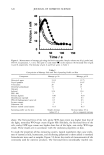
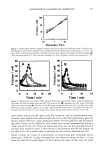
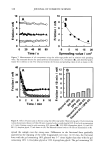
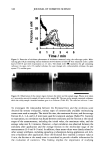
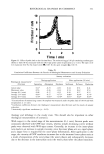
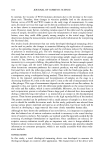
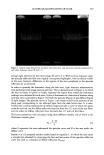
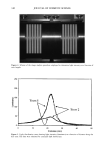
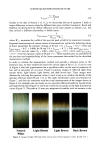
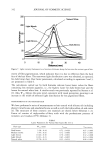
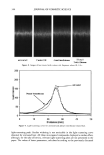
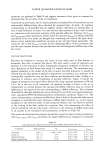
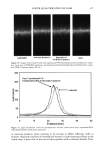
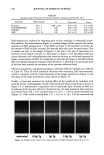
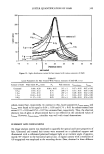
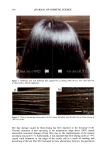
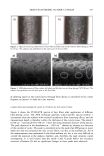
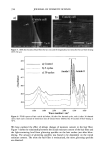
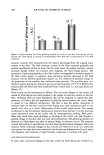
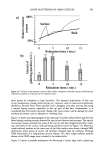
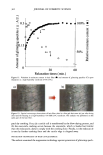
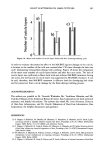
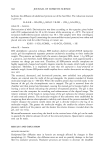
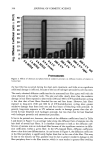
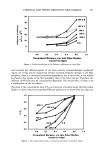
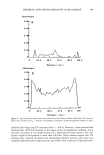
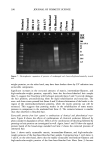
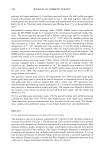
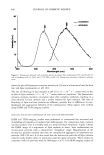
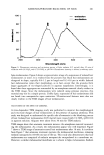
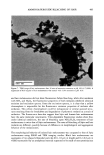
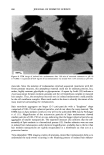
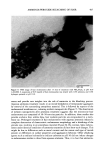
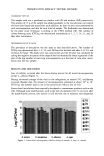
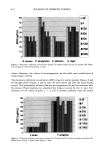
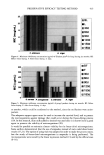
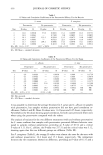
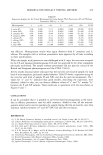
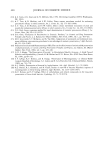
360 JOURNAL OF COSMETIC SCIENCE a) b) Figure 9. Light-scattering level from glittering speckles of cuticle (a) just after blow-drying, and five minutes after blow-drying in relaxing (b) low-humidity (30% RH) and (c) high-humidity (75% RH) conditions. moisture contents were represented by the relative percentage from the original water content of the fiber. The bulk moisture content of the fiber increased gradually and reached equilibrium within an hour. On the other hand, the surface moisture content increased rapidly within two minutes after stopping the blow-drying process. The generation of glittering speckles on the fiber surface corresponded to moisture regain in the fiber surface region. In addition, these glittering speckles decreased as the bulk moisture content reached equilibrium (Figure 11). The influence of moisture change on the generation of the speckles was confirmed more precisely. The speckles were con- firmed to appear during the relaxation process in high humidity (23øC/75% RH) for five minutes after the fibers had been transferred from a dried state in a silica-gel desiccator (Figure 12). These results can be summarized as follows. The structural changes in the cuticle cell caused by blow-drying are closely related to the change in moisture content in the hair fiber. Although there are many hypotheses that can be proposed to explain this phe- nomenon, we believe that the generation of splitting spaces between the cuticle layers is caused by two different mechanisms. The first is that the abrupt desorption of moisture from the wet hair caused by blow-drying may cause mechanical stress on the cuticle cells, and, as a result, deformation of the cuticle layers occurs. The second mechanism is that the dramatic absorption of moisture from the hair in its dry state also causes mechanical stress on the cuticle cells by inhomogeneous swelling. Both proce- dures only result from rapid shrinkage or swelling of the cuticle cell, and therefore a gradual change in moisture does not cause these phenomena. The glittering speckles are observed to a high degree just after an abrupt change in moisture occurs. The moisture content will soon be in equilibrium, and thus these speckles almost disappear within ten minutes. These structural changes in hair cuticles are believed to occur in a daily hair care routine, but they have been unnoticed thus far because deformation of cuticle layers will disappear upon relaxing at high humidity conditions or wetting with water. HAIR DEGRADATION MECHANISM In most cases, structural changes in the hair cuticle by blow-drying are reversed in a

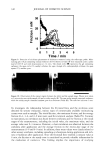
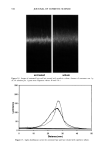
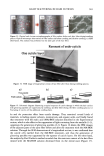
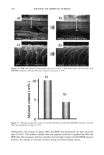
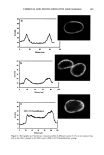
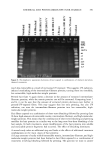
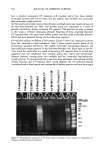
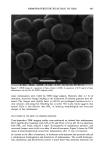
LIGHT SCATTERING IN HAIR CUTICLES 361 a) 100%- 5O% - Surface /•. .... Bulk I I I b) 5 10 15 Relaxation times (min.) ß - . : - • • • 0 5 10 15 Relaxation times (min.) Figure 10. Variation in (a) moisture content in fiber surface compared to the bulk content, and (b) amount of glittering speckles as a function of the relaxation times. short period by relaxation in high humidity. The repeated applications of hair care cycles, shampooing, rinsing, blow-drying, etc., however, seem to cause several glittering speckles to become fixed. These speckles won't disappear even after wetting and using a natural drying process, especially at the tip part of the hair. Furthermore, it is considered that this harsh structural change will cause serious cuticle damage by other mechanical stresses, such as abrasion or combing force. Figure 13 shows microphotographs of the same part of a fiber surface before and after the blow-drying/combing process observed by optical and electron microscopes. The optical microscope images revealed that some of the cuticle cells had chipped away after comb- ing, selectively at the cuticles with glittering speckles (circled in Figure 13). Moreover, rough-surfaced residues at the same part of the fiber surface were shown through SEM observation where pieces of cuticle cell had been chipped away by combing. Through TEM observation of a longitudinal section (Figure 14), these rough-surfaced residues shown in the SEM image were revealed to be endocuticles. Figure 15 shows a possible mechanism for fracturing a cuticle edge with a glittering
Purchased for the exclusive use of nofirst nolast (unknown)
From: SCC Media Library & Resource Center (library.scconline.org)