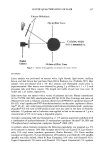
324 JOURNAL OF COSMETIC SCIENCE at the end of the sweep area and placed again at the start of measurement in the reverse direction [probe lifting function, as reported by Date and Inaba (14)]. During the measurements, ambient temperature and relative humidity were kept at 25 øC and 50%, respectively. The temperature of the sample stage was kept at 32øC. For calibration, a certain force (0.01-0.1 N) was applied to the probe horizontally by a weight and a pulley. To compensate for zero-point shifting during measurement, the measured fric- tional force in each reciprocating process was calculated with the following equation: Fc F = •c x (Vf - Va) + 2 where Fc is the force applied at calibration, and Vc, Vf, and Vb are the voltages detected at calibration, at the forward process, and at the backward process, respectively. SAMPLES USED FOR MEASUREMENT Various types of commercial cosmetic emulsions were used for measurement. These include massage creams, moisturizing creams, and essences (O/W-type and W/O-type emulsions that can give various skin sensations). Standard cosmetic cream formulations that contained conventional cosmetic ingredients were also used for measurement. Vis- cosity standard oils were purchased from Toki Sangyo (Tokyo, Japan). SENSORY EVALUATION OF COSMETIC SAMPLES Skilled panels carried out evaluation of cosmetic samples to assess their sensory attrib- utes, including spreading, stickiness, absorption, and richness. The panels graded the test samples on a scale from -3 to + 3 against the selected references for each attribute. Special attention was paid to the changes in spreadability and stickiness during appli- cation of the cosmetics. MEASUREMENT OF SPREADING VALUE Spreading values of oils were measured according to the method developed by Zeidler (15), with slight modifications. Oil samples (5 lnl) were placed on the forearms of human volunteers. The oil that spread spontaneously on the skin was blotted on a piece of wax paper to measure the area of spread. The area at 5 min after application was used as the spreading value. During the experiments, ambient temperature and relative humidity were kept at 25øC and 50%, respectively. RESULTS AND DISCUSSION MEASUREMENT USING THE BLOCK-TYPE PROBE When cosmetic emulsions are applied to skin, they usually spread evenly and form thin films on the skin. To simulate this process by rheological measurement, it is important to spread samples evenly on the sample stage. In preliminary experiments using con- ventional friction analyzers that consist of reciprocating sample stages and load cell sensors, however, the probe squeezed and piled up the applied samples at either end of the sweep area during reciprocation. To avoid this phenomenon, our measuring device

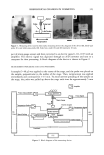
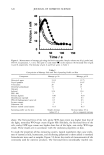
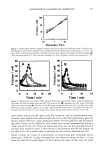
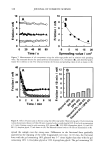
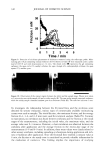
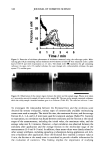
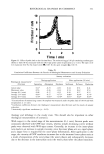
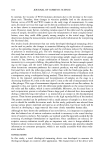
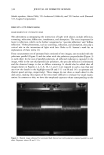
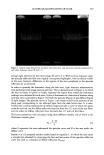
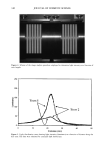
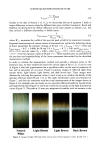
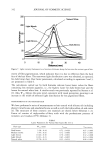
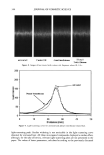
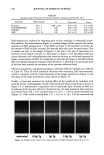
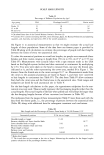
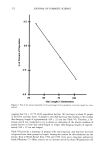
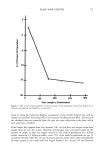
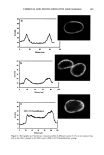
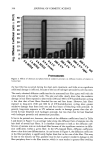
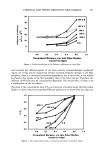
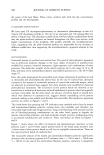
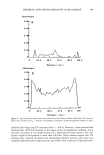
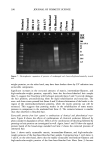
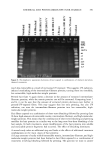
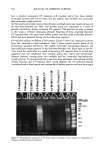
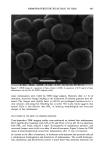
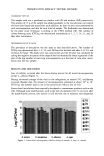
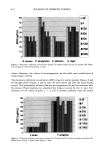
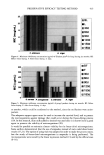
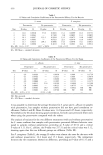
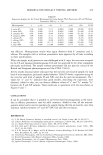
RHEOLOGICAL CHANGES IN COSMETICS 325 was equipped with a probe-lifting function as described in Materials and Methods. Improved spreading status of samples on the stage was obtained with this function (Figure 3). Figure 4 shows the results of measurements with the block-type probe using O/W-type massage gels (Table I) that drastically change their spreading properties during mas- saging. The changes in the measured frictional force reflected the changes in spread- ability experienced during massaging. Since the measured frictional force decreased at almost the same rate that the spreadability decreased on the skin, the device could reproduce and detect the same phenomenon that occurred on the skin. To examine the relationship between the measured frictional force and the viscosity of samples, viscosity standard oils were used for measurement (Figure 5). A high correlation between the frictional force and the viscosity was found over a broad range, with only a minor dependence on the sample volume, which possibly could decrease over time due to evaporation if conventional cosmetics are measured. In addition, large differences in viscosity resulted in relatively small differences in friction (e.g., a 70-fold increase in viscosity yielded only an 8- to 9-fold increase in friction). This is due to the variation of sample thickness according to viscosity. The relation between the sample thickness and viscosity made it possible to detect the spreading changes that arise from large viscosity changes without changing the attenuation of the strain gauge amplifier. This is favorable for detection of dynamic changes occurring on the skin, since changing the attenuation of the amplifier is generally associated with zero-point shifting in measurement. Con- versely, it may become more difficult to detect changes in skin sensation that arise from small viscosity changes. With respect to another important sensory attribute, namely stickiness, no clear corre- lation was found between the results of the sensory evaluation and the frictional force of conventional moisturizing creams measured with the block-type probe (Figure 6A). The frictional force with the rich, sticky W/O-type cream was smaller than the force of the other two (light, non-sticky) creams. The frictional forces fell to almost the same level (about 0.01 N) 10 rain after the beginning of measurements, irrespective of the sticki- ness properties of the measured samples. The baseline friction might hinder the evalu- ation of stickiness. MEASUREMENT USING THE ROLLER-TYPE PROBE To evaluate the stickiness of cosmetics, another type of probe, i.e., the roller-type probe, was developed and used for the measurement of the same moisturizing creams described Figure 3. Improved spreading of samples on the stage owing to the probe-lifting function Sample distribution after 1 rain of reciprocation with probe lifting (A) and without lifting (B). A W/O-type foundation was used as a sample. Sample volume was 20 lal probe load, 0.05 N reciprocation, 2.4 cm/s. The scale bar in (B) represents 10 mm.
Purchased for the exclusive use of nofirst nolast (unknown)
From: SCC Media Library & Resource Center (library.scconline.org)