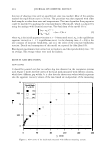
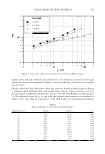
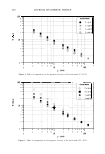
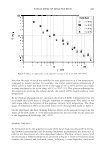
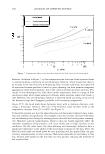
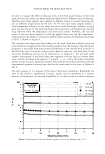
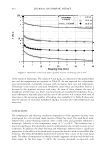
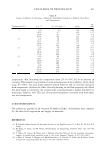
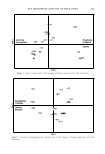
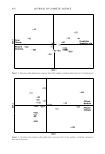
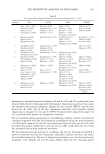
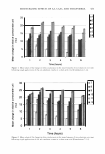
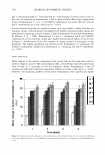
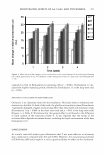
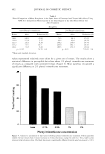
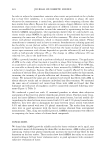
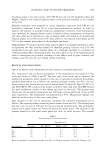
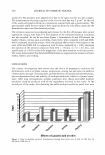
452 - UI JOURNAL OF COSMETIC SCIENCE 100 ----r-----�--------:-=====-�--,-----;----� ----------------------------- t -··------------------------- Facial Mask + 10 1 6 ------------------------·---·r----------------------------- T = 45 oc EE 2.2 0 1/s 10.211/S 28.38 1/s 0 ____ -----------�-----------------------------��---5-_K_m_o_d�el ___ , __ , ♦ 5 131.9 1/s ---------- ---------------------------"1------------------------------ ----------------------------- --------- ________________________ ,. _____________________________ ----------------------------- 10 15 25 20 Shearing time (min) 35 30 40 Figure 9. Dependence of the facial mask's apparent viscosity on shearing time at 45 ° C. of the extent of thixotropy. The values of k and r1olTJ00 as a function of the applied shear rate and the temperature are reported in Table II. As one expected for a thixotropic structured material, k generally increases with increasing shear rate and temperature. Thixotropy is the result of structural breakdown under shear and manifests itself as a decrease in the apparent viscosity with time. As time of shear elapses, the rate of breakdown will decrease, as a fewer structural bonds are available for breakdown. Struc tural reformation may take place and the rate of this process will increase with time of shear due to the increasing number of bonding sites available (15). Table II shows also that the amount of structural breakdown (TJ 0 ITJ00) increases also with temperature and shear rate. CONCLUSIONS The temperature and shearing conditions dependency of the apparent viscosity were investigated for a facial mask made mainly of Dead Sea mud. The mud facial mask behaved like a shear-thinning material with a yield stress and generally exhibited a thixotropic behavior in the temperature range of 5 ° to 60°C. This behavior has a practical significance that decelerates particle sedimentation due to high viscosity at rest conditions. In addition, the shear-thinning and thixotropic behaviors have a significant importance in the ability of the facial mask to spread on the skin with a controllable film thickness. The Herschel-Bulkley model fitted well the flow curves of the mud facial mask. The effect of temperature on the facial mask's apparent viscosity was divided into three stages. In the first stage, 5°-20°C, the viscosity decreased, as expected, with

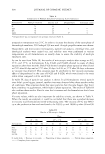
FACIAL MASK OF DEAD SEA MUD 453 Table II Degree and Extent of Thixotropy of Dead Sea Mud Mask, Evaluated at Different Shear Rates and Temperatures 1lo Temperature (°C) -y· (s-1) k X 103 (min- 1 ) 11o/11= (Pas) 5 2.20 0.0 1.00 24.4 10.21 47 1.05 12.7 28.38 121 1.16 6.2 47.43 190 1.23 4.5 15 2.20 28 1.03 22.3 10.21 79 1.05 10.6 28.38 125 1.17 5.2 47.43 361 1.28 2.7 25 2.20 39 1.08 23.5 10.21 139 1.13 10.1 28.38 209 1.20 4.9 47.43 404 1.35 2.8 35 2.20 82 1.34 41.4 10.21 270 1.43 12.2 28.38 280 1.50 5.5 79.02 489 1.51 3.8 45 2.20 150 1.90 17.8 10.21 328 1.93 12.9 28.38 555 1.97 5.2 131.90 618 2.76 2.7 temperature. But increasing the temperature from 20 ° to 45°C led to an increase in viscosity. This behavior was attributed to the gelatinization of the stabilizer. In the third stage, 45°-60 ° C, the mud mask regained normal behavior and its viscosity decreased with temperature. As far as the effect of steady shearing on the flow properties of a Dead Sea mud mask is concerned, the second order structural kinetic model described its thixotropic behavior well. The rate of structural breakdown increased with both shear rate and temperature. ACKNOWLEDGMENTS The authors are grateful to Dr. Hussam El-Haffar and Mrs. Aida Frehatt from Ammon Co. for their kind cooperation and supply of materials. REFERENCES (1) K. Sukenik, Balneotherapy for rheumatic diseases at the Dead Sea area, Isr. J. Med. Sci. 32, Sl6-Sl9 (1996). (2) M. Hagit, 0. Esith, and W. Ronni, Balneotherapy in dermatology, Dernzatol. Ther. 16, 132-140 (2003). (3) S. Halevy, H. Giryes, M. Friger, and S. Sukenik, Dead Sea bath salt for the treatment of psoriasis vulgaris: A double-blind controlled study,]. Eur. Acad Derrnatol. Venereol., 9, 237-242 (1997). (4) Z. Maor, S. Yehuda, S. Magdassi, G. Meshulam-Simon, Y. Gavrieli, Z. Gilad, and D. Efron, Cream composition comprising Dead Sea mud, US Patent 6582709 (2003).
Purchased for the exclusive use of nofirst nolast (unknown)
From: SCC Media Library & Resource Center (library.scconline.org)