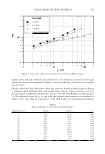
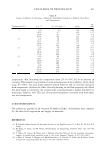
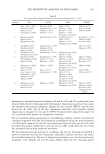
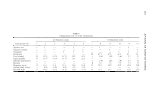
456 JOURNAL OF COSMETIC SCIENCE sticks were reformulated, reducing sodium stearate concentration and adding ingredi ents that might improve slipperiness while acting as skin conditioners. These charac teristics require an appropriate sensory tool for evaluation. Descriptive analysis is a method currently used in the sensory evaluation of food. In 1987, Aust et al. (2) applied this methodology to cosmetic emulsions, and recently Parente et al. (3) applied it to evaluate cosmetic ingredients. Conventional descriptive analysis methodologies such as flavor profile, texture profile, quantitative descriptive analysis (QDA), and Spectrum® constitute useful tools to solve diverse problems asso ciated with quality control, shelf life, product development, and consumer preferences, but they demand an important number of training sessions (4-6). This technique involves the selection of terms and the development of a consensus list of descriptors. To avoid this long and difficult step, free-choice profile (FCP) has been proposed as an alternative (7). In FCP, each judge chooses his or her own terms to describe perceived sensations (8,9). Williams and Arnold (10) showed that FCP with the scores analyzed by general pro crustes analysis (GPA) gave results similar to those of conventional profiling and simi larity scaling. Assessors are required to be objective, use intensity scales, and develop a list of attributes and a consistent vocabulary (11). It is interesting to explore the use of this technique to evaluate personal care products due to the advantages it offers and its widespread and successful use in food products (12-14). The aim of the present work is to select agents with improved slipperiness and skin conditioning properties for stick formulations based in propyleneglycol and water, with sodium stearate as gelling agent, and to determine the adequate concentrations of the different conditioning agents using FCP methodology. MATERIALS AND METHODS SAMPLES Formulations to be used as stick bases were manufactured using sodium stearate, pro pyleneglycol, and water (Table I), adding three different concentrations of each of the following conditioning agents (15, 16): • Octyldodecanol: oily component used in emulsions, deodorants, and antiperspirants, having good spreadability. Table I Sample Composition Samples Component (%) Al A2 A3 Bl B2 B3 Cl C2 C3 Sodium stearate 6.5 6.5 6.5 6.5 6.5 6.5 6.5 6.5 6.5 Propylenglycol 68.5 67.0 65.5 68.5 67.0 65.5 68.5 67.0 65.5 Deionized water 23.0 22.5 22.0 23.0 22.5 22.0 23.0 22.5 22.0 Octy ldodecanol 2.0 4.0 6.0 PPG-5-ceteth-20 2.0 4.0 6.0 PPG-15-stearyl ether 2.0 4.0 6.0

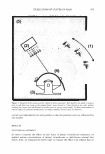
FCP DESCRIPTIVE ANALYSIS OF STICK BASES 457 • PPG-5-ceteth-20: tensoactive, water-soluble, having emollient and moisturizing properties. • PPG-15-stearyl ether: easily spreadable emollient, lubricating skin without excessive oiliness. Propyleneglycol and the conditioning agent were heated in a water bath to 80°C. Sodium stearate was then added, and the solution was stirred until total dispersion was reached. Finally, water heated to 80°C was added, and the formulation was stirred until it was homogeneous and then molded at 60°C (17 ,18). The Ethics Committee of the Universidad de la Republica Oriental del Uruguay con cluded that all samples were adequate for testing on humans. SENSORY ANALYSIS�FREE-CHOICE PROFILE (FCP) Selection �f descriptors. A panel of eight assessors from the Faculty of Chemistry trained in the descriptive analysis of food products, but with no previous experience in evaluating cosmetics, participated. Vocabulary development consisted in presenting to assessors two pairs of samples in three sessions. Each pair had the lowest (2%) and the highest (6%) concentration of two different conditioning agents (see Table I): Session 1: Al-B3 and Cl-A3 Session 2: Bl-A3 and Cl-B3 Session 3: Al-C3 and Bl-C3 Assessors were asked to describe differences perceived between the samples of each pair in: • Sample surface by observing the lateral surface of the stick portion extracted. • Sensations experienced when the stick was applied twice on their inner forearm. • Sensations perceived on skin when touching with the fingers, right after the stick was applied. • Skin characteristics five minutes after application, by touching with the fingers. Later on, individual interviews were held, in which assessors selected the terms they wished to use for evaluation in their individual score sheets. A training session was carried out afterwards using these personal score sheets, providing assessors the chance to modify or clarify descriptors. Finally, individual score sheets with non-structured 10-cm scales were obtained to describe attribute intensity. Sample evaluation. A balanced complete block experimental design was carried out for duplicate evaluation of the nine samples during nine sessions (two samples per session). The samples were evaluated at room temperature and labeled with three-digit code numbers. Non-structured 10-cm scales were used to describe attribute intensity. Sensory testing was performed in a sensory laboratory that was designed in accordance with the ISO (1988) standard (19). STATISTICAL ANALYSIS FCP sensory data were analyzed by generalized procrustes analysis (GPA) using Senstools for Windows, version 2.2.21 software (Oliemans, Punter and Partners BV and Talcott BV, Utrecht, The Netherlands). In sensory profiling an assessor scores N samples for V attributes or descriptive terms, providing an N x V matrix. These data may be considered as representing a configuration
Purchased for the exclusive use of nofirst nolast (unknown)
From: SCC Media Library & Resource Center (library.scconline.org)