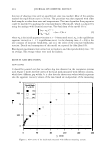
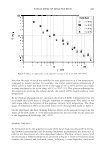
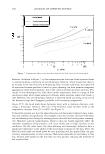
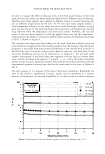
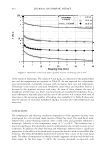
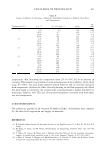
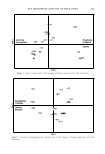
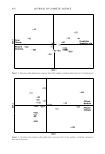
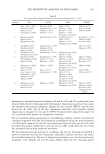
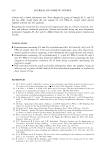
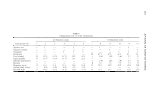
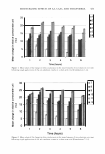
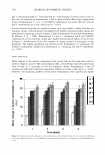
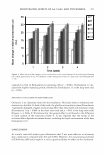
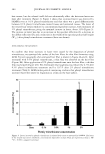
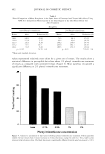
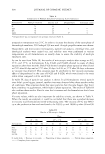
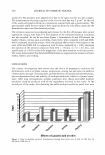
·c :::I .... Cl) Cl) E 0 Cl) E 0 Cl) - :::I � � m � - .E Cl) C m .c u C m Cl) MOISTURIZING EFFECTS OF AA, CAAS, AND TOCOPHEROL 471 30 25 20 15 10 5 0 1 2 3 lime (week) 4 □ 7 ■ B ■ 9 ■ 10 o 11 a 12 Figure 4. Mean values of the changes in skin conductance on the inner forearms of ten volunteers following twice-daily applications of the w/o emulsion creams during four weeks in a long-term trial (Formulations 7-12). compared to that of Formulation 8 containing AA (p 0.001). Formulation 12 dis played the highest hydrating profile, followed by Formulation 11 in the long-term trial (p 0.05). INFLUENCE OF OCCLUSION ON SKIN HYDRATION Occlusion is an important factor for skin hydration. Occlusion leads to enhanced pen etration into the skin. In both of the trials, the placebo w/o emulsion cream (Formulation 7) generally displayed a higher moisturizing effect than the placebo o/w emulsion cream (Formulation 1) (p 0.001 in the short-term trial and p 0.05 in the long-term trial) (Figures 1-4, Table I). We believe that this general effect is attributed to the difference in lipid content of the emulsions (Table I). It was reported that the extent of the occlusive effect depends on various factors, including the lipid concentration of the base formulation (25 ). CONCLUSIONS As a result, statistical analysis gave information that T was more effective in increasing skin conductance compared with AA and CAAS. However, the moisturizing potential of CAAS was sufficiently high for it to be a good candidate for effective skin hydration.

472 JOURNAL OF COSMETIC SCIENCE The effect of CAAS was comparable to that of T and was higher than that of AA. Occlusion of the formulations may be an important factor in skin hydration. Because w/o creams had a higher lipid content, increased conductance values were observed. ACKNOWLEDGMENT This project was supported by the Research Fund of Istanbul University, project no. UDP-199/003092003. REFERENCES (1) A. V. Rawlings, I. R. Scott, C. R. Harding, and P.A. Browser, Stratum corneum moisturization at the molecular level,]. Invest. Derrnatol., 103, 731-740 (1994). (2) H. Mireles-Rocha, I. Galindo, M. Huerta, B. Trujillo-Hernandez, A. Elizalde, and R. Cortes-Franco, UVB protection with antioxidants: Effects of oral therapy with d-alpha-tocopherol and ascorbic acid on the minimal erythemal dose, Acta Derm. Venerol., 82, 21-24 (2002). (3) P. M. Maia Campos and G. M. Silva, Ascorbic acid and its derivatives in cosmetic formulations, Cosmet. Toiletr., 115, 59-62 (2000). (4) C. Fox, Advances in the cosmetic science and technology of topical biactive materials, Cosmet. Toiletr., 112, 67-84 0997). (5) S. Tamburic, G. Abamba, and J. Ryan, Moisturizing potential of d-a-tocopherol, Cosrnet, Toiletr., 114, 73-82 0999). (6) F. Gonzalez, Human cytochromes P450: Problems and prospects, TIPS Rev., 13, 346-352 (1992). (7) K. Anbarasi, G. Kathirvel, G. Vani, G. Jayaraman, and C. S. Shyamala Devi, Cigarette smoking induces heat shock protein 70 kDa expression and apoptosis in rat brain: Modulation by bacoside A, Neurosci., 138, 1127-1135 (2006). (8) M. Valko, C. J. Rhodes, J. Moncol, M. Izakovic, and M. Mazur, Free radicals, metals and antioxidants in oxidative stress-induced cancer, Chern.-Biol. Interact., 160, 1-40 (2006). (9) A. Valencia and I. E. Kochevar, Ultraviolet A induces apoptosis via reactive oxygen species in a model for Smith-Lemli-Opitz syndrome, Free Rad. Biol. Med., 40, 641-650 (2006). (10) S. R. Pinnell, H. Yang, M. Omar, N. Monteiro-Riviere, H. V. de Buys, L. C. Walker, Y. Wang, and M. Levine, Topical L-ascorbic acid: Percutaneous absorption studies, Derrnatol. Sttrg., 27, 137-142 (2001). (11) M. D. Carbonate and M.A. Pathak, Skin photosensitizing agents and the role of reactive oxygen species in photoaging,J. Photochem. Photobiol. B, 14, 105-124 0992). (12) C. L. Philips, S. B. Combs, and S. R. Pinell, Effects of ascorbic acid on proliferation and collagen synthesis in relation to the donor age of human fibroblasts,]. Invest. Dennatol., 103, 228-232 (1994). (13) H. Padh, Cellular functions of ascorbic acid, Biochem. Cell. Biol., 68, 1166-1173 (1990). 04) K. Kameyama, C. Sakai, and S. Kondoh, Inhibitory effect of magnesium L-ascorbyl-2-phosphate (VC-PMG) on melanogenesis in vitro and in vivo,]. Acad. Dermatol., 34, 29-33 0996). 05) H. Z. Zhai and H. I. Maibach, Skin whitening agents, Cosmet. Toiletr., 116, 20-25 (2001). (16) P. Spiclin, M. Gasperlin, and V. Kmetec, Stability of ascorbyl palmitate in topical microemulsions, Int. J. Pharrn., 222, 271-279 (2001). (17) E. Kleszczewska, L-ascorbic acid-Clinical use, toxicity, properties, methods of determination and application in chemical analysis, Pharmazie, 55, 640-644 (2000). (18) G. R. Buettner and B. A. Jurkiewicz, Catalytic metals, ascorbate and free radicals: Combinations to avoid, Radiat. Res., 145, 532-541 (1996). (19) R. Austria, A. Semenzato, and A. Bettero, Stability of vitamin C derivatives in solution and topical formulations,]. Pharm. Biomed. Anal., 15, 795-801 (1997). (20) M. Lopez-Torres, J. J. Thiele, Y. Shindo, D. Han, and L. Packer, Topical application of alpha-
Purchased for the exclusive use of nofirst nolast (unknown)
From: SCC Media Library & Resource Center (library.scconline.org)