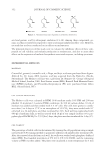
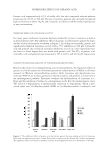
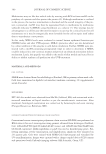
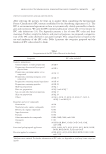
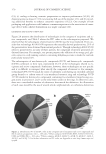
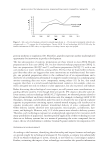
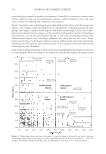
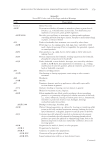
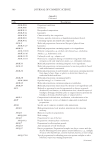
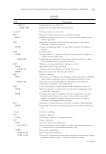
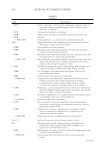
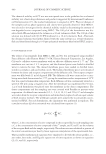
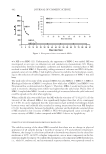
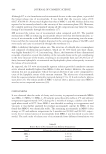
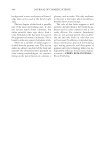
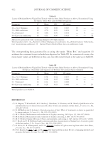
JOURNAL OF COSMETIC SCIENCE 374 on technological trends for product development. Generally, it is not easy to obtain infor- mation related to the use of technologies however, patents represent a free and open source of data for studying and evaluating cross impacts. Figure 4 presents some technological pairs identifi ed in this survey and their respective impacts. According to previous reports (9), we classifi ed the technological pairs in three groups: low impact, unidirectional impact, and bidirectional impact. First, the techno- logical pairs classifi ed as low impact can be considered independent of other technologies and, therefore, are not discussed further. Second, in the cases of technological pairs with unidirectional impact, one technology infl uences the other, but not vice versa. Third, bidirectional impact technologies infl uence and are infl uenced by the paired technology. Following, we will present and comment some of the unidirectional and bidirectional technological pairs identifi ed. Some of the unidirectional impacts observed are not meaningful from the perspective of prod- uct development. First, for example, we observed a considerable number of unidirectional Figure 4. Technological pairs and their cross impact. A specular image is obtained if one traces a diagonal line from the upper right to the lower left. Some technological pairs (A, B) were identifi ed. n = 109 tech- nologies. For further information on IPC codes, see Appendix or visit: http://www. wipo.int/ipcpub.

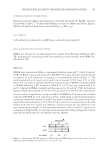
HOW COULD TECHNOLOGICAL FORECASTING HELP COSMETIC CHEMISTS 375 impacts between technologies in the same class, such as the impacts between technologies A61K 8/00 and A61K 8/18 (impacts A, B = 0.24 and B, A = 0.71) or A61K 31/00 and A61K 31/045 (Figure 4). Such impacts only mean that innovations related to cosmetic or toilet preparations (A61K 8/00) are strongly characterized by their composition (A61K 8/18). Second, we observed unidirectional impacts between cosmetic preparations charac- terized by a special physical form (A61K 8/02) and types of cosmetic preparations, such as anti-perspirants and body deodorants (A61Q 15/00 impacts A, B = 0.04 and B, A = 0.60) or tanning skin care preparations (A61Q 19/04 impacts A, B = 0.10 and B, A = 0.87). Third, we observed some unidirectional impacts of specifi c excipients and active compounds over their relative cosmetic preparations. For example, whenever monoclonal or polyclonal immunoglobulins (C07K 16/00) were employed, there was a preparation containing peptides (A61K 38/00 Figure 4). In general, these impacts are rather obvious and vaguely meaningful for the formulation practitioner. For that reason, some of those cases were not identifi ed in Figure 4. Therefore, it is necessary that one skilled in cosmetic technologies identifi es and interprets the meaningful technological impacts so that pat- ent information becomes useful for product innovation. In fact, we observed some unidirectional technological impacts with relevant information for cosmetic chemists. For instance, the impact of technology A61K 47/00 (medicinal preparations characterized by the non-active ingredients used) over technology A61K 36/00 (medicinal preparations of undetermined constitution containing naturally de- rived ingredients). This impact means that in 60% of the patents classifi ed as A61K 47/00, the ingredient that characterized the innovation was originally natural. This result refl ects the relevance of naturally derived ingredients as an alternative to innovate in cos- metic preparations. Another unidirectional impact observed was the infl uence of technology A61Q 3/02 (manicure or pedicure preparations for nail coatings) on technology A61Q 5/00 (prepara- tions for hair care). This impact is explained by the use of the same fi lm-forming polymers in preparations for nail coatings as well as for eyelash mascaras, in which the polymers are supposed to offer resistance for fragile nails or lengthening effects for eyelashes (44). Such patents also claimed for skin care activity. The relationship between these two technolo- gies elucidates the possibility of using one specifi c new raw material in many different new products to better explore either the resources or the innovative capability. In relation to bidirectional impacts, we observed the infl uence of technology C08L 83/00 (compositions of silicon-derived macromolecular compounds) on technology B32B 9/04 (layered products comprising a substance as the main or only constituent of a layer, such as surface-treated particles). This impact is related to the use of silicone polymers of dif- ferent solubility, either crosslinked or not, to improve particle dispersibility in a silicone liquid medium. These polymers could be used to treat the surface of pigments, clays, and other minerals to improve the stability of the fi nal dispersion to offer higher adhesion to the skin and to enhance transfer resistance (26), among others. This data refl ects the relevance of silicone polymers in particle surface treatment. Finally, we observed a bidirectional impact between technologies A61Q 19/04 (skin care preparations for chemically tanning the skin) and A61Q 17/00 (barrier preparations, like sun care preparations). This impact was also supported by the unidirectional impacts between technologies A61Q 19/04 and A61Q 17/04 (topical preparations for affording protection against sunlight or other radiations) or technologies A61Q
Purchased for the exclusive use of nofirst nolast (unknown)
From: SCC Media Library & Resource Center (library.scconline.org)