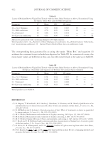
JOURNAL OF COSMETIC SCIENCE 394 in bacterial count after 1-month use however, after 2 months of use, there was a marked increase in the microfl ora, suggesting the possibility of resistance. Although bacterial resistance to antibiotics is rampant, much is not known about the effect of long-term use of lactobacillus extract nevertheless, it promises to be a valuable agent in the reduction of the intensity of acne lesions. REFERENCES (1) E. Metchnikoff, The Prolongation of Life, Optimistic Studies (Putnam’s Sons, New York, 1908), pp. 161– 183. (2) D. M. Lilly and R. H. Stillwell, Probiotics: growth-promoting factors produced by microorganisms, Science, 147, 747–748 (1965). (3) P. Marteau, E. Cuillerier, S. Meance, M. F. Gerhardt, A. Myara, M. Bouvier, C. Bouley, F. Tondu, G. Bommelaer, and J. C. Grimaud, Bifi dobacterium animalis strain DN-173 010 shortens the colonic transit time in healthy women: a double-blind, randomized, controlled study, Aliment Pharmacol Ther., 16, 587–593 (2002). (4) B. S. Gan, J. Kim, G. Reid, P. Cadieux, and J. C. Howard, Lactobacillus fermentum RC-14 inhibits Staphylococcus aureus infection of surgical implants in rats, J Infect Dis., 185(9), 1369–1372 (2002). (5) B. Karska-Wysocki, M. Bazo, and W. Smoragiewicz, Antibacterial activity of Lactobacillus acidophilus and Lactobacillus casei against methicillin-resistant Staphylococcus aureus (MRSA), Microbiol Res., 165(8), 674–686 (2010). (6) R. S. Ali, A. Falconer, M. Ikram, C. E. Bissett, R. Cerio, and A. G. Quinn, Expression of the peptide antibiotics human beta defensin-1 and human beta defensin-2 in normal human skin, J Invest Dermatol., 117(1), 106–111 (2001). (7) M. Frye, J. Bargon, and R. Gropp, Expression of human beta-defensin-1 promotes differentiation of keratinocytes, J Mol Med., 79(5–6), 275–282 (2001). (8) T. Tomita and T. Nagase, Defensins as a mechanism of host defense and innate immunity, Nippon Ronen Igakkai Zasshi, 38(4), 440–443 (2001). (9) Y. Sang and F. Blecha, Antimicrobial peptides and bacteriocins: alternatives to traditional antibiotics, Anim Health Res Rev., 9(2), 227–235 (2008). (10) H. Baba, A. Masuyama, C. Yoshimura, Y. Aoyama, T. Takano, and K. Ohki, Oral intake of Lactobacillus helveticus-fermented milk whey decreased transepidermal water loss and prevented the onset of sodium dodecylsulfate-induced dermatitis in mice, Biosci Biotechnol Biochem., 74(1), 18–23 (2010). (11) A. Yamamoto, K. Takenouchi, and M. Ito, Impaired water barrier function in acne vulgaris, Arch Der- matol Res., 287(2), 214–8 (1995). (12) N. Muizzuddin, “Acne: Causes, Treatment and Myths,” in Dermatology Research Focus on Acne Melanoma and Psoriasis, D. E. Roth. Ed. (Nova Science Publishers, New York, 2009), pp. 97–106. (13) P. Lyte, R. Sur, A. Nigam, and M. D. Southall, Heat-killed Propionibacterium acnes is capable of inducing infl ammatory responses in skin, Exp Dermatol., 18(12), 1070–1072 (2009). (14) M. Sullivan, S. Schnittger, T. Mammone, and E. Goyarts, Skin treatment method with lactobacillus extract, U.S. Patent 7,510,734,B2 (2009). (15) N. Muizzuddin, K. D. Marenus, and D. H. Maes, Factors defi ning sensitive skin and its treatment, Am J Contact Dermat., 9(3), 170–175 (1998). (16) C. Matthies, A. Dooms-Goossens, J. M. Lachapelle, A. Lahti, T. Menne, I. R. White, and J. Wilkinson, Patch testing with fractionated balsam of Peru, Contact Dermatitis, 19, 384–385 (1988). (17) B. M. Hausen, T. Simatupang, G. Bruhn, P. Evers, and W. A. Koenig, Identifi cation of new allergen constituents and proof of evidence for coniferyl benzoate in Balsam of Peru, Am J Contact Dermat., 6(4), 199–208 (1995). (18) The United States Pharmacopeial Convention, Microbial Limit Tests in United States Pharmacopeia, 27th revision/National Formulary, 22th Ed. (The United States Pharmacopeial Convention, Inc., Rockville, MD, 2003). (19) P. M. Elias, Epidermal lipids, barrier function, and desquamation, J Invest Dermatol., 80 (Suppl), 44s– 49s (1993). (20) G. Grubauer, P. M. Elias, and K. R. Feingold, Transepidermal water loss: the signal for recovery of bar- rier structure and function, J Lipid Res., 30(3), 323–33 (1989).

PHYSIOLOGICAL EFFECT OF A PROBIOTIC ON SKIN 395 (21) G. Grove, “Age Related Differences in Healing of Superfi cial Skin Wounds in Humans,” in The Effects of Aging in Oral Mucosa and skin, C. A. Squier and M. W. Hill. Eds. (CRC Press, Boca Raton, FL, 1994), pp. 124–125. (22) N. Muizzuddin, D. H. Maes, and T. Mammone, A rapid method to clinically assess the effect of an anti- acne formulation, J. Cosmet. Sci., 60, 25–29 (2009). (23) E. Begon, O. Chosidow, and P. Wolkenstein, Disulone, Ann Dermatol Venereol., 131(12), 1062–1073 (2004). (24) L. H. Kircik, Harnessing the anti-infl ammatory effects of topical dapsone for management of acne, J Drugs Dermatol., 9(6), 667–671 (2010). (25) M. Viljanen, E. Savilahti, T. Haahtela, K. Juntunen-Backman, R. Korpela, T. Poussa, T. Tuure, and M. Kuitunen, Probiotics in the treatment of atopic eczema/dermatitis syndrome in infants: a double- blind placebo-controlled trial, Allergy, 60(4), 494–500 (2005). (26) T. Ogawa, S. Hashikawa, Y. Asai, H. Sakamoto, K. Yasuda, and Y. Makimura, A new synbiotic, Lacto- bacillus casei subsp. casei together with dextran, reduces murine and human allergic reaction, FEMS Immunol Med Microbiol., 46(3), 400–409 (2006). (27) W. P. Bowe and A. C. Logan, Acne vulgaris, probiotics and the gut-brain-skin axis—back to the future, Gut Pathog., 3(1), 1–4 (2011). (28) S. P. Yazdankhah, A. A. Scheie, E. A. Høiby, B. T. Lunestad, E. Heir, T. Ø. Fotland, K. Naterstad, and H. Kruse, Triclosan and antimicrobial resistance in bacteria: an overview, Microb Drug Resist., 12(2), 83–90 (2006).
Purchased for the exclusive use of nofirst nolast (unknown)
From: SCC Media Library & Resource Center (library.scconline.org)