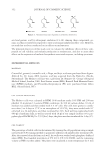
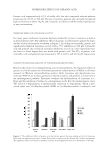
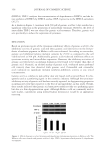
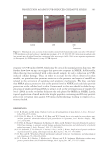
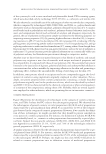
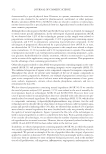
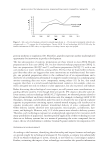
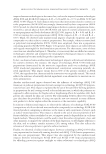
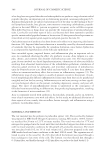
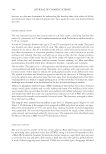
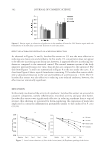
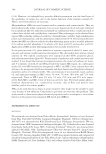
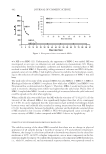
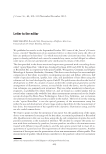
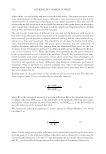
JOURNAL OF COSMETIC SCIENCE 402 w/o ME to an MBG (11). Unfortunately, the appearance of MBG-2 was turbid. ME was investigated as w/o type via dilution test and conductivity measurement (16). Hence, incompatibility between hydrophilic carbomer and hydrophobic external phase of ME resulted in turbid MBG-2. Expectably, adding mixture of carbomer and PEG-40 hydro- genated castor oil into MBG-3 had slightly achieved to stabilize the formulation, result- ing in the reduction of turbid appearance. However, the appearance of MBG-3 was still hazy. The rank order of viscosity of the prepared MBGs was also MBG-1 MBG-3 MBG-2. Rheological behavior of MBG-1 was plastic fl ow while that of MBG-2 and MBG-3 was Newtonian fl ow as demonstrated in Figure 1. Therefore, MBG-1 would not begin to fl ow until it received a shearing stress which was higher than the yield value. Plastic fl ow of MBG-1 implied that MBG-1 acted as a semisolid gel at stresses below the yield value and could be spread on the skin when applying. When colloidal silica was added into the ME with the viscosity of 74.44 ± 0.31 cP, the viscosity of the obtained MBG-1 was signifi cantly higher than that of its counterpart (p 0.05). It can be explained that the interconnected gel network via hydrogen bonds between water and colloidal silica resulted in strong interactions between ME droplets (23,24). Incompatibility between hydrophilic carbomer and hydrophobic external phase of ME resulted in low viscosity of MBG-2. PEG-40 hydrogenated castor oil might in- crease viscosity of MBG-3 when compared with MBG-2 due to its lipophilicity. STABILITY OF NICOTINAMIDE MICROEMULSION-BASED GELS The stability testing of the three MBGs revealed that there was no change in physical appearance of all samples during 2 months of storage at 4°C and ambient temperature. However, the change in color from yellowish to brownish was observed in the stored for- mulations at 60°C. At 60°C or higher temperature, one or more components in the for- mulations might decompose. To confi rm this assumption, each component in ME formulation, i.e., oleth-10, soybean oil, and nicotinamide aqueous solution, was separately stored at Figure 1. Rheograms of three nicotinamide MBGs.

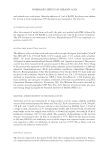
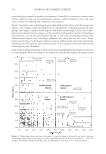
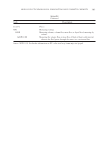
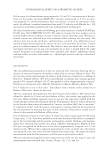
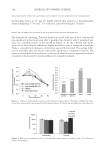
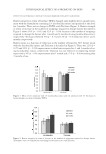
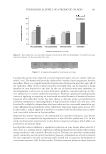
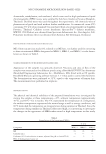
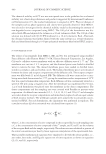
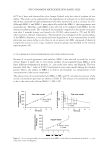
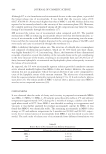
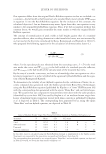
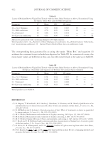
NICOTINAMIDE MICROEMULSION-BASED GELS 403 60°C for 2 days and observed for color change. Indeed, only the color of soybean oil was darker. The result can be explained by the degradation of soybean oil via lipid oxidation, which was catalyzed by high temperature like other natural oils such as coconut oil (25). Although MBG-2 and MBG-3 were physically stable like MBG-1, their appearance was unsatisfactory. Therefore, only MBG-1 was selected to be analyzed with HPLC for the chemical stability study. The content of nicotinamide compared to the initial concentra- tion after 2 months storage was found to be 99.98% when stored at 4°C and 98.18% when stored at ambient temperature. Nicotinamide was entrapped in the internal phase of the MBGs therefore, it was protected from degradation. It was reported that ascorbyl palmitate was more stable in w/o than in oil-in-water (o/w) MEs composed of identical components since its cyclic ring, oxidation sensitive group, was shielded in the internal aqueous phase (10). IN VITRO RELEASE OF NICOTINAMIDE FROM THE STUDIED FORMULATIONS Because of its good appearance and stability, MBG-1 was selected to study for in vitro release. Figure 2 shows the in vitro release profi les of nicotinamide from MBG-1 with three different mathematical models, i.e., zero order, fi rst order, and Higuchi. The best linearity with the r2 value of 0.9932 was found in zero order model during the studied period. Hence, the ability of MBG-1 to deliver nicotinamide was independent of the concentration of the active compound.. The release rates of nicotinamide from MBG-1, ME, and CC calculated as percent of the initial concentration per hour are shown in Table II. The release of nicotinamide tended to be in the rank order of from MBG-1 ME CC. Figure 2. In vitro release profi les of nicotinamide from MBG-1 with different mathematical models, i.e., zero order, fi rst order, and Higuchi.
Purchased for the exclusive use of nofirst nolast (unknown)
From: SCC Media Library & Resource Center (library.scconline.org)