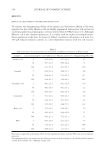
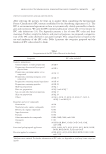
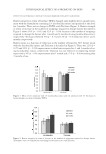
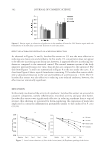
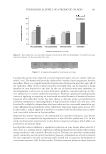
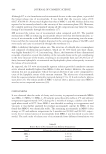
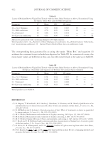
JOURNAL OF COSMETIC SCIENCE 404 Although C C is o/w formulation and nicotinamide locates in the outer phase, it provided the lowest release rate of nicotinamide. It was found that the viscosity value of CC (6827.87±549.63 cP) was much higher than that of MBG-1 and ME. Release ability was reported to be inversely related to the viscosity of the continuous phase (26). Moreover, the complex partition of nicotinamide among all the compositions may limit the trans- ferring of nicotinamide through the membrane (27). ME increased the release rate of nicotinamide when compared with CC. The possible mechanisms of ME in enhancing nicotinamide release were that the thermodynamic ac- tivity of nicotinamide in the ME could be modifi ed to favor partitioning into the mem- brane and that the nanosized droplets dispersed in the continuous phase of the ME could move easily and carry nicotinamide through the membrane (7). MBG-1 exhibited the highest release rate. The structure of colloidal silica is amorphous and composed of submicron-sized spheres, which are 40–60% fused into short chains, very highly branched, 0.1–0.2 microns long. Hence, the formation of three-dimensional networks of particles created the mobility of the network chains in the gel contributing to the loose structure of the matrix, resulting in nicotinamide burn out (28,29). Low af- fi nity between hydrophilic nicotinamide and hydrophobic phase subsequently increased the release of nicotinamide. As expected, the 3% w/w nicotinamide aqueous solution provided cumulative amount active released markedly higher than MBG-1 (data not shown). However, the aqueous solution was not an appropriate vehicle for topical delivery of any active compound be- cause of the lipophilic nature of the stratum corneum. The release rate of nicotinamide from the aqueous solution drastically increased during 0.5 to 12 h and reached a plateau state after 12 h. The release profi le of MBG-1 did not show a plateau state since MBG-1 acted as active compound reservoirs (30). CONCLUSIONS It was observed that the order of clarity and viscosity in prepared nicotinamide MBGs was MBG-1 MBG-3 MBG-2. All samples were physically stable at 4°C and ambient temperature (approximately 30°C) during the 2 months of storage a darker color devel- oped when stored at 60°C. Since MBG-1 was desirable according to its appearance and viscosity, it was further analyzed for residual nicotinamide content by HPLC. It was found that MBG-1 was chemically stable. The remaining nicotinamide in MBG-1 after storage at 4°C and ambient temperature for 2 months was 99.98% and 98.18%, respec- tively. In vitro release kinetics of nicotinamide from MBG-1 was best fi tted to zero order model. The rank order of release rate of nicotinamide from different formulations was Table II Release Rates of Nicotinamide from Different Formulations Sample Release rate (percent of initial concentration/hour) MBG-1 0.30716 ME 0.00029 CC 0.00019

NICOTINAMIDE MICROEMULSION-BASED GELS 405 MBG-1 ME CC. The addition of colloidal silica as a thickening agent in MBG-1 resulted in high release of nicotinamide due to loose structure of the matrix gel as well as low affi nity between the hydrophilic nicotinamide and the external hydrophobic phase of the formulation. On the basis of screening formulations, it was concluded that MBG-1 was a suitable formulation for topical nicotinamide due to its appearance, viscosity, sta- bility, and in vitro release characteristics. ACKNOWLEDGMENT The authors are grateful for fi nancial support received from Graduate School and Faculty of Pharmaceutical Sciences, Prince of Songkla University, Thailand. REFERENCES (1) M. Seiberg, C. Paine, E. Sharlow, P. Andrade-Gordon, M. Costanzo, M. Eisinger, and S. S. Shapiro, In- hibition of melanosome transfer results in skin lightening, J. Invest. Dermatol., 115, 162–167 (2000). (2) N. Otte, C. Borelli, and H. C. Korting, Nicotinamide – biologic actions of an emerging cosmetic in- gredient, Int. J. Cosmet. Sci., 27, 255–261 (2005). (3) D. L. Damian, C. R. Patterson, M. Stapelberg, J. Park, R. S. Barnetson, and G. M. Halliday, UV radiation- induced immunosuppression is greater in men and prevented by topical nicotinamide, J. Invest. Dermatol., 128, 447–454 (2008). (4) A. Kawada, N. Konishi, N. Oiso, S. Kawara, and A. Date, Evaluation of anti-wrinkle effects of a novel cosmetic containing niaciamide, J. Dermatol., 35, 637–642 (2008). (5) B. W. Barry, Novel mechanisms and devices to enable successful transdermal drug delivery, Eur. J. Pharm. Sci., 14, 101–114 (2001). (6) V. B. Junyaprasert and P. Boonme, Microemulsions for topical drug delivery, J. Ind. Pharm., 5, 21–29 (2002). (7) P. Boonme, Applications of microemulsions in cosmetics, J. Cosmet. Dermatol., 6, 223–228 (2007). (8) P. Boonme, Uses of microemulsions as novel vehicles in skin care products, HPC Today, 3, 18–20 (2009). (9) P. Boonme and S. Yotsawimonwat, Anti-ageing microemulsions and nanoemulsions, HPC Today, 5, 42–46 (2011). (10) P. Spiclin, M. Gasperlin, and V. Kmetec, Stability of ascorbyl palmitate in topical microemulsions, Int. J. Pharm., 222, 271–279 (2001). (11) P. Spiclin, M. Homar, A. Zupancic-Valant, and M. Gasperlin, Sodium ascorbyl phosphate in topical microemulsions, Int. J. Pharm., 256, 65–73 (2003). (12) M. Gallarate, M. E. Carlotti, M. Trotta, A. E. Grande, and C. Talarico, Photostability of naturally oc- curring whitening agents in cosmetic microemulsions, J. Cosmet. Sci., 55, 139–148 (2004). (13) N. Pakpayat, F. Nielloud, R. Fortune, C. Tourne-Peteilh, A. Villarreal, I. Grillo, and B. Bataille, For- mulation of ascorbic acid microemulsions with alkyl polyglycosides, Eur. J. Pharm. Biopharm., 72, 444– 452 (2009). (14) P. Boonme, V. B. Junyaprasert, N. Suksawad, and S. Songkro, Microemulsions and nanoemulsions: Novel vehicles for whitening cosmeceuticals, J. Biomed. Nanotechnol., 5, 373–383 (2009). (15) N. Suksawad, S. Songkro, and P. Boonme, Phase behavior of systems composed of oleth-10, water, vari- ous oils and cosurfactants, CD-ROM Proceedings of the 35th Congress on Science and Technology of Thailand (STT. 35), Chonburi, Thailand, M_M0003.pdf (2009). (16) N. Suksawad, S. Songkro, and P. Boonme, Kine tics of in vitro release of nicotinamide from non-ionic microemulsions, Proceedings of the 1st Current Drug Development International Conference (CDD2010), Phuket, Thailand, 212–215 (2010). (17) International Conference on Harmonization (ICH), Guidance for Industry, Q1A(R2): Stability Testing of New Drug Substances and Products, 2003, accessed November 2011, www.fda.gov/downloads/regulatory- information/guidances/ ucm128204.pdf. (18) L. Kumar and R. Verma, In-vitro evaluation of prepared topical gel of nimesulide, J. Chem. Pharm. Res., 2, 273–279 (2010).
Purchased for the exclusive use of nofirst nolast (unknown)
From: SCC Media Library & Resource Center (library.scconline.org)