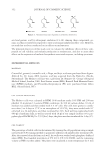
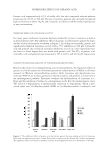
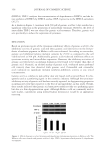
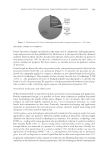
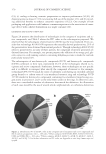
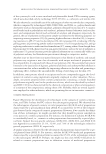
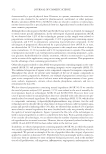
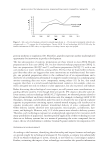
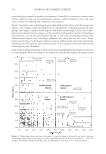
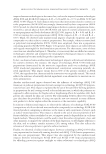
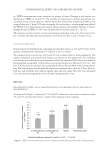
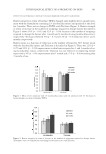
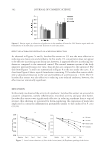
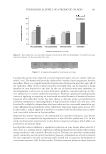
JOURNAL OF COSMETIC SCIENCE 356 (DHICA). TRP-2 catalyzes the tautomerization of dopachrome to DHICA, and the fu- ture oxidation of DHICA by DHICA oxidase (TRP-1) gives rise to the DHICA-eumelanin (26,27). As is shown in Figure 3, treatment with 500 μM of geranic acid for 3 days resulted in a signifi cant reduction in the generation of intracellular tyrosinase. However, the level of intracellular TRP-2 was not altered by geranic acid treatment. Therefore, geranic acid acts specifi cally to reduce the expression of tyrosinase. DISCUSSION Based on previous reports of the tyrosinase-inhibitory effects of geranic acid (11), the inhibitory activity of geranic acid and three geranic acid derivatives on the biosyn- thesis of melanin pigment in Melan-a cells was evaluated. According to our results, geranic acid inhibited relative melanin contents by 25.6% as compared to the cell viability level at 500 μM. Additionally, geranic acid evidenced inhibitory effects on tyrosinase activity and intracellular expression. However, the inhibitory activities of geranic acid derivatives on melanin formation were found to be weaker than that of geranic acid. Geraniol, an alcohol analog of geranic acid, evidenced more profound cell toxicity than was observed with geranic acid. Citronellol and citronellic acid evidenced no signifi cant melanin synthesis-inhibitory activity at any tested concentration. Geranic acid is a colorless to pale yellow clear oily liquid, with a typical fl avor. It is fre- quently used as a perfuming agent in the cosmetics industry. Although the tyrosinase- inhibitory activity of geranic acid has been recently reported, its depigmenting properties in melanocytes were fi rst reported, to the best of our knowledge, in this study. Overall, these results indicated that geranic acid may prove useful not only as a perfuming agent but also as a skin depigmentation agent. Although Melan-a cells are commonly used in such studies, experiments using normal human melanocytes would be an appropriate next step. Figure 3. Effects of geranic acid on tyrosinase and dopachrome tautomerase expression in Melan-a cells. The Melan-a cells were treated with geranic acid for 3 days. TRP-2 (tyrosinase-related protein-2) dopachrome tautomerase.

INHIBITORY EFFECTS OF GERANIC ACID 357 ACKNOWLEDGMENT This work was supported by a grant from the Korea Healthcare Technology R&D Project, Ministry for Health, Welfare, and Family Affairs, Republic of Korea (A060001) and the Technology Development Program for Agriculture and Forestry, Ministry of Agriculture and Forestry, Korea. REFERENCES (1) S. Suola and B. Kitchell, The biology of melanocytes, Vet. Dermatol., 14, 57–65 (2003). (2) J. Y. Lin and D. E. Fisher, Melanocyte biology and skin pigmentation, Nature, 445, 843–850 (2007). (3) L. Baumann, Cosmetic Dermatology (The McGraw-Hill Companies, New York, 2001). (4) Y. Miyamura, S. Coelho, R. Wolber, S. Miller, K. Wakamatsu, B. Z. Zmudzka, S. Ito, C. Smuda, T. Passeron, W. Choi, J. Batzer, Y. Yamaguchi, J. Z. Beer, and V. J. Hearing, Regulation of human skin pigmentation and responses to ultraviolet radiation, Pigment Cell Res., 20, 2–13 (2006). (5) N. Wang and D. N. Hebert, Tyrosinase maturation through the mammalian secretory pathway: bring- ing color to life, Pigment Cell Res., 19, 3–18 (2006). (6) H. Ando, H. Kondoh, M. Ichihashi, and V. J. Hearing, Approaches to identify inhibitors of melanin biosynthesis via the quality control of tyrosinase. J. Invest. Dermatol., 127, 751–761 (2007). (7) S. Parvez, M. Kang, H. S. Chung, C. Cho, M. C. Hong, M. K. Shin, and H. Bae, Survey and mechanism of skin depigmenting and lightening agents, Phytother. Res., 20, 921–934 (2006). (8) S. Okombi, D. Rival, S. Bonnet, A. Mariotte, E. Perrier, and A. Boumendjel, Discovery of benzylidenebenzofuran-3(2H)-one(Aurones) as inhibitors of tyrosinase derived from human melano- cytes, J. Med. Chem., 49, 329–333 (2006). (9) B. Hoschle and D. Jendrossek, Utilization of geraniol is dependent on molybdenum in Pseudomonas aeruginosa: evidence for different metabolic routes for oxidation of geraniol and citronellol, Microbiology, 151, 2277–2283 (2005). (10) W. A. M. Wolken and M. J. Werf, Geraniol biotransformation-pathway in spores of Penicillium digitatum, Appl. Microbiol. Biotechnol., 57, 731–737 (2001). (11) T. Masuda, Y. Odaka, N. Ogawa, K. Nakamoto, and H. Kuninaga, Identifi cation of geranic acid, a tyrosinase inhibitor in Lemongrass (Cymbopogon citratus), J. Agric. Food Chem., 56, 597–601 (2008). (12) J. J. Mateo, N. Gentilini, T. Huerta, M. Jimenez, and R. Stefano, Fractionation of glycoside precursors of aroma in grapes and wine, J. Chromatogr. A, 778, 219–224 (1997). (13) S. Selli, T. Cabaroglu, A. Canbas, H. Erten, and C. Nurgel, Effect of skin contact on the aroma composi- tion of musts of Vitis vinifera L. cv. Muscat of Bornova and Narince grown in Turkey, Food Chem., 81, 341–347 (2003). (14) T. Chatterjee, Biotransformation of geraniol by Rhodococcus sp. Strain GR3, Biotechnol. Appl. Biochem., 39, 303–306 (2004). (15) S. S. Joglekar and R. S. Dhavlikar, Microbial transformation of terpenoids, Appl. Microbiol., 18, 1084– 1087 (1969). (16) W. Wolken, J. Tramper, and M. Werf, Toxicity of terpenes to spores and mycelium of Penicillium digita- tum, Biotechnol. Bioeng., 80, 685–690 (2002). (17) Y. H. Kong, Y. O. Jo, C. Cho, D. Son, S. Park, J. Rho, and S. Y. Choi, Inhibitory effects of cinnamic acid on melanin biosynthesis in skin, Biol. Pharm. Bull., 31, 946–948 (2008). (18) T. P. Dooley, R. C. Gadwood, K. Kilgore, and L. M. Thomasco, Development of an in vitro primary screen for skin depigmentation and antimelanoma agents, Skin Pharmacol., 7, 188–200 (1994). (19) J. H. Kim, S. H. Baek, D. H. Kim, T. Y. Choi, T. J. Yoon, J. S. Hwang, M. R. Kim, H. J. Kwon, and C. H. Lee, Downregulation of melanin synthesis by haginin A and its application to in vivo lightening model, J. Invest. Dermatol., 128, 1227–1235 (2008). (20) A. Poma, S. Bianchini, and M. Miranoa, Inhibition of L-tyrosine-induced micronuclei production by phenylthiourea in human melanoma cells, Mutation Res., 446, 143–148 (1999). (21) S. R. Gallagher, Digital image processing and analysis with image J, Current Protocols Essential Laboratory Techniques, 3, A.3C.1–A.3C.24 (2010). (22) S. Shono and K. Toda, “The Effect of Fatty Acids on Tyrosinase Activity,” in Pigment Cell, M. Seiji Ed. (University of Tokyo Press, Tokyo, 1981), pp. 263–268.
Purchased for the exclusive use of nofirst nolast (unknown)
From: SCC Media Library & Resource Center (library.scconline.org)