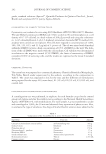
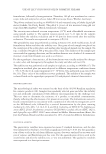
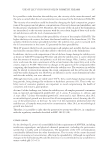
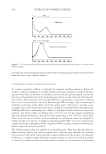
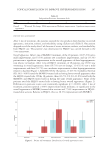
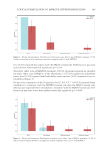
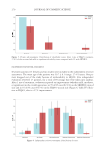
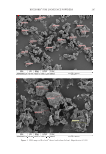
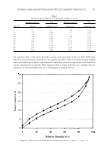
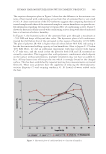
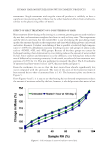
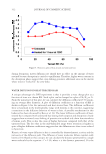
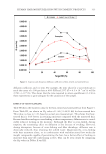
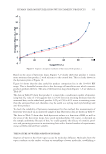
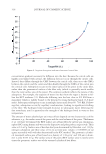
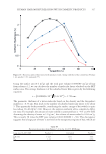
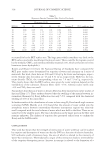
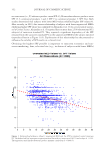
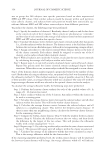
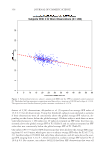
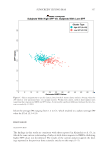
JOURNAL OF COSMETIC SCIENCE 312 during desorption. Lower diffusion rate should have no effect on the amount of water retained because desorption is carried to equilibrium. Therefore, higher water contents in the desorption phase suggest that cross-linking generates additional areas in the matrix where water is “locked-in” by cross-links. WATER DIFFUSION IN HEAT-TREATED HAIR A unique advantage of a DVS experiment is that it provides a mass change plot as a function of time at a chosen RH. Such a plot can be changed to a plot of Mt/Meq vs t. From the initial rate of this plot, we can calculate the diffusion coeffi cient D (9) assum- ing an average fi ber diameter. A plot of diffusion coeffi cient as a function of RH is shown in Figure 6 for the untreated and heat-treated hair. The diffusion coeffi cients show a maximum in the mid-humidity range with minima at the extremes, suggesting a transition in the diffusion behavior of water in hair. A possible mechanism for this behavior has been discussed by Keis et al. (9). The lower diffusion coeffi cients of heat- treated hair compared with untreated hair during both sorption and desorption clearly suggests heat-activated cross-linking of proteins via residual side chain functionalities of amino acids. This is also the cause of higher hysteresis compared with that of the untreated hair. The fact that in the mid-humidity range water retention is higher in spite of higher diffusion coeffi cients suggests that the diffusion rate alone is not related to hysteresis. Kinetics of water va por diffusion in hair is controlled by thermodynamic activity and the tortuosity of the diffusion path. The diffusion of water molecules follows random walk kinetics (10). Based on this concept, we can calculate the distance penetrated by a single water molecule by the equation: x2 = 2 Dt, where x is the distance penetrated, D is the Figure 5. Hysteres i s plots of heat-treated and untreated hair.

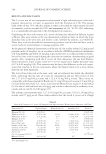
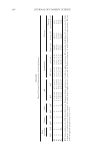
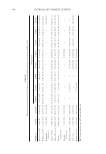
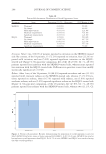
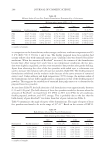
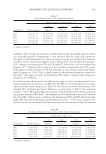
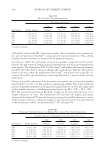
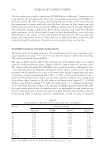
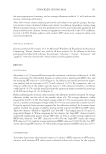
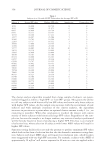
HUMAN HAIR MOISTURIZATION WITH COSMETIC PRODUCTS 313 diffusion coeffi cient, and t is time. For example, the time taken for a water molecule to reach the center of a 100-μm hair at 40% RH and 25°C (D = 4.5 × 10⁻⁹ cm2/s) will be 2,780 s (~0.75 h). This shows that the time required to attain equilibrium (2–3 h) in these experiments is quite adequate for the saturation of the sample. EFFECT OF CROSS-LINKING Table III shows the hysteresis data for the heat-treated and untreated hair from Figure 5. From Table III, we obtain an HR value of 1.44 (31.44/21.88) for heat-treated hair. This value is close to 1.45, based on actual area measurement. This shows that heat- treated hair is 44% better in retaining moisture compared with the untreated hair. Because hair fi ber undergoes cross-linking at these temperatures, diffusion rate is consid- erably reduced, locking-in the moisture. Although the fi ber is cross-linked, during sorption, the restraining effect on diffusion is less because of swelling. However, during desorption, because of cross-linking and fi ber shrinkage, diffusion rate is drastically reduced, thus retaining the sorbed water. Quantitatively, cross-linking with heat treatment alone, or in combination with multifunctional low molecular weight compounds capable of penetrating the hair, has a better effect of locking-in moisture than rinse-off conditioning actives. This can be seen clearly by comparing the HR values in Tables II and III. Figure 6. Sorption a nd desorption diffusion coeffi cients of heat-treated and untreated hair.
Purchased for the exclusive use of nofirst nolast (unknown)
From: SCC Media Library & Resource Center (library.scconline.org)