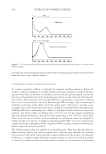
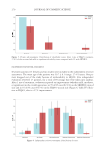
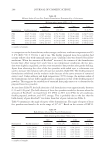
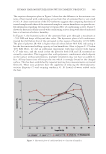
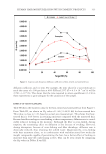
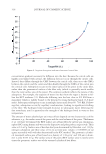
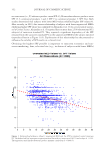
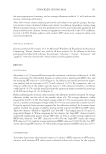
JOURNAL OF COSMETIC SCIENCE 316 concentration gradient necessary for diffusion into the hair. Because the cuticle cells are highly cross-linked with cystine, the diffusion does not occur through the cuticle cells. Instead, they diffuse through the CMC between the cuticle cells, then on to the CMCs between the cuticle and the cortex and then fi nally through the CMCs of the cortex into the cortical cells. Adsorption occurs on the inner surfaces of the pores in the entire fi ber, rather than the geometrical surface of the fi ber only (which is generally much smaller than the total surface area of the pores). The sorption isotherm refl ects the nature of this adsorption. For example, the sorption of water into hair from the vapor is known to fol- low the BET isotherm (11). Molecules diffusing into the hair close to 0% RH form a monolayer which is tightly bound to the keratin by strong hydrogen bonds (5–8 kcal/ mole). Subsequent adsorption occurs in multiple layers until about 60–70% RH. Follow- ing this, adsorption occurs by capillary condensation, leading to signifi cant swelling of the fi ber. The hydrogen bond strength decreases in subsequent layers following the fi rst monolayer, until it approaches the strength of the hydrogen bond in water at that temperature. The amount of water adsorbed per unit mass of hair depends on two characteristics of the substrate, e.g., the surface area of the pores and the total volume of the pores. Thielmann et al. (12) have determined the BET surface area of hair fi bers by inverse gas chromatog- raphy (IGC) using hexane and water as the dispersive and polar probes, respectively. Their value is 0.3 m2/g. Surface area of hair has also been determined by Hessefort et al. (13) by nitrogen adsorption and their value of 0.4 m2/g (total pore volume = 0.000689 cm3/g) agrees reasonably well with that determined by the IGC method. The geometric cylindri- cal (assumed) surface area of hair based on a density of 1.38 g/cm3 and 100 μm in diam- eter is only 0.055 m2/g. The surface area of the pores (BET surface area) is nearly seven times the geometric surface area of the assumed cylindrical hair fi bers. Figure 9. Sorption–desor p tion isotherms of untreated control hair.

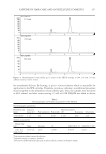
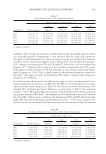
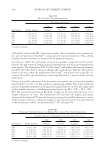
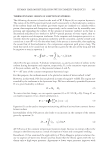
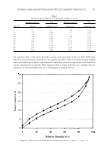
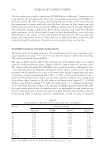
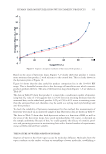
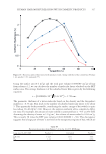
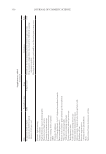
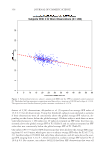
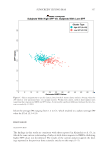
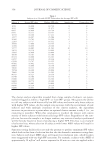
HUMAN HAIR MOISTURIZATION WITH COSMETIC PRODUCTS 317 U sing the surface area (0.4 m2/g) and the total pore volume (0.000689 cm3/g) of hair from reference 12, we can calculate the number of molecular layers adsorbed on the BET surface area. The average thickness t of the adsorbed water fi lm is given by t he following equation: q q 21 18 0.000689 10 0.4 10 1.723 nm. t The geometric thickness of a water molecule based on the density and the Avogadro’s number is ~0.33 nm. This leads to the number of adsorbed molecular layers to be about 5. This apparently looks reasonable, considering the surface energy of hair which is quite low (about 30–40 mJ/m2) (14). However, the sorption isotherm tells a completely differ- ent story. For example, the amount of water sorbed in untreated hair is ~4% at 20% RH. Assuming the density of water as 1.0 g/cm3, the volume of water sorbed is 0.04 cm3/g. This is nearly 58 times the BET pore volume (0.04/0.000689 = ~58). This discrepancy suggests that a large part of water is not held in the nanoporous regions of hair, which are Figure 10. Hysteresis plot s of hair treated with products 1 and 2 along with that of the control hair. Product 1 (x) product 2 (¡) untreated (). Table IV Hysteresis Loop Areas from Figures 7–9 in the 10–60% RH Range Loop area 10–60% RH Product 1 Untreated Product 2 ¦Hi (%) 14.23 10.0 5.84 HR 1.42 1.0 0.58
Purchased for the exclusive use of nofirst nolast (unknown)
From: SCC Media Library & Resource Center (library.scconline.org)