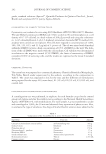
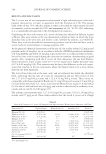
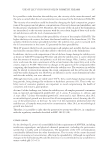
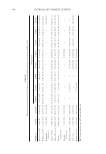
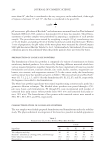
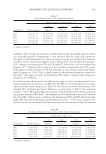
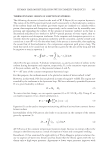
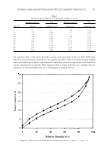
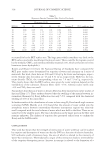
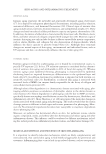
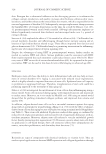
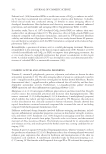
JOURNAL OF COSMETIC SCIENCE 318 accounted for by the BET surface area. The large pores which contribute very little to the BET surface area hold a much larger fraction of water. These could be the regions covered by the medulla, CMCs, and intermacrofi brillar materials (15), which are known to be less keratinous (more hydrophilic). Ro wen and Blaine (16) from the National Bureau of Standards have compared the BET pore surface areas determined by sorption of water and nitrogen on a series of materials. For wool, their data are 206 and 0.96 m2/g for water and nitrogen, respec- tively. Similar data for nylon are 45 and 0.31 m2/g, respectively. However, for tita- nium dioxide (TiO2), the corresponding values are 7.0 and 7.9 m2/g, respectively. This clearly shows that the BET surface areas given by water sorption depend on the swellability of the substrate. Keratin fi bers swell ~15%, whereas nylon swells only ~4% and TiO2 does not swell. No nuniform distribution of water in keratin fi bers has been known from earlier studies of Spei and Zahn (17). These authors observed that the swelling of the matrix between in- termediate fi laments by X-ray diffraction was only 5.5% compared with the diametral swelling of 16% of the entire fi ber. In further studies of the distribution of water in hair using D2O and small angle neutron scattering (SANS), Murthy et al. (18) found that the amount of water sorbed into the amorphous matrix between intermediate fi laments (nanoporous region) was relatively small compared with the total volume of water which was held in the fi ber. These are as- sumed to be the smallest pores. The exact distribution in the larger pores in the fi ber still remains unknown. The analysis of sorption data presented earlier seem to confi rm the X-ray and the SANS results. CO NCLUSIONS Th is work has shown that the strength of interaction of water with hair can be studied by sorption and desorption of water into hair by DVS as a function of relative humidity. S-D isotherms yield a hysteresis loop, the area of which is related to the intensity of water–hair interaction. Thermodynamic origin of this interaction leads to irreversibility of the sorption–desorption process. Increase in entropy is related to the formation of a Table V Hysteresis Data for Untreated Hair Used in This Study RH (%) Hysteresis, H (%) Average H 95% confi dence level S1 S2 S3 S4 S5 10 0.88 0.95 0.9 1.01 0.92 0.93 0.063 20 1.2 1.31 1.22 1.32 1.26 1.26 0.066 30 1.49 1.49 1.45 1.54 1.47 1.49 0.042 40 1.88 1.82 1.83 1.72 1.67 1.78 0.107 50 2.22 2.24 2.32 2.08 1.9 2.15 0.205 60 2.33 2.45 2.73 2.24 2.07 2.36 0.306 70 1.28 1.4 1.92 1.29 1.43 1.46 0.326 80 0.55 0.65 0.71 0.51 0.59 0.60 0.099 90 0.17 0.34 0.19 0.05 0.20 0.19 0.128 ¦Hi 12.00 12.65 13.27 11.76 11.51 12.24 0.894

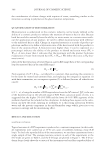
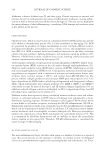
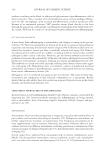
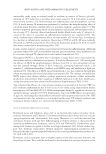
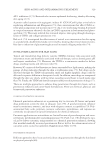
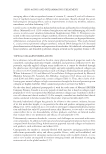
HUMAN HAIR MOISTURIZATION WITH COSMETIC PRODUCTS 319 swollen hair–water composite. A method has been developed to convert simple hysteresis data into a hysteresis ratio HR which can quantify the ability of hair treated with products and processes to retain (or repel) moisture as compared with the corresponding untreated hair. Work described in this communication shows that cross-linking with heat is more effective in retaining moisture as compared with rinse-off conditioning actives. The work described in this communication can be used to evaluate “moisturizing” or “anti- moisturizing” actives and products. Such information will be useful for formulators. The nature of sorption of water into the hair substrate has been considered from a molecular perspective. Swelling of the sorbent has a major effect on the measurement of pore vol- ume and surface area by the BET method. This analysis clearly shows that a large fraction of water is held in larger pores and is not accounted for by the BET analysis. This creates a discrepancy between the results of BET analysis by gas (nitrogen or carbon dioxide) adsorption and the DVS results obtained with sorption of water. Using carefully prepared hair samples, we have been able to show the effectiveness of DVS method in quantifying effi cacy of cosmetic formulations and processes with a limited number of experiments where the effects were robust. In the case of weak effects, adequate number of replicates will be necessary to establish statistically signifi cant outcomes. AC KNOWLEDGMENTS So me of the work reported in this communication was performed during the late nineties by Dr. Cordula Wilrich and Amy Lyttle at TRI/Princeton. The author gratefully acknowl- edges their contribution. Also, the author is thankful to Dr. David Graham, President of TRI for permission to publish this paper. RE FERENCES ( 1 ) C. R. Robbins, Chemical and Physical Behavior of Human Hair, 3rd Ed. (Springer-Verlag, New York, NY, 1994), pp. 23–28. ( 2 ) C. C. Wagner, P. K. Kiyohara, M. Silveira, and I. Joekes, Electron microscopic observations of human hair medulla, J. Microsc., 226, 54–63 (2007). (3 ) Nagase, S. Shibuichi, K. Ando, E. Kariya, and N. Satoh, Infl uence of structure of hair fi ber on hair ap- pearance. I. Light scattering from the porous structure of the medulla of human hair, J. Cosmet. Sci., 53, 89–100 (2002). ( 4 ) W. P. Bryan, Sorption hysteresis and the laws of thermodynamics, J Chem. Educ., 64, 209–212 (1987). ( 5 ) S. Rosenbaum, Solution of water in polymers: the keratin-water isotherm, J. Polym. Sci., C31, 45–55 (1970). ( 6 ) Y. K. Kamath, H.-D. Weigmann, and C. J. Dansizer, Surface wettability of human hair, Part 1: effect of deposition of polymers and surfactants, J. Appl. Polym. Sci., 29, 1011–1026 (1984). ( 7 ) W. J. Moore, Physical Chemistry, 3rd Ed. (Prentice-Hall, Englewood-Cliffs, NJ, 1964), p. 191. ( 8 ) S. B. Ruetsch and Y. K. Kamath, Penetration of cationic conditioning compounds into hair fi bers, J. Cosmet. Sci., 56, 323–330 (2005). ( 9 ) K. Keis, C. L. Huemmer, and Y. K. Kamath, Effect of oil fi lms on moisture vapor absorption on human hair, J. Cosmet. Sci., 58, 135–145 (2007). (1 0 ) W. J. Moore, Physical Chemistry, 3rd Ed. (Prentice-Hall, Englewood-Cliffs, NJ, 3rd Edition, 1964), Vol. 964, pp. 341–343. (11) S. Ross and I. D. Morrison, Colloidal Systems and Interfaces (John Wiley & Sons, New York, NY, 1988), pp. 50–53. (12) F. Thielmann, D. Pearce, and Y. Kamath, The characterizationof surface area and surface heterogeneity profi les of hair by inverse gas chromatography, IFSCC Mag., 5, 189–193 (2002).
Purchased for the exclusive use of nofirst nolast (unknown)
From: SCC Media Library & Resource Center (library.scconline.org)