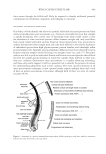
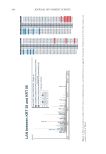
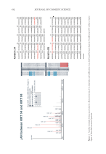
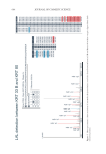
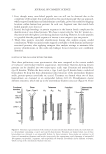
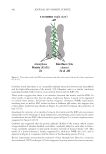
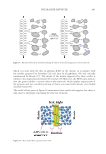
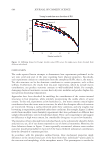
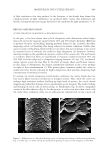
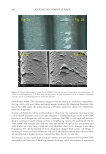
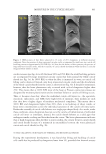
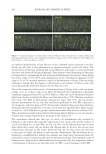
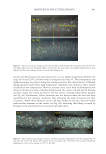
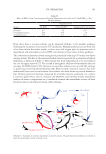
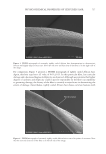
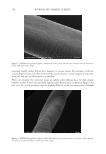
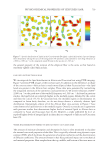
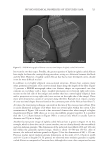
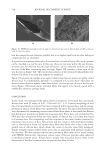
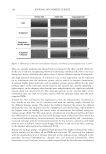
694 JOURNAL OF COSMETIC SCIENCE Since in blister formation, the portion of cuticle cells that is lifted consists of the epicuticle and exocuticle joined together, leaving behind endocuticular remnants, we will refer to this type of lifting as exocuticular delamination. This contrasts with what was observed before for endocuticular lifting, in which the solid portion of cuticle cell that was lifted consisted of the epicuticle, exocuticle, and endocuticle glued together. Its mechanism of formation can again be explained by changes occurring in the interlayer moduli as the exocuticle, endocuticle, and CMC lose moisture. When the hot iron surface enters transiently in contact with the hair surface, it rapidly dehydrates and hardens the epicuticle and exocuticle, while contracting the endocuticle. The contracting and hardening of these layers cause stress concentrations across the exocuticle and endocuticle causing their junction to break with a slight lifting leading to blister formation. SHAPE RECOVERY OF LIFTED OR BUCKLED CUTICLE CELLS BY HYDRATION It is well known that water acts as the main plasticizer of keratin fibers (7), and water plasticization effects on hair have been mainly ascribed to hydration effects in the amorphous proteins of the cortex. However, moisturizing video experiments carried out with hair fibers presenting lifted and buckled cuticle cells showed that the cuticle cells also sense changes of moisture in the environment. In these experiments, the cuticle cells were seen to respond almost immediately, particularly when exposed to high levels of moisture. This rapid response occurs as long as their endocuticle is not damaged and therefore indicates that the cuticle cells undergo plasticization as they absorb moisture from the environment. The video experiments showed that the light interference patterns (LIPs) corresponding to lifted cuticle cells disappear almost instantaneously as the hair is exposed to small puffs of air containing high levels of moisture (i.e., 90% RH). The LIPs disappear when the endocuticle of the lifted or buckled cuticle cells is plasticized by water and allows them to recover their normal shape. This recovery process closes the air gap between lifted cuticle cells and those immediately below. Furthermore, when puffs of moisturized air containing lower levels of moisture (i.e., 70% RH) were applied to hair there was no plasticization and shape recovery. The above experiments indicate that for cuticle cell shape recovery to occur, the endocuticle requires high levels of water absorption. This contrasts with other observations showing that thermal delamination only occurs when the endocuticle loses high levels of moisture, strongly suggesting that the endocuticular protein structure has the characteristics of a hydrogel in its native state. Such structure will allow it to absorb high levels of water when exposed to the environment. Furthermore, the experiments suggest that not only the endocuticle but also other cuticle cell layers exchange moisture with the environment. Unfortunately, currently, there is no available technique by which one can obtain the thermal water absorption isotherm of the cuticle sheath separately from the cortex. Thus, the inference is that moisturization effects on the cuticle sheath must rely on indirect observations such as the one described in this paper. BUCKLING AND LIFTING CUTICLE CELLS BY IMMERSION IN ISOPROPYL ALCOHOL As it was shown in the previous section, lifted and buckle-shaped cuticle cells with failure at the CMC can recover their normal shape through rehydration. In fact, the recovery was so efficient that when the hair was analyzed again by microscopy, the previously lifted

695 MOISTURE IN THE CUTICLE SHEATH cuticle cells appeared in a flat position, as if they were cemented like normal cuticle cells. However, as will be discussed later, this is just a superficial change, as the cement had been broken before, and, therefore, the apparent normal cells were readily lifted again by solvent dehydration. For instance, videorecording analysis showed that when these fibers were immersed in isopropyl alcohol (IPA), the apparently normal-looking cuticle cells immediately lifted and buckled again. It should be mentioned here that real normal cuticle cells (i.e., ones not previously decemented) did not show such lifting behavior upon IPA immersion. The phenomenon of cuticle cell lifting and buckling with IPA can be explained by considering the fact that such a solvent dehydrates the endocuticles of apparently normal looking cuticle cells, causing them to contract, lift, and buckle again. This important observation confirms that the protein structure of the endocuticle behaves like a hydrated gel, which contracts as it loses water, causing cuticle cell buckling once the cement is broken. CUTICLES CELLS ARE NOT SENSITIVE TO MOISTURE EVAPORATION So far, enough evidence has been presented indicating that the shape of most cuticle cells in hair fibers is sensitive to moisture. However, during the experimental analysis, it was often found that some cuticle cells do not change shape by either dehydration or rehydration. For instance, the videorecording technique showed that while there are regions of cuticle cells that rapidly undergo lifting and buckling by thermal dehydration during blow drying and elongation, there were also other regions where the cuticle cells did not change shape at all. This observation was true even for long periods of blow drying. Likewise, some cuticle cells that had been de-cemented and buckled either by high elongations or thermal stresses did not recover their shape when hydrated even after long periods of water immersion. Both observations point toward a lack of responsiveness to moisture changes in the cuticle cell. Such a phenomenon indicates the possibility that proteins in the endocuticle of these cuticle cells lost their native structure in a process akin to denaturation. It could also be that other structures in the cuticle cell layers were mechanically denatured or damaged. CONCLUSION The experiments discussed above indicate that the mechanical properties and damage patterns of hair cuticle cells are not only sensitive to their moisture content but also to its rate of evaporation. In addition, the results also indicate that in its undamaged form, the endocuticle, exocuticle, and CMC protein structures have a balanced moisture distribution, which allows them to work as an assembly in the transfer of mechanical stresses, providing resistance to damage. The analysis also indicates that cuticle cell buckling can be produced by either only mechanical stresses or by a combination of mechanical and thermal stresses. Two patterns of cuticle cell thermomechanical buckling could be distinguished, namely, endocuticular and exocuticular. Both seem to be driven by transient dehydration of the endocuticle and to a certain extent of the exocuticle. The former is characterized by rupture of the CMC cementing top cuticle cells to those immediately underneath, while the second is characterized by the rupture of the cement between exocuticle and endocuticle. Finally, the results also suggest that the endocuticular protein structure behaves like a hydrogel, which interchanges moisture with the environment.
Purchased for the exclusive use of nofirst nolast (unknown)
From: SCC Media Library & Resource Center (library.scconline.org)