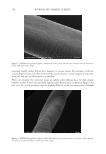
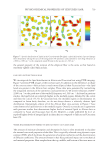
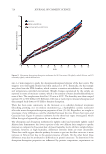
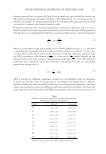
714 JOURNAL OF COSMETIC SCIENCE Cross-sectioned hair (5 μm thickness) was used to ensure a linear transmission detector response for the entire IR spectral range. For each of the scans, the spatial resolution of each pixel was 6.25 × 6.25 μm, where each pixel provided a complete mid-IR spectrum. FTIR maps were generated with ISys software (Malvern Panalytical Ltd., Malvern, UK). The concatenated images were then baseline corrected from the base of the Amide II band to 900 cm−1 prior to truncation of the spectra and images (150 × 150 μm). Resulting spectra were processed with GRAMS/AI™ software (Thermo Fisher Scientific, Waltham, MA). DYNAMIC VAPOR SORPTION (DVS) OF HAIR Water vapor absorption curves were obtained using a TA Instruments Q5000 SA sorption analyzer (TA Instruments, New Castle, DE). All experiments were conducted at 25˚C with a nitrogen gas flow of 200 mL/min. Hair was cut into 1–2 mm snippets, and 10 mg ± 0.5 was loaded into a stainless-steel mesh sample pan. The following sorption- desorption procedure was applied: (1) initial drying: 60˚C and 0% relative humidity (RH) for 120 min (2) isothermal equilibration: 25˚C and 0% RH for 15 min (3) absorption curve: fiber snippets were subjected to increasing humidity in 10% RH steps from 0% to 90% RH (720 min at each step) and (4) desorption curve: after the absorption sequence, the water vapor was progressively desorbed from the sample by lowering the humidity in 10% RH steps from 90% to 0% RH (720 min at each step). TENSILE STRENGTH MEASUREMENTS OF HAIR Tensile strength measurements were carried out with a system manufactured by Dia-Stron Ltd. (Andover, UK) equipped with a Tensile Tester (Type MTT690), Fiber Micrometer (Type FDAS770), and Automated Loading System (ALS1500). The entire unit is housed in an ETS Controlled Environment Chamber (Model 5533) designed and built by Electro-Tech Systems, Inc. (Glenside, PA). The fiber micrometer was a Mitutoyo Laser Scan Micrometer (Model LSM-6200) from Mitutoyo Corporation (Kawasaki, Japan). UvWin (version 3.60, build 8) software was used to operate the tensile tester system, which was controlled by a UV 1000 Control Unit and PU 1100 Pneumatics Unit (Dia-Stron Ltd.). The following parameters were used for the tests: method type–MTT680 Extension extension—100%, mm rate—20 mm/min start position—30 mm gauge force—3 g maximum force—2,000 g cycles—1 cycle number—1 break detect force—5 g end angle—360 slices—1 filter width—32 data interval—80 ms proportional gain—25 integral gain—2 derivative gain—50 system offset—24,650. Fibers were crimped prior to testing using brass crimps with a custom-designed press. The length of each fiber between the two crimps was 30 mm. Studies were carried out at 65% RH and 100% RH at room temperature (22°C). The crimped fibers were placed on a black anodized aluminum carousel, also manufactured by Dia-Stron Ltd., that contained 100 small compartments to house individual fibers. Humidity was controlled by the environmental chamber for the 65% RH tests however, 100% RH tests were carried out by adding water to the fiber compartments of the sample cassette resulting in the fiber being submerged.

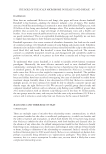
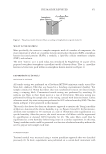
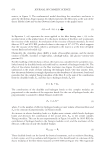
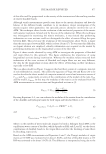
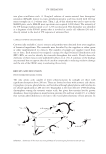
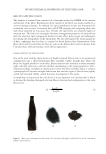
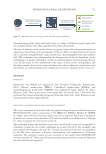
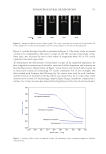
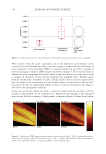
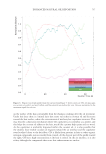
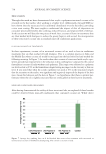
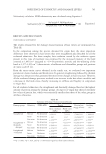
715 PHYSICOCHEMICAL PROPERTIES OF TEXTURED HAIR RESULTS AND DISCUSSION The analysis of textured hair consisted of a thorough analysis by FESEM of the exterior and interior of the fibers. Examination of the interior of the fibers was made possible by a cross-sectioning technique. In addition, the lipid distribution in hair was determined by examining cross-sections of textured hair with FTIR imaging and comparing these data with those obtained for Caucasian hair. Overall, the lipid levels are relatively higher in textured hair. This led us to investigate the water management properties of textured hair with the idea that lipid composition would certainly affect water regain and subsequent loss during the drying phase of the experiment. We also investigated the tensile properties of hair, confirming that less force is required to break African hair. Examination of the fibers after break revealed that the fracture zone in the African hair cortex is distinct from Caucasian hair, while presenting a more fibrous appearance. CHARACTERISTICS OF AFRICAN HAIR One of the most striking characteristics of highly textured African hair is its geometrical configuration into a three-dimensional fiber assembly. Unlike straight hair, where the fibers are aligned parallel to each other, African hair has the tendency to form extremely tight curls that interweave with one another contributing to the optical properties, three- dimensional shape, and physical characteristics of the hair fiber assembly. Figure 1 contains a photograph of Caucasian straight dark brown hair and two types of African hair (tightly curled and extremely tightly curled) that were investigated in this study. A simple way to characterize the curl of hair is to use Equation 1 to calculate the CI, which is obtained by dividing the length of a hair fiber in the stretched configuration to the same fiber at rest: CI Length Length stretched rest = (1) Figure 1. Hair types investigated in this study: (A) Caucasian, (B) tightly curled African, and (C) extremely tightly curled African.
Purchased for the exclusive use of nofirst nolast (unknown)
From: SCC Media Library & Resource Center (library.scconline.org)