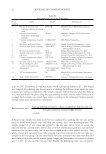
15 COMPARATIVE CLINICAL EVALUATION OF C LAPPACEA SUPPLEMENTARY MATERIALS Ingredients in the C lappacea extract cream: ethylhexyl methoxycinnamate, propylene glycol, octocrylene, isopropyl palmitate, glycerin, butyl methoxydibenzoylmethane, cetyl alcohol, Cl 77,891, cetearyl alcohol, ammonium acryloyldimethyltaurate/VP Copolymer, centella asiatica extract, aloe barbadensis leaf juice, ceteareth-20, diazolidinyl urea, citrus aurantium amara flower oil, fragrance, methylparaben, C lappacea extract, tocopheryl acetate, disodium ethylenediaminetetraacetic acid, propyl paraben, polysorbate 80, sodium benzoate, Cl 42,090, chlorphenesin, Cl 19,140, methylisothiazolinone, and deionized water. The control product was identical but excluded the C lappacea extract. AUTHOR CONTRIBUTIONS O.R. and W.P. conceived the project, designed the trial, performed all data collection, analyzed and interpreted the experimental results, and wrote the manuscript. M.T. contributed to experimental design, supported the clinical trial, helped interpret experimental results, and managed the research project. A.I. and T.K. contributed to experimental design, supported the clinical trial, helped interpret experimental results, managed the research project, and approved the final manuscript. ACKNOWLEDGMENTS The authors would like to thank the Thai Traditional Medical Knowledge Fund and Research and Development Institute, as well as Suan Sunandha Rajabhat University (Bangkok, Thailand), for financial support and assistance. The authors additionally thank everyone who cooperated and assisted with this study. REFERENCES (1) M.A. Farage, K.W. Miller, P. Elsner, H.I. Maibach, Characteristics of the aging skin, Adv. Wound. Care., 2, 5–10 (2013). (2) N.A. Vashi, M.B de Castro Maymone, R.V. Kundu, Aging differences in ethnic skin, J. Clin. Aesthet. Dermatol., 9, 31–38 (2016). (3) M. Norsaengsri, P. Chantaranothai, The tribe Centotheceae (Poaceae) in Thailand, Thai. For. Bull (Bot.)., 36, 52–60 (2008). (4) T. Kamoltham, S. Rungsimakan, K. Supan, and P. Rodsienglump, Chemical constituents of Centotheca lappacea (L.) Desv. Aerial parts, J. Thai. Trad. Alt. Med., 15, 14–29 (2017). (5) T. Kamoltham, J. Manosroi, C. Chankhampan, W. Manosroi, and A. Manosroi, In vitro anti-aging activities of Centotheca lappacea (L) desv. (Ya repair) extract, Chiang. Mai. J. Sci., 44(X): 1–12 (2017). (6) J. Tinlapat, K. Ingkaninan, S. Meethang, S. Munsing, and A. Hematulin, The radioprotective potential of Centotheca lappacea (L) desv. extract in human endothelial cell, J. Assoc. Med. Sci., 53, 55–61 (2020). (7) N. Mookratsameepath and N. Sirisoontornluk, Study and development of Centotheca Leppacea (L.) Desv. extract for cosmetic applications, A Special Project for the Degree of Doctor of Pharmacy, Faculty of Pharmacy, Mahidol University, 2015. (8) H. S. Ryu, Y. H. Joo, S. O. Kim, K. C. Park, and S. W. Youn, Influence of age and regional differences on skin elasticity as measured by the Cutometer, Skin. Res. Technol., 14, 354–358 (2008).

16 JOURNAL OF COSMETIC SCIENCE (9) H.P. Dobrev, A study of human skin mechanical properties by means of Cutometer, Folia. Med., 44, 5–10 (2002). (10) H. Ohshima, S. Kinoshita, M. Oyobikawa, M. Futagawa, H. Takiwaki, A. Ishiko and H. Kanto, Use of Cutometer area parameters in evaluating age-related changes in the skin elasticity of the cheek, Skin. Res. Technol., 19, 238–242 (2013). (11) A.K. Langton, S. Alessi, S, M. Hann, AL-L Chien, S. Kang, C.E.M. Griffiths and R.E.B. Watson, Aging in skin of color: Disruption to elastic fiber organization is detrimental to skin’s biomechanical function, J. Invest. Dermatol., 139, 779–788 (2019). (12) T. Mauricio, Y. Karmon and A. Khaiat, A randomized and placebo-controlled study to compare the skin-lightening efficacy and safety of lignin peroxidase cream vs. 2% hydroquinone cream, J. cosmet. dermatol., 10, 253–259 (2011). (13) W.O. Pratchyapurit, Combined use of two formulations containing diacetyl boldine, TGF-β1 biomimetic oligopeptide-68 with other hypopigmenting/exfoliating agents and sunscreen provides effective and convenient treatment for facial melasma. Either is equal to or is better than 4% hydroquinone on normal skin, J. cosmet. dermatol., 15, 131–144 (2016). (14) N.A. Vashi and R.V. Kundu, Facial hyperpigmentation: causes and treatment, Br. J. Dermatol., 169 (Suppl.3), 41–56 (2013). (15) F. Solano, S. Briganti, M, Picardo and G. Ghanem, Hypopigmenting agents: an updated review on biological, chemical and clinical aspects, Pigment. Cell. res., 19, 550–571 (2006). (16) T. Aburjai, F.M. Natsheh, Plants used in cosmetics, Phytother. res., 17, 987–1000 (2003). (17) Y. Hu, H. Zeng, J. Huang, L. Jiang, J. Chen, Q. Zeng, Traditional Asian herbs in skin whitening: The current development and limitations, Front. Pharmacol., 11, 982 (2020). (18) D. Bandyopadhyay, Topical treatment of melasma, Indian J Dermatol., 54, 303–309 (2009). (19) F. Prignano, J.P. Ortonne, G. Buggiani, T. Lotti, Therapeutic approaches to melasma, Dermatol. Clin., 25, 337–42 (2007). (20) M. Picardo, M. Carrera, New and experimental treatments of cloasma and other hypermelanoses, Dermatol. Clin., 25, 353–62 (2007). (21) Z.D. Draelos, Skin lightening preparations and the hydroquinone controversy, Dermatol. Ther., 20, 308– 13 (2007). (22) E.C. Davis, V.D. Callender, Postinflammatory hyperpigmentation: A review of the epidemiology, clinical features, and treatment options in skin of color, J. Clin. Aesthet. Dermatol., 3, 20–31 (2010). (23) Y. Takema, Y. Yorimoto, M. Kawai, G. Imokawa, Age-related changes in the elastic properties and thickness of human facial skin. Br. J. Dermatol., 131, 641–8 (1994). (24) S. Ahn, S. Kim, H. Lee, S. Moon, I. Chang, Correlation between a cutometer and quantitative evaluation using Moire topography in age-related skin elasticity, Skin. Res. Technol., 13, 280–284 (2007). (25) S. Luebberding, N. Krueger, M. Kerscher, Mechanical properties of human skin in vivo: a comparative evaluation in 300 men and women, Skin. Res. Technol. 20, 127–135 (2014). (26) A.K. Langton, H.K. Graham, C.E.M. Griffiths, R.E.B. Watson, Ageing significantly impacts the biomechanical function and structural composition of skin, Exp. Dermatol., 28, 981–984 (2019). (27) C. Galzote, R. Estanislao, M.O. Suero, A. Khaiat, A.I. Mangubat, R. Moideen, H. Tagami, X. Wang, Characterization of facial skin of various Asian populations through visual and non-invasive instrumental evaluations: influence of age and skincare habits, Skin. Res. Technol., 19, 454–465 (2013). (28) N. Krueger, S. Luebberding, M. Oltmer, M. Streker, M. Kerscher, Age-related changes in skin mechanical properties: a quantitative evaluation of 120 female subjects, Skin. Res. Technol., 17, 141–148 (2011). (29) H. Dobrev, Use of cutometer to assess epidermal hydration, Skin. Res. Technol., 6, 239–244 (2000).
Purchased for the exclusive use of nofirst nolast (unknown)
From: SCC Media Library & Resource Center (library.scconline.org)