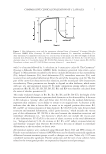
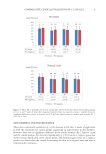
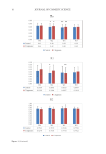
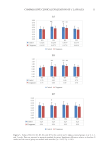
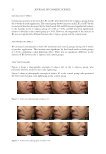
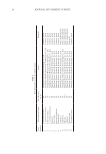
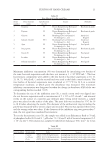
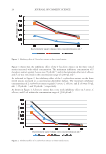
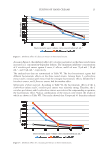
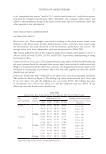
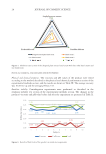
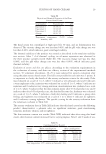
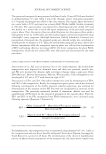
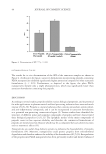
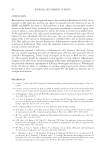
27 TESTING OF HAND CREAMS to as “composite plant extract”) with a 2:1 C reticulata peel extract to L erythrorhizon extract ratio had the strongest bacteriostatic effect. Therefore, this composite plant extract was added to the formulation design of the hand cream below, and its bacteriostatic effect and other properties were investigated. HAND CREAM FORMULA DETERMINATION BACTERIOSTATIC EFFECTS Bacteriostatic rate. Three samples were made according to the plant extract hand cream formula in the hand cream formula determination section, and these were tested using the bacteriostatic rate assay described in the bacteriostatic performance test section. The average values from three independent replicates are presented in Table VIII. The average inhibitory rates of the composite plant extract hand cream against S aureus, C albicans, and E coli were 92.46%, 92.33%, and 97.61%, respectively, demonstrating a strong bacteriostatic effect. Comparison of bacteriostatic effects. Four common hand creams and an alcohol-based disinfecting gel were compared with the designed plant extract hand cream using the antibacterial test (Figure 5). Compared with the other four cosmetics, the designed bacteriostatic hand cream exhibited an outstanding bacteriostatic effect that was only slightly less than the alcohol disinfection gel control. Field trials. Field trials were conducted on 10 subjects for each microorganism separately. The results are shown in Figure 6. The killing log values of inactivation for S aureus and E coli were about 3.0, and the inhibition rate was nearly 99.9%. The killing log value of inactivation of C albicans was about 2.0, and the inhibition rate was 99.0%. It can effectively meet the bacteriostasis disinfection. Table VIII Bacteriostatic Rate Assay Results for the Composite Plant Extract Hand Creama Test microorganisms Serial number Inhibition rate (%) Number of microorganisms recovered in positive control (cfu/piece) 2 min 5 min 10 min 20 min S aureus 1 93.19 97.17 98.38 98.50 2.13 × 10⁴ 2 92.12 97.42 98.33 98.64 1.98 × 10⁴ 3 92.06 96.82 98.36 98.48 1.80 × 10⁴ Average 92.46 97.13 98.36 98.54 1.97 × 10⁴ C albicans 1 92.01 95.60 97.10 97.77 2.04 × 10⁴ 2 95.55 95.64 97.50 97.98 1.79 × 10⁴ 3 92.49 96.27 97.21 97.89 1.93 × 10⁴ Average 92.35 95.84 97.27 97.77 1.92 × 10⁴ E coli 1 97.77 97.82 98.45 98.81 1.97 × 10⁴ 2 97.41 97.98 98.63 98.91 1.83 × 10⁴ 3 97.65 98.11 98.53 98.93 2.06 × 10⁴ Average 97.61 97.97 98.54 98.88 1.95 × 10⁴ a Inspection temperature 23.6°C, relative humidity 52%.

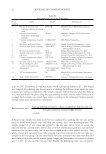
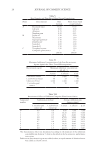
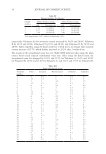
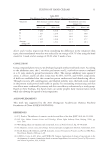
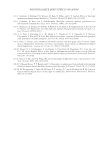
28 JOURNAL OF COSMETIC SCIENCE PHYSICAL, CHEMICAL, AND EMULSIFICATION PROPERTIES Physical and chemical properties. The viscosity and pH values of the product were tested according to the method described in the physical and chemical performance section of the experimental methods section, and the results are shown in Table IX. The average viscosity was 10,307.22 cp and the average pH was 7.53. Emulsion stability. Centrifugation experiments were performed as described in the emulsion stability test section of the experimental methods section. The changes in the products’ viscosity and pH value before and after the experiment are presented in Table X. Figure 5. Inhibition rate (2 min) of the designed plant extract hand cream with four other hand creams and one disinfectant. 3.07 2.95 3.01 2.93 2.92 3.18 3.15 3.20 2.96 3.14 2.04 2.03 2.23 2.07 2.06 2.21 2.14 2.29 2.01 2.17 3.28 3.12 3.14 3.11 3.15 3.14 3.12 3.09 3.28 3.07 2.00 2.25 2.50 2.75 3.00 3.25 3.50 1 2 3 4 5 6 7 8 9 10 Subjects S aureus C albicans E coli Figure 6. Results of field trials of the product on tested microorganisms. Killing log values
Purchased for the exclusive use of nofirst nolast (unknown)
From: SCC Media Library & Resource Center (library.scconline.org)