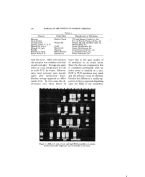
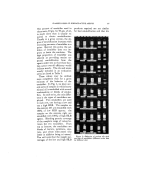
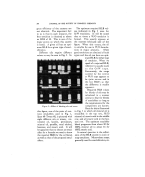
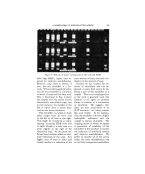
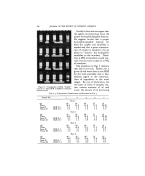
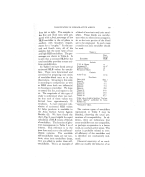
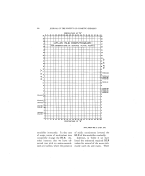
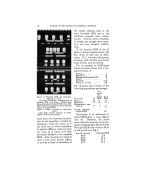
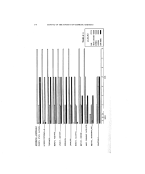
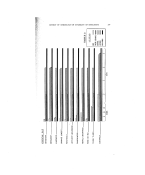
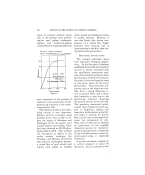
CLASSIFICATION OF SURFACE-ACTIVE AGENTS 325 The best ratio in this series is 45% Span 60 and 55% Tween 60 at a calculated HLB of 10.3. The evaluation of different chemi- cal types of emulsifiers is then con- sidered as previously mentioned. For this example, the stearate blend is the best chemical type. Usually it will be desirable to cover a much wider range of alternate chemical types than the space limitation per- mitted us in the third row of Fig. 6. It must be remembered that all blends must be at the correct HLB. It is interesting to note that the addition of polyol to the aqueous phase of an emulsion such as was just studied does not appear to alter the HLB appreciably. The samples in the top row of Fig. 7 show the effect of adding various amounts of commercial sorbitol sirup. The per- centages are the amount of Adex* in the total formula, not the amount in the aqueous phase. Therefore, for the fourth sample the aqueous phase contains approximately 40% polyol which is a sizable proportion. In the second row, three different polyols are employed. Little dif- ference is noted in the emulsifica- tion, regardless of the type of polyol used. This does not imply that the three polyols will produce similar cosmetic effects. These differences are well known and are due to the variations in hygroscopicities, co- solubilities, and other physical prop- erties of the polyols themselves. The data indicate that at the proper balance of emulsifier, the emulsifi- cation will not be appreciably fected by the type and amount of polyol. The dividing line between in- gredients and emulsifie•:s is often not clear. Stearic acid, lanolin, cholesterol, and beeswax are just a few examples of materials that may serve a dual role. An example of this is in soap-emulsified-facial- creams in which the stearic acid is partially neutralized. In this, the stearic acid forms a bulk of the oil phase, but portions of the stearic acid are present as emulsifier, both neutralized and as free acid. By examining a system, it is usually possible to evaluate each ingredient in the terms of its uses. APPLICATIONS OTHER THAN EMUL- SI FICATION (1) Atntifoaming Antifoaming is quite a specific action, therefore it is surprising when most of the Atlas agents that have found success as antifoam agents fall in the range of 1.5-3 and all are less than 8. No complete study of this subject, as with emulsi- fiers, has been made or is contem- plated. (2) PI"etting and Spreading Atlas wetting and spreading agents fall in the rather narrow HLB range of 7 to 9. We have frequently tried products outside this range, but with little success, particularly when the values were greater than 9. Wetting is usually desired in an aqueous solution, suspension, or O/W emulsion, and this is probably the cause of the narrow effective

326 JOURNAL OF THE SOCIETY OF COSMETIC CHEMISTS range. No extensive selection work has been done in this field. (3) Detergents Atlas detergent materials fall into the HLB range of 13-15. This range is in accord with recent the- ories of detergency that solubilizing of the soil is a part of the action since 13-15 is above the usual O/W emulsifier range and is close to solubilizers. (4) Solubilizers Solubilizing requires the highest HLB (for common uses) at 15-18. For this purpose, single high HLB agents are frequently used. Early work has indicated that the HLB can be too high for efficient solu- bilizing. The effective range ap- pears to be narrow even for different oils. No thorough study of solubil- izing rs. HLB has been undertaken. SUMMARY We have described a system for the choice of emulsifiers based on their hydrophile-lipophile balance/ The HLB system, though it does not indicate the over-all efficiency of the emulsifier, does tell "what it will do"--that is, wha't kind of an emulsion or product to expect. By so doing, it enables us to compare various chemical types of emulsifiers at their optimum balance. Esti- mated HLB values for various types of emulsifiers and fats and oils were presented as well as a method for their determination. Use of the method was illustrated by choosing an emulsifier combina- tion for a typical cosmetic cream. The HLB system appears to be suit- able for all types of problems em- ploying surface-active agents. BIBLIOGRAPHY (1) Goodey, J. H., Australian Chem. Inst. y. & Proc., 16 47 (1949). (2) Lambert, J. M., and Busse, W. F., 5 e. Am. Oil Chem. Sot., 26 289-296 (1949), Table 4. (3) McBain, J. W., et al., Chem. Abst., 31. 16777 36 34139 , 5581a 38 11606 42. 4022b. (4) Roberts, C. H. M., 7. _Phys. chem., 36 3102 (1932). (5) Schwartz, Anthony M., and Perry, James W., "Surface Active Agents Their Chemistry and Technology," In- terscience Publishers, New York, 1949, pp. 346-347. (6) Atlas Powder Company, "Surface Ac- tive Agents," Wilmington, Del., 1948. Table facing pages 26 and 27. * Nots: Span, Tween and Arlex are Reg. Trade Marks, Atlas Powder Company.
Purchased for the exclusive use of nofirst nolast (unknown)
From: SCC Media Library & Resource Center (library.scconline.org)