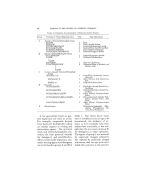
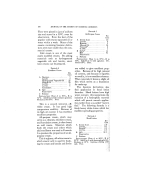
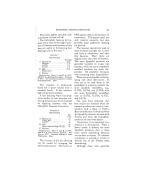
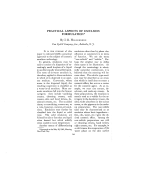
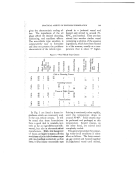
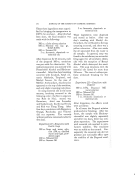
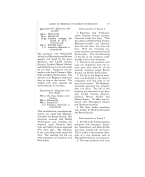
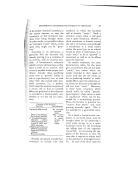
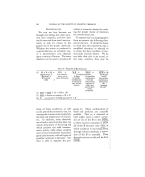
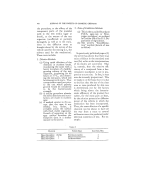
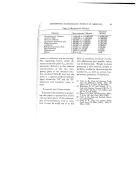
PRACTICAL ASPECTS OF EMULSION FORMULATION 369 gives the characteristic cooling ef- fect. The ingredients of the oil phase afford the desired cleansing, lubricating, and emollient effects. The non-vehicle type emulsion is comparatively easy to formulate and does not present the problems characteristic of the vehicle type. placed in a jacketed vessel and heated and stirred to around 75- 80øC., until melted. They are then stirred into another similar vessel containing a solution of the aqueous ingredients, which have been heated in a like manner, usually at a tem- perature that is about 5 ø higher. Figure 1.--Non-Vehicle Type Creams 7 ¸ A 29 1 55 B 35 1 5O C 55 .. 20 A 65 2 .. B 67 2 c ss • '• A 40 .. 25 B 40 27 C 55 '1' 5 A 88 1 1 B 90 1 .. C 94 .... Cold or Cleansing Creams 15 .. •o i' 'i' Vanishing Creams 25 .. 20 T 'i "• .. 2 .. i6 2s Tissue or Night Creams 3 10 10 .. 3 .. 25 2 .. •o • 8 5 'f 2 .. .. 7 Cream Lotions 3 1 1 .. 5 2 .. 'i " • s i .... 'i .. 1'.• 2.5 In Fig. 1 are listed a dozen in- gredients which are commonly used in the non-vehicle creams. It will be noted that these formulations have a good deal in com/m3n,mot., only as far as ingre&{eht•m•'½'Sn- cerned, but also in e. he,metqhod•l•f• manufacture.., of tiss•, Stirring is continued, rather rapidly, until the temperature drops to around 3040 ø . Solid creams may be perfumed and packaged at this temperature. Liquid creams, on the other hand, are stirred until completely cooled. The general procedure for prepar- i•hg water-in-oil emulsions is some- •hat as follows. The fatty materi- 4• ,•ir• stirred and heated together im:a•jacketed vessel until melted,

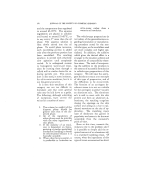
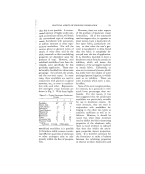
370 JOURNAL OF THE SOCIETY OF COSMETIC CHEMISTS and the temperature then regulated to around 45-55øC. The aqueous ingredients are placed in solution and heated to around $' o •-60 C., or in any event, 5 ø more than the oil phase. The aqueous solution is then slowly stirred into the oil phase. To avoid phase inversion, each succeeding portion is added only after the previous portion has been emulsified. The resulting emulsion is stirred with relatively slow agitation until completely cooled. It is widespread custom to homogenize water-in-oil emul- sions by running them through a colloid mill or similar device for re- ducing particle size. This proce- dure is also used, in some instances, for oil-in-water emulsions, but it is not the general practice. It is seen that emulsions of this category are not too difficult to formulate and that some general rules may be laid down as a guide. The following, although admitting of exceptions, have served the writer for a number of years: 1. The volume (or weight) of the disperse phase should be greater than that of the dis- persed phase. 2. All of the ingredients of either phase must be miscible with the other ingredients of that phase. 3. If the stability of an emul- sion is dependent on homo- genizing or similar specialized mechanical handling, it should be reformulated because it is basically unstable. 4. When other factors permit, it is preferable to formulate an oil-in-water rather than a water-in-oil emulsion. The vehicle-type preparations do not admit of the generalizations re- garding formulation or manufactur- ing procedure noted for the non- vehicle types, as the emulsifiers used are more complex .and highly spe- cialized. In addition, the additive which gives the desired effect is a stranger to the emulsion scheme and the question of compatibility there- fore arises. The task of incorporat- ing the additive in the emulsion is the essence of successful formulation in vehicle-type preparations of this category. We will take the astrin- gent deodorant cream as an example of this type of preparation, and of the difficulties to be encountered. The function of an astringent de- odorant cream is to act as a vehicle for the astringent material--usually an aluminum salt. The aluminum salt is said to react with the skin protein and form an aluminum al- buminate, the resulting coagulant closing the openings on the skin surface and acting as a bar to epi- dermal excretions at the site of ap- plication. The vanishing cream type of deodorant has gained in popularity and seems to be the most acceptable from the consumer's point of view. Even at this time, cosmetic for- mulators new to the problem ask if it is possible to simply add the re- quired amount of an aluminum salt to a standard vanishing cream. Of course, when the ingredients of this type of cream are examined we know
Purchased for the exclusive use of nofirst nolast (unknown)
From: SCC Media Library & Resource Center (library.scconline.org)