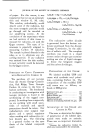
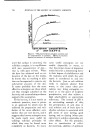
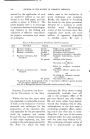
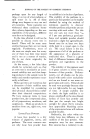
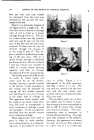
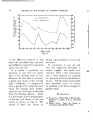
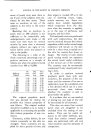
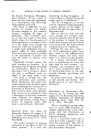
298 JOURNAL OF THE SOCIETY OF COSMETIC CHEMISTS effects belong in the second class. The permeability influence appears relatively new and may justify more extended study as a bactericidal technique (3). neutralize the antiseptic, you cannot get growth started again. Then, and only then, does it appear you are justified in applying the terms "sterile" and "bactericidal." In / i ANTISEPTIC CONCENTRATION Figure 2.--Relation between antiseptic concentrations and effects on bacterial growth. Criteria of sterility. In Fig. 2 is shown a scheme believed to be generally applicable for the study of antiseptic actions. This suggests that when all other conditions are maintained constant, as the concentration of the anti- septic in a series of medication tubes is increased there is first an exci- tation of growth, then a gradual reduction in plate counts, and then plates showing no colonies. If one chooses the correct chemical, either as a separate intermediate neutral- izing bath or as a component of the culture medium, it will be found that organisms so treated can be "revived." Finally with increasing concentration of antiseptic, there will be found systems in which, even though you know how to 1948 we outlined (2) five steps by which any investigator can assure himself and his market as to just what his antiseptic can do--the problem being one in which by successive approximation one fixes the concentration designated as the range between bacteriostasis and bactericidal effects. Again I want to point out that the above is not merely an academic problem but is intimately related to life and death. In 1948 Dr. Morton (4) showed that hemolytic strepto- cocci treated with any of the three most popular mercurials showed no growth in blood broth media (lacking neutralizers) but did kill many of the mice into whose abdominal cavities the organism-

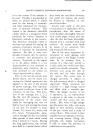
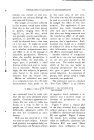
MECHANISMS AND EVALUATION OF ANTISEPTIC ACTIONS 299 mercurial suspension was intro- duced. In other words, these mer- curials were neutralized by thio- glycolate media and found also in animal tissues chemicals capable of neutralizing them and allowing bacterial growth to resume. At the same time it would not be fair to forget that complete bacteri- ostasis by an antiseptic which finds in tissues no neutralizing mechanism is equivalent in effect to sterility for that system. This means that in the last analysis a clear demon- stration by animal tests is the controlling criterion. It is, how- ever, economical and convenient to set up such screening tests as are here proposed. Answers to this paper from the three firms con- cerned did demonstrate antiseptic property for these mercurials, but we know of no conclusive evidence that any mercurial, at any con- centration, for any time of exposure will sterilize any bacterial culture. Few manufacturers will make any claims for effectiveness on spores, and Klarmann and Wright (5) demonstrated 24-hour survivals of several spore organisms exposed to 1% solution of quaternaries--when blood serum was used to neutralize the cationic. We now come to the recognized mechanisms by which adsorbed antiseptics may be rendered in- nocuous, and these are shown in Table 2. When one comes to the practical applications of these criteria, it appears there are at least three main groups to be considered. TABLE 2--MECHANISMS OF NEUTRALIZATION OF ANTISEPTICS 1. Insolubilization--mercurials plus sulfides or thio compounds 2. Complex formation--solubilization--cop- per plus ammonia 3. Desorption to another surface--phenol to charcoal, serum proteins 4. Oxidation-reduction reactions--iodine plus thiosulfate 5. Opposition of charge on colloidal parti- cles and ions--anionics rs. cationics 6. Displacement from bacteria by strongly adsorbed innocuous substances Many surgeons and bacteriologists hold the view that truly sterile techniques on and in tissues are practically impossible, and the best that can be done is to reduce the number and virulence of invading organisms to the degree at which the natural tissue defense mecha- nisms can overwhelm them. This is especially relevant to materials for use on denuded tissues, for which the antibiotics seem most appropriate. For achieving what Dr. Blank (6) has called "Degerm- ing the Cutaneous Surface," a compromise must be made, and iodine tincture still appears the most suitable reagent. It should be possible to sterilize glass, metallic surfaces, instruments, etc., but no reagent superior to formaldehyde in isopropanol is known to us. In all permissible cases heat sterilization by autoclaving or by anhydrous dry wall techniques is still the standard and final technique. It is to be emphasized that in vitro testing which relies only on dilution of the antiseptic-bacteria system is likely to give false appearances of sterility. Sterility can be demon-
Purchased for the exclusive use of nofirst nolast (unknown)
From: SCC Media Library & Resource Center (library.scconline.org)