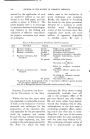
322 JOURNAL OF THE SOCIETY OF COSMETIC CHEMISTS series of patch tests were done to see if any of the subjects were sen- sitized by the first series. There were no reactions on any of the subjects to the nylon or the cotton control. Realizing that no reactions to patch tests on 200 subjects is not sufficient to be statistically safe, undergarments were made of the nylon and were worn for several months by more than a thousand subjects without any signs of irri- tation before nylon was placed on sale to the public. The following is a table of the likely maximum percentage rate of positive reactions in a sample of infinite size when the subjects tested number from 100 to 10,000. No One Two Subjects reac- reac- reac- Tested tions tion tions 100 3.00 4.40 5.80 200 1.50 2.20 2.90 300 0.99 1.50 2.00 500 0.60 0.90 1.20 1,000 0.30 0.45 0.60 2,000 0.15 0.23 0.30 5,000 0.06 0.09 0.12 10,000 0.03 0.05 0.06 The original prophetic patch test was devised for testir, g the possible skin irritant properties of new fabrics. The original method should be modified so as to make it applicable to evaluating the possible skin irritant properties of new cos- metics. Cosmetics, unlike fabrics, do not remain constantly on the skin un- changed. Some cosmetics are ap- plied for short periods of time and then wiped or washed off as in the case of cleansing cream, soaps, cuticle remover, etc. Some cos- metics have volatile ingredients which evaporate frem the skin soon after the cosmetic is applied, as in the case of perfumes, nail lacquers, and hair dyes. If closed patch tests are performed with such preparations, the skin may be irritated because the irritant ingredient, which under normalusage conditions will remain on the skin only for a short time, is sealed on to the skin for twenty-four hours or longer. The results of such closed patch testing would not represent the actual result under conditions of the normal use of the cosmetic. The cosmetic may be erroneously condemned if only closed patch test- ing is done. In order to perform rationaI prophetic patch tests with new cosmetics, the purpose of the cos- metic and the manner of its use or application must be considered, and a test devised which can in a com- paratively short time indicate whether the cosmetic is safe to place before the public. It is evident that no one method of testing nor one type of test will be best suited for all cosmetics. This does not mean that covered patch tests are altogether to be excluded from the testing of cos- metics. They can be useful ad- juncts to the other methods, pro- vided that similar covered patch tests are performed with old and tried cosmetics used for purposes of comparison.

THE SKIN TESTING OF NEW COSMETICS 323 Favorable results of the prophetic patch test should always be followed by usage tests among a thousand or more subjects over a period of at least two months. There is no test which equals the test of actual usage by a large group over a long period. Conversely, prophetic patch tests are unnecessary after a cosmetic has passed the test of common usage by the public over a period of time. It is like tasting the food after the banquet has been served. I will enumerate some modifica- tions of the prophetic patch test which I have successfully used in testing new cosmetics. In testing a new deodorant soap, I first performed closed patch tests with various dilutions of a well- known toilet soap to find what dilu- tion can remain on the skin under a covered patch for twenty-four hours without causing a reaction on most of the subjects. I found this to be 0.2 cc. of a 0.5 per cent solution of the soap on a piece of flannel 3 sq. cm. in area. Ten subjects were used for this preliminary test. Then 200 subjects were patch tested at thesame time with the same dilution and same amount of the new deodorant soap, the old toilet soap, and a deodorant soap long on the market. The two series of patch tests were performed ten days apart and when no more reactions resulted from the new deodorant soap than from each of the control soaps, the new deodorant soap was pronounced safe for the trial usage test by several thousand subjects. I was asked to perform prophetic patch tests on a new hair dye. The dye in addition to other in- gredients contained considerable ammonia. It was obvious that closed patch tests with ammonia would give reactions. It was also obvious that hair dyes are not cov- ered and sealed on to the hair and scalp. They are washed off after 15-30 minutes. In this case I decided to do open patch tests with all the shades of the dye and a hair dye long on the market was used as a control. The dye was applied each day for three days to the same area of skin and no reac- tions were noted. Ten days later the procedure was repeated on the same area of skin. When no re- actions were observed in any of the 200 subjects, the dye was pro- nounced safe for trial use on several thousand subjects. After it success- fully passed the trial usage test it was placed on the market. A new antiperspirant was tested by intensive actual usage, under observation• on 200 subjects for one month. A new hand lotion was similarly tested in addition to the covered patch test using an old hand lotion as a control. A new cold wave was tested under a covered patch using as a control a cold wave that had been on the market for some time. So appropriate prophetic patch tests can be devised for depilatories, nail lacquers, lipsticks, shampoos, creams, and any other cosmetics.
Purchased for the exclusive use of nofirst nolast (unknown)
From: SCC Media Library & Resource Center (library.scconline.org)